
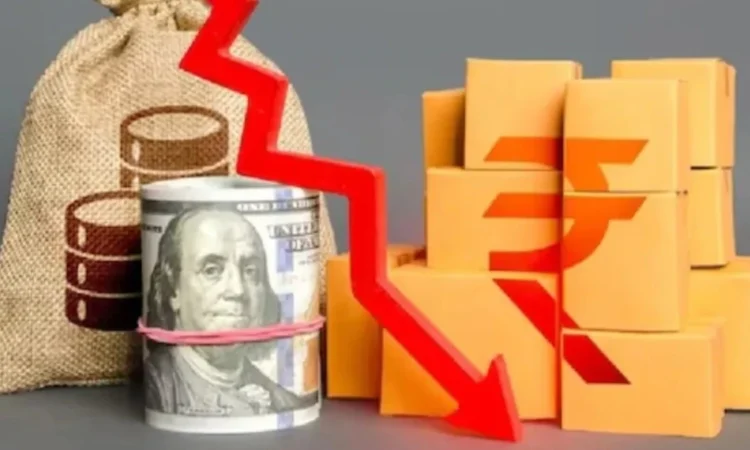
Benchmark indices Nifty and Sensex have turned jittery after hitting fresh highs, thanks partly to a sharp fall in rupee that hit a record low of 90.21 a dollar level earlier today, raising fears of more foreign equity outflows at the fag end of the year. With December just kicking off, foreign outflows hit Rs 4,335 crore up to December 2 against net November outflows of Rs 3,765 crore. FPI outflows for the Calendar 2025 now stands at Rs 1,48,010 crore, the worst ever Calendar-wise, as per data available with NSDL.
Rupee has been falling, as there has been concerns over delays in India-US trade deal, especially amid a lack of RBI intervention.
“A real concern now, which has contributed to the slow drifting down of the stock market, is the continued depreciation in the rupee and fears of further depreciation since the RBI is not intervening to support the rupee. This concern is forcing the FIIs to sell despite the improving fundamentals of rising corporate earnings and strong rebound in GDP growth,” said VK Vijayakumar, Chief Investment Strategist, Geojit Investments.
Jateen Trivedi, VP Research Analyst – Commodity and Currency, LKP Securities said rupee’s fall below the 90-mark for the first time is led by the absence of a confirmed India–US trade deal and repeated delays in timelines.
“Markets wanted concrete numbers rather than broad assurances, leading to accelerated selling in the rupee over the past few weeks,” he said.
The muted RBI intervention has also contributed to the swift depreciation. With the RBI policy outcome scheduled on Friday, December 5, markets expect clarity on whether the central bank will step in to stabilise the currency, he said.
“Technically, the rupee is deeply oversold, and a move back above 89.80 is essential for any meaningful recovery,” Trivedi said.
YES Securities said the rupee volatility remains elevated due to tariff uncertainty, but downside risk seems to be contained. It also believes rupee is undervalued on a REER basis.
“FIIs inflows in Indian equities tend to pick up when depreciation in INR exceeds the long-term average. INR’s depreciation this calendar year is 4.5 per cent, steeper than the 25-year annual average of 3 per cent. Overall, the equity setup is constructive but subject to momentum in corporate profits,” it said.
Meanwhile, Nomura in its ex-Japan Asia strategy note called India, the best diversifier against any risk of unwinding of crowded tech-trades. It finds Indian stock valuations relatively decent after underperformance in 2025.
It is overweight India as it believes the widely expected US-India trade-deal should remove a key overhang on the market. It said India’s valuation premium to Asia ex-Japan now at 57 per cent
against post 2015 average of 53 per cent.
Supportive policies such as RBI rate cuts, GST rate cuts and injection into the banking sector seem to be stabilising earnings and the economy, it added.
In the case of Friday’s RBI review, Care Ratings said despite strong growth momentum, there is a possibility of a 25-bps rate cut by the RBI.
“The external environment continues to be a key source of headwinds for the economy Given the strong growth in H1, the RBI is likely to revise its FY26 growth forecast to 7.5 per cent. The RBI may revise down its CPI projections to ~2.1 per cent in the December policy meeting,” it said.
The rating agency believes the RBI will continue to ensure favourable money market conditions and sees MPC maintaining its neutral stance, signalling a likely end to the current easing cycle.
“However, if the RBI chooses to not cut the policy rate amidst strong GDP growth data, the Governor will opt for a dovish tone to keep the option open to cut later,” it said.
Emkay Global’s Lead Economist Madhavi Arora said some market participants argue that additional rate cuts could weigh further on narrowing interest rate differentials with the US and reduce India’s risk premia, pressuring the already fragile rupee.
“However, India’s relative loss of export competitiveness vs EM Asia amid higher tariffs, would, in principle, warrant some adjustment via a weaker currency vs peers. Such depreciation would act as a natural stabilizer for a weaker CAD, rather than being misread as a rate-easing deterrent,” she said.
Disclaimer: Business Today provides stock market news for informational purposes only and should not be construed as investment advice. Readers are encouraged to consult with a qualified financial advisor before making any investment decisions.


