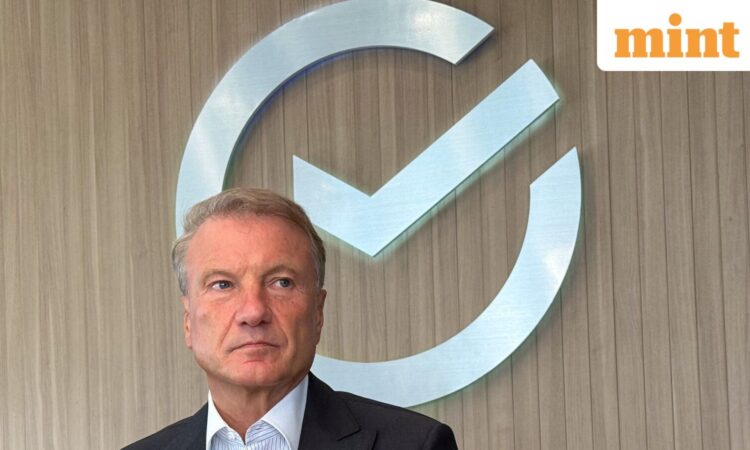
New Delhi: Russia’s largest bank Sberbank will invest in India’s capital markets and also help Russian retail investors access the benchmark Nifty50 index on the National Stock Exchange, Herman Gref, the lender’s chief executive officer (CEO) and chairman, said on Thursday.
In an interaction with reporters, the CEO said that the bank’s investment plans in India involve investments in government securities.
The Sberbank chief’s remarks came as a Russian delegation led by President Vladimir Putin is in New Delhi on a 2-day visit starting Thursday. Gref has served as Russia’s trade and economy minister during 2000-2007, and has headed the state-run bank thereafter.
He said that the state-run lender recently launched an instrument for private Russian investors to invest in Nifty50 companies. Nifty50 is a stock market index that represents the float-weighted average of 50 of the largest Indian companies listed on the National Stock Exchange.
“We launched (an instrument) three days ago. We launched a special instrument for the private investors in Russia (to get) the opportunity to invest in Nifty50 index. And what we see, it would be a good opportunity for the Russian companies, for the Russian private people to invest in India,” he said, adding that enabling Russian private investments would help generate more interest among those investors for Indian companies.
Sanctions’ wake
Russia’s move comes at a time when rupees worth billions of dollars are sitting idle in Indian banks. This build-up has happened because Western sanctions in the wake of Ukraine war made it harder for Russia to use dollars or euros for trade, forcing Moscow to settle more transactions with New Delhi in the Indian currency.
Sberbank, Russia’s largest lender, processes about 65–70% of India’s exports to Russia and 10–15% of Russia’s exports to India. The two countries now have $68.7 billion in total bilateral trade.
Amid Western sanctions in the past three years, Russian entities have been looking at newer investment avenues for their funds parked in India, largely in rupee Vostro accounts. The vostro accounts were opened due to a lack of investment opportunities in India-Russia trade, continued volatility in exchange rates and challenges with fund repatriation following Western sanctions over Russia’s invasion of Ukraine in February 2022.
In another major development, the bank has got a special licence for gold exports to India, Gref said. India is a major importer of gold. According to data from the commerce ministry, gold imports surged 199.2% year-on-year to $14.72 billion in October, backed by pent-up demand and the festival season.
With a banking licence and branches in two cities in the country, Sberbank plans to expand its operations in the country and offer full retail services in India. It aims to set up a total of 10 branches in the country, Gref said. It will also set up a 40,000-50,000 sq. ft. corporate office in New Delhi.
“During the next three years, we will enlarge our business here and we will realize the full line of the banking operations in B2B and B2C. It would not be so fast, but step by step,” he said.
Retail operations planned
On its retail banking plans and discussions with the Indian government, the Sberbank chief said: “We will start with retail operations also. But we don’t want to jump. It will be step by step. We discussed the new 10-year strategy. And in 10 years we will become the normal bank with a full stack of operations.”
In September, Mint reported that Sberbank is piloting a cashless payment system for Russian tourists. Mint previously also reported that India and Russia were exploring linkages between India’s UPI and the Bank of Russia, as well as integrating India’s RuPay with Russia’s MIR cards.
On plans to invest in government securities, Gref said that along with investing its own funds in Indian treasury bills, the lender will also enable investment by other interested Russian investors.
This investment is likely to be in rupees, and surplus rupees parked in India is a problem that Sberbank is facing, he said. Without disclosing the exact amount of rupees parked in the bank, he said that “a few billion dollars worth of rupees” are currently parked in the bank.
He expressed optimism about the rupee–ruble trade, saying it does not require intervention. Instead, he stressed the need to develop adequate market instruments to expand bilateral trade in the two currencies.
“I think it’s a bad idea to fix the currency (in rupee-ruble trade). We need to develop the market instruments,” he said.
Mint earlier reported that the rupee-settlement mechanism rolled out in 2022 to ease trade with sanction-hit countries has failed to gain traction with India’s largest crude supplier Russia, and Indian refiners continue to source Russian crude supplies through traders based in the United Arab Emirates and settle transactions in dirhams.
Confidence in economy
The top Russian banker expressed confidence in the Indian economy, and said that he expects India to sustainably grow at 6-7% annually for the next 10 years.
He compared the current Indian economy to that of China in the last decade and said: “I feel in this country (India), I have the same feeling, like 15 years ago in China. I think maybe the growth in India would not be so fast, like in China…but long term and sustainable.”
“It’s the right moment to invest in India and also support the country to build more sustainable relations with our country.”
Gref’s remarks on India’s economy follow growth figures in the latest September quarter, when the gross domestic product rose at 8.2%, beating estimates significantly.
Stressing on the need to enhance bilateral trade, he said: “If we can increase our import from India to a few billion USD, it would be maybe good, the best what we can do for both of the countries, because Russia needs more sustainable relations and Indian goods and India needs that.”
Bilateral trade between New Delhi and Moscow hit a record $68.7 billion in FY25, nearly 7 times the pre-pandemic level of $10.1 billion. However, the widening trade deficit remains a concern, as India imported $63.84 billion—mostly crude oil—while exports stood at just $4.88 billion.
Responding to a question on the US sanctions on two of Russia’s largest oil suppliers Rosneft and Lukoil and the likely impact on bilateral trade, Gref stressed on the need to widen the trade basket.
“Is it going to go back to $12 billion suddenly, dramatically overnight, or is it going to find a replacement trade which can actually sustain that sort of level? I think it’s not such a good idea to depend on one type of the goods here. That’s why we try to, uh, bring on the table more opportunities for trade, for trade and investment,” he said.
Russia has been the largest supplier of oil to India since FY23, accounting for about 35% of India’s crude basket. This share, however, is expected to come down with the sanctions which came into effect on 21 November.