
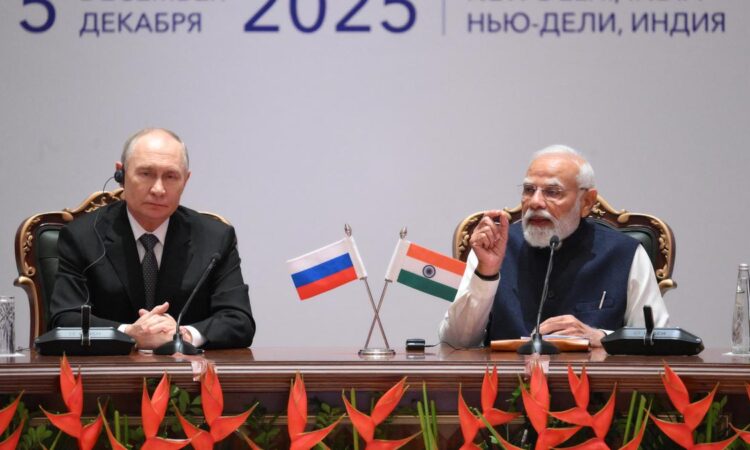
India and Russia have agreed to continue working towards enhancing the settlement of bilateral trade in the national currencies of the two countries, Prime Minister Narendra Modi and President Vladimir Putin said in a joint statement on Friday (December 5, 2025).
Mr. Putin is in India for a two-day visit to attend the 23rd India-Russia Annual Summit as well as to hold meetings with Mr. Modi. The two leaders also discussed how to remove the tariff and non-tariffs barriers so that the two countries can achieve their target of crossing bilateral trade worth $100 billion by 2030. Annual bilateral trade stood at $68.7 billion in 2024-25.

“Russia and India have agreed to continue jointly developing systems of bilateral settlements through use of the national currencies in order to ensure the uninterrupted maintenance of bilateral trade,” the joint statement said.

It added that the two sides have agreed to continue consultations on enabling the interoperability of the national payment systems, financial messaging systems, as well as central bank digital currency platforms.
Enhancing trade, reducing deficits
According to experts, the ongoing move towards trade in national currencies is a way for the two countries to reduce their dependence on the U.S. dollar and move towards addressing the widening trade deficit India has with Russia.
“By operationalising rupee-denominated trade, we can bypass the dollar-dependency that is currently aggravating our deficit,” Suketu Thanawala, partner at StraCon, a business advisory and consulting firm, said.
Notably, at a time when the World Trade Organization is being increasingly sidelined in matters of international trade, the joint statement underlined the importance of an “open, inclusive, transparent and non-discriminatory multilateral trade system with the World Trade Organization at its core”.
“Both Sides emphasised that addressing tariff and non-tariff trade barriers, removing bottlenecks in logistics, promoting connectivity, ensuring smooth payment mechanisms, finding mutually acceptable solutions for issues of insurance and reinsurance and regular interaction between the businesses of the two countries are among the key elements for timely achievement of the revised bilateral trade target of $100 billion by 2030,” the statement added.
Target $100 billion
Speaking later in the evening at the India-Russia Business Forum, Mr. Modi further said that he believed the $100 billion target would be achieved before the target year of 2030.
“Last year, President Putin and I had set a target of crossing $100 billion of bilateral trade between India and Russia by 2030,” Mr. Modi said. “But, based on my conversations with President Putin since yesterday, and given the visible potential, I don’t think we would have to wait until 2030. I can see that clearly. We are moving ahead with the resolution to reach that target before time and my confidence is growing.”
Some experts say that, while the achievement of the $100 billion target by 2030 is debatable, the fact is that bilateral trade between the two countries is set to grow robustly.
‘Bottom-up growth’
“There may be debate as to whether $100 billion is achievable, but there is no doubt that the trade will not go back to dismal levels of $10 billion,” Lydia Kulik, Head of India Studies at the SKOLKOVO School of Management said.
She said the reasons behind this confidence were two-fold: “First, a lot has been done in recents months or a couple of years in removing obstacles to trade and even more will be done, particularly towards improving the access for Indian exporters to the Russian market.”
The second factor, she added, was that the development of business links between the two countries is currently taking place organically.
“The interest is growing naturally from the bottom up, it is not solely happening on the top governmental level,” Ms. Kulik said.
Cooperation in energy & connectivity
The joint statement also noted the importance of hastening the resolution of issues faced by investors in the energy sector of the two countries, saying that the India-Russia cooperation in the energy sector is a significant pillar of the Special and Privileged Strategic Partnership the two countries share.
The two Sides also agreed to deepen cooperation in building stable and efficient transport corridors, with the aim to further support the International North-South Transport Corridor (INSTC), the Chennai-Vladivostok (Eastern Maritime) Corridor, and the Northern Sea Route.
(With inputs from Suhasini Haidar)
Published – December 05, 2025 07:02 pm IST


