
Many farmers are interested in putting in solar on their farm to both save on taxes and reduce their electricity costs, especially as demand for electricity increases due to AI data centers. Investing in solar energy is a significant decision for agricultural producers, and understanding the federal incentives available is crucial for maximizing financial benefits. The cornerstone incentive is the Solar Investment Tax Credit (ITC) combined with the beneficial, though taxable, Rural Energy for America Program (REAP) grants. Careful planning around these incentives can substantially offset the cost of a new solar system.
To qualify for the ITC, the project must be completed by Dec. 31, 2027.
The Solar Investment Tax Credit (ITC)
The base ITC rate is 6%, but most farm solar projects qualify for a significantly higher credit. A project is eligible for a 30% ITC if it has a maximum net output of less than one megawatt. Most projects are under this limit.
Taxpayers also have the ability to stack additional bonus credits:
- Domestic Content Bonus: Up to an additional 10 percentage points for projects meeting domestic material requirements.
- Energy Community Bonus: Up to an additional 10 percentage points if the project is located in an “energy community” (e.g., brownfield sites or certain areas with high fossil fuel unemployment).
Basis Reduction and Recapture
It’s important to note the depreciable basis of the solar property must be reduced by 50% of the ITC claimed. Additionally, if the property is sold or ceases to be an investment credit property within five years of being placed in service, a portion of the ITC will be subject to recapture, decreasing by 20% each year the property is held.

REAP Grants and the ITC
The Rural Energy for America Program (REAP), which is administered by USDA, provides grants and loan guarantees, covering up to 50% of eligible project costs, to agricultural producers and small rural businesses for renewable energy systems.
Tax Treatment and Impact on Basis
A crucial aspect of REAP grants is they are considered taxable income to the recipient and must be included in gross income. USDA reports the grant on Form 1099.
However, the key benefit is that a REAP grant does not reduce the basis of the solar property for ITC purposes. This is because the grant is treated as taxable income, not as a purchase price adjustment. This allows the farmer to claim the ITC on the full cost of the solar system, even on the portion paid with grant funds.
Timing and Tax Liability
Taxpayers must exercise care to ensure the REAP grant is received in the same year the project has been placed in service to align the taxable income with the offsetting tax credit and depreciation expense. Also, farmers need to have enough tax liability to fully soak up the income tax benefits. The farmer can transfer the credit and receive payment for approximately 90% or more of the ITC, but this can be complicated.
The Big Picture
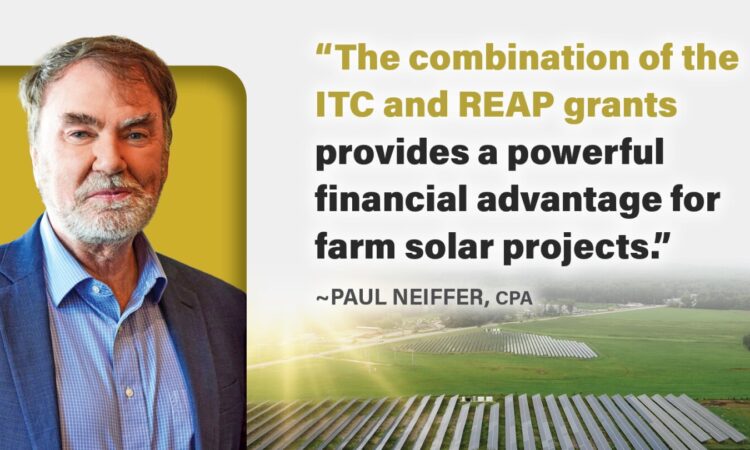
The combination of the ITC and REAP grants provides a powerful financial advantage for farm solar projects. By including the grant as income, the recipient avoids reducing the eligible basis for the ITC, maximizing the overall federal tax benefits. Careful due diligence and documentation are essential to fully realize these significant financial advantages.


