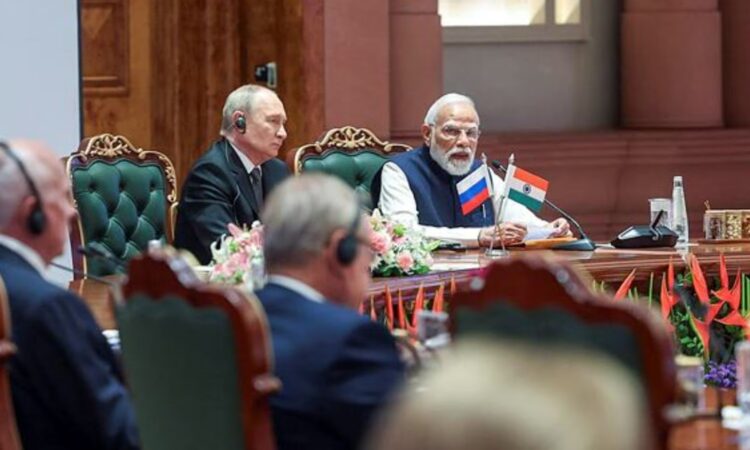
India and Russia on Friday reiterated their commitments to increase bilateral trade to $100 billion from the current level of $70 billion and boost settlements using their domestic currencies after the summit meeting between Prime Minister Narendra Modi and Russian President Vladimir Putin.
Putin’s two-day visit, his first to India after the Ukraine war began in 2024, comes in the backdrop of the steep 50 per cent US tariffs on India and sanctions on two of Russia’s largest oil companies, Rosneft and Lukoil, which have resulted in a decline of discounted Russian oil exports to India.

“The leaders reaffirmed their shared ambition to expand bilateral trade in a balanced and sustainable manner, including by increasing India’s exports to Russia, strengthening industrial cooperation, forging new technological and investment partnerships, especially in advanced high-technology areas and finding new avenues and forms of cooperation,” said a joint statement issued after the 23rd India-Russia Annual Summit.
The statement said addressing tariff and non-tariff trade barriers, removing bottlenecks in logistics and ensuring smooth payment mechanisms are among the key elements required to achieve the trade target of $100 billion by 2030.
“Russia and India have agreed to continue jointly developing systems of bilateral settlements through the use of national currencies to ensure the uninterrupted maintenance of bilateral trade. Additionally, the sides have agreed to continue their consultations on enabling the interoperability of the national payment systems, financial messaging systems, as well as central bank digital currency platforms,” the statement said.
Former trade officer and head of think tank Global Trade Research Initiative (GTRI) said the trade gap between the two countries has surged to $58.9 billion, but India can lift exports to Russia seven-fold — from $5 bn to $35 bn — if it cracks market access in food, pharma, textiles and machinery.
“Closing the trade gap will depend on identifying and scaling high-potential product lines where India is globally competitive but commercially absent in Russia. In 2024, Russia imported $202.6 bn of goods globally but sourced just $4.84 bn from India — giving New Delhi a modest 2.4 per cent share of Russia’s import market. The shortfall is visible first in food and agriculture, where Russia depends heavily on imports but India’s penetration remains thin,” GTRI said.
Energy cooperation
Story continues below this ad
The joint statement said India and Russia have confirmed their intention to broaden cooperation in nuclear energy, including fuel cycle, life cycle support for operating Kudankulam Nuclear Power Plant (KKNPP) and non-power applications, as well as to elaborate a new agenda of interaction in the field of peaceful use of atomic energy and related high technologies.
“The sides noted the importance of cooperation in the peaceful uses of nuclear energy as a significant component of the strategic partnership, taking into account the plans of the Government of India to increase India’s nuclear energy capacity to 100 GW by 2047. The Sides welcomed the progress achieved in the implementation of KKNPP, including the construction of the remaining NPP units and agreed on adhering to the timeline for supplies of equipment and fuel,” the statement read.
Both partners announced boosting cooperation in the area of the energy sector and reiterated the “importance of expeditious resolution of issues related to investment projects in this area, and agreed to resolve the various concerns being faced by their investors in the energy sector”.
Transport and trade routes
India and Russia also agreed to deepen cooperation in building stable and efficient transport corridors, with a focus on expanding logistics links for improving connectivity and enhancing infrastructure capacity to support the International North-South Transport Corridor, the Chennai-Vladivostok (Eastern Maritime) Corridor and the Northern Sea Route.
Story continues below this ad
“The sides noted the fruitful cooperation between the railways of Russia and India, aimed at establishing partnerships in the field of mutually beneficial technology exchange. They confirmed their readiness to intensify trade and investment cooperation in the Far East and the Arctic zone of the Russian Federation,” the joint statement read.