
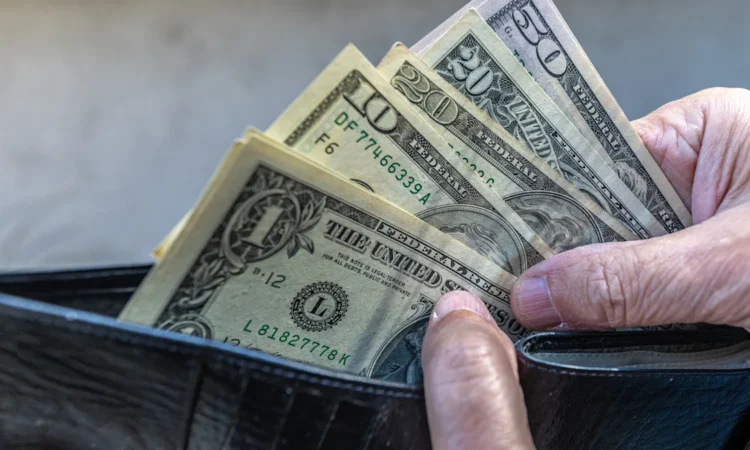

While it isn’t currently in danger of becoming the world’s least valuable currency, the U.S. dollar has lost some ground. In fact, the U.S. dollar fell about 8% compared to the value of 16 highly traded currencies around the world in 2025.
The strength of the U.S. dollar relative to other world currencies has an impact on trade. A weaker U.S. dollar means that goods produced in the United States become cheaper in other nations while imports become more expensive. This pattern falls in line with the Trump administration’s economic goals of rebalancing trade and eliminating trade deficits with other nations. But a weakened dollar also makes it more expensive for Americans to travel to other countries. More importantly, a declining U.S. dollar fuels inflation, which further contributes to an increasingly K-shaped economy, where more Americans are dipping into their savings to survive and small businesses are slashing their jobs.
However, not all currencies are rising in value against the USD at the same rate. The three currencies that grew the most in value against the U.S. dollar in 2025 were the Swedish krona, the Mexican peso, and the Swiss franc. Each of these dynamics was influenced by specific causes, but economic uncertainty in the United States was a major underlying factor.
Read more: Here’s How Much It Costs To Make Every Major US Coin
Unlike most members of the European Union, Sweden opted to keep its currency instead of adopting the collective euro. And in the past year, the Swedish krona grew in value by 20.2% against the U.S. dollar and by at least 5% against the euro.
This growth is fueled by Sweden’s gross domestic product (GDP), which is projected to rise at nearly double the rate of EU’s in 2026, per a Bloomberg report. Sweden also has low public debt, which was 33.6% of the GDP at the end of 2024, per Fitch Ratings calculations. In comparison, the United States’ debt-to-GDP ratio at the end of 2024 was 114.5%. Additionally, investors have become increasingly interested in Sweden’s defense sector, and the currency has been pounced on by speculative investors not wishing to miss out on the krona’s rise, per a report from Stockholm-based bank SEB Group.
Notably, in times of global upheaval, currencies like the krona don’t usually perform as well as their counterparts from larger nations like the U.S. However, that situation seems to have flipped. In a November 2025 speech, Anna Seim, deputy governor of Sweden’s central bank (Sveriges Riksbank), opined, “… the dollar depreciation is likely to be related to financial flows out of dollar exposures due to uncertainty about U.S. economic policy. This breaks the historical pattern of the dollar as a safe harbor.”


