(Bloomberg) — Emerging-market stocks, currencies and precious metals are extending a storming start to 2026 as tensions between the US and Europe weigh on the dollar and re-energize diversification flows around the world.
The rally gathered pace Friday, with emerging Asian shares on track for a record close as South Korean and Hong Kong tech shares rallied. China’s central bank set the yuan’s daily reference rate stronger than the 7-per-dollar level for the first time in over two years, lifting Asian currencies. Gold rose to just under $5,000 an ounce.
Most Read from Bloomberg

Investors are pouring cash into emerging-market funds at a record pace as momentum builds for a rotation out of US holdings. It’s sent a gauge of EM stocks to records with the MSCI EM Latin America Index of equities hitting its highest since April 2018, while some local currency government bonds have also hit new highs.
The Greenland tussle has revived questions about US exceptionalism and the role of the dollar, spurring funds from Europe to India to diversify away from Treasuries. The flow has added an impetus to an EM rally fueled by robust global growth, the AI spending boom and political shifts in Latin America, as well as fiscal and monetary policy orthodoxy in much of the developing world.
People “are looking to diversify away from US assets, and I would kind of describe it as quiet-quitting of US bonds,” TCW Group Inc. Chief Executive Officer Katie Koch said in a Bloomberg Television interview. “I don’t think there’s going to be a massive announcement, I just think they’re going to look for opportunities to diversify away.”
Currencies like the Brazilian real and Colombian and Chilean pesos have gained more than 3% this year. Meantime, the world’s biggest reported gold buyer, the National Bank of Poland, on Tuesday approved plans to purchase another 150 tons of the precious metal.
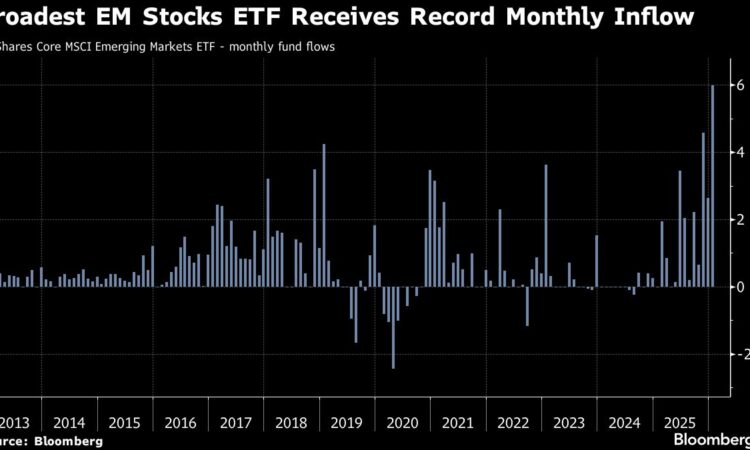
The $135 billion iShares Core MSCI Emerging Markets ETF, which invests in EM stocks, has lured almost $6 billion in January. That puts it on track for the biggest monthly inflow since its inception in 2012.
“EM assets are one of the key beneficiaries from stronger global growth,” Oliver Harvey, a strategist at Deutsche Bank in London, wrote in a note. “And when opportunities to express a positive growth view have been constrained in developed markets, the outlook is even more bullish for EM.”