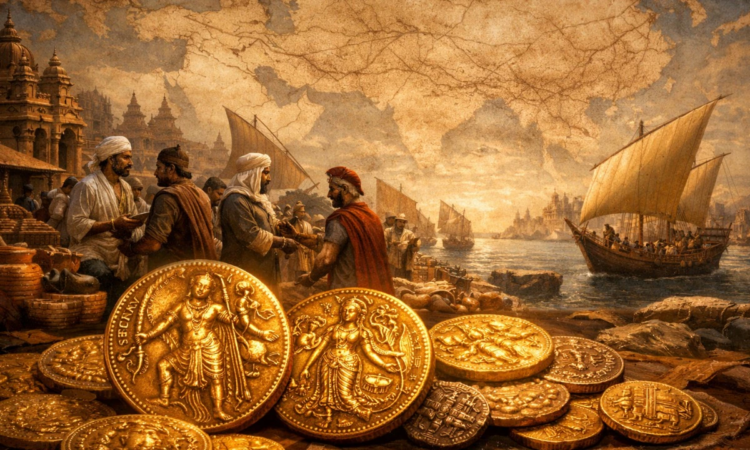
Long before the Mughals or European traders entered the subcontinent, India was already a major economic force. Powerful Hindu kingdoms ruled vast territories, controlled busy trade routes, and minted coins that travelled far beyond modern India’s borders.
In many regions where Indian kings never ruled directly, coins bearing their names still circulated widely, this was a subtle but powerful marker of influence.
These coins were more than currency. They were symbols of trust, prosperity, and prestige, accepted across seas and deserts because India was seen as a land worth trading with.
WHY INDIAN COINS CIRCULATED OUTSIDE INDIA
Ancient and early medieval India sat at the centre of global trade networks. Indian merchants traded spices, textiles, gemstones, metals, and religious ideas with Rome, Persia, Southeast Asia, and Central Asia.
Because Indian goods were in demand, Indian currency naturally followed.
In some regions, Indian coins were preferred over local money. Strong empires, stable governance, and reliable metal content made these coins trustworthy. For foreign traders, accepting Indian coins was a mark of honour and good business.
SAMUDRAGUPTA AND THE GOLD STANDARD
One of the most striking examples comes from the Gupta Empire under Samudragupta in the 4th century CE. His reign is often called a golden age, and quite literally so.
Samudragupta issued almost exclusively gold coins, a rare practice in the ancient world. According to historians, he never minted silver coins, underlining the economic confidence of his empire.
Scholar Radhakumud Mukherjee notes that Samudragupta issued at least eight distinct types of gold coins, often depicting the king as a warrior, musician, or conqueror.
Trade links with the Roman, Sassanian, and Persian empires ensured that Gupta gold coins travelled far beyond India.
Archaeological finds show these coins appearing in foreign markets, valued both for their gold content and imperial symbolism.
VIJAYANAGARA: A CURRENCY THAT SHAPED EUROPEAN TRADE
In southern India, the Vijayanagara Empire (1336–1646) created one of the most influential monetary systems of the medieval world.
Founded by Harihara and Bukka south of the Krishna River, the empire flourished at a time when European traders were just beginning to reach Indian shores.
Krishnadevaraya, its most celebrated ruler, actively encouraged overseas trade. Gold and copper coins became central to commercial life, and Vijayanagara currency soon spread beyond India to Arab lands, Portugal, and Southeast Asia.
According to the Reserve Bank of India, Vijayanagara coinage was so standardised that it later inspired European trading companies.
The Dutch and French “single-swamy” pagodas and the English East India Company’s “three-swamy” pagodas were directly influenced by these Hindu coins.
Many Vijayanagara gold coins featured Lord Venkateshwara of Tirupati, blending devotion with economic power.
LOST KINGDOMS REVEALED BY COINS
Coins often survive when texts do not. Numismatist Pankaj Tandon has highlighted coins discovered in present-day Balochistan that belonged to a little-known dynasty called the Paratarajas.
These rulers governed the Pardan kingdom between roughly 125 and 300 CE.
Their copper coins were inscribed in the Kharosthi script, while silver coins used Brahmi, showing a fascinating blend of cultural influences.
Through coins alone, historians have reconstructed a chronology of 11 Parataraja kings — proof that money can sometimes tell history better than manuscripts.
FROM THE PALLAVAS TO THE CHOLAS: INDIA’S MARITIME REACH
The Pallava dynasty, which ruled parts of Tamil Nadu and Andhra Pradesh between the 4th and 9th centuries, also left its mark abroad.
Pallava gold and copper coins have been found as far as Cambodia, influencing the coin designs of Khmer rulers.
Later, the Chola Empire (9th to 13th centuries) took Indian influence even further. With a powerful navy and thriving overseas trade, Chola coins circulated in Sri Lanka, Indonesia, and Thailand.
These coins reflected not just commerce, but India’s growing maritime confidence.
WHAT THESE COINS REALLY TELL US
Indian coinage over 2,500 years absorbed influences from Greece, Rome, Persia, and China, while retaining its own identity. Images of kings, gods, animals, and sacred symbols travelled along the Silk Road and across oceans.
These coins remind us that India was never isolated. It was deeply connected to the ancient world — economically, culturally, and politically.
Long before modern borders, Indian currency spoke a language the world understood.
– Ends