
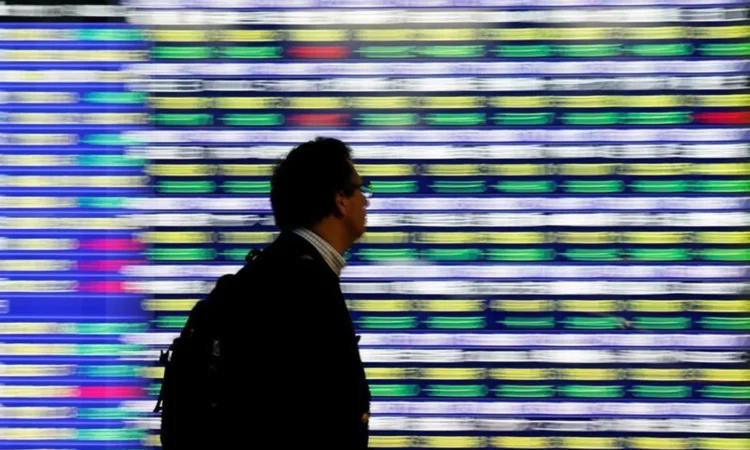
The war in the Middle East reverberated across the region, with Israel bombarding Teheran in a fresh wave of strikes
Published Wed, Mar 4, 2026 · 08:25 AM
[SYDNEY] Asian stocks were poised to track Wall Street lower even after a late rebound trimmed a broader sell-off, as US assurances on securing shipping through the Strait of Hormuz helped steady nerves.
Equity-index futures for Tokyo and Hong Kong pointed to losses and Australian shares tumbled 1.4 per cent at the open. That came after the S&P 500 closed down 0.9 per cent after earlier slumping as much as 2.5 per cent. US President Donald Trump said that the US will escort and insure tankers and other vessels through the world’s most-critical energy chokepoint, a measure meant to head off a potential crisis.
Trump’s comments helped oil pare advances and gold to drop during the US session. Both commodities edged higher in early Asian trading on Wednesday (Mar 4). West Texas Intermediate crude traded near US$75 a barrel. The yield on 10-year Treasuries climbed three basis points to 4.06 per cent, while the US dollar rose for a second consecutive day.
“For now, markets are trading headline to headline,” said Fawad Razaqzada at Forex.com. “Much will depend on whether tensions stabilise – or whether this proves to be the start of a more prolonged disruption to global supply.”
The war in the Middle East reverberated across the region, with Israel bombarding Teheran in a fresh wave of strikes. The Islamic Republic fired missiles at Qatar, Bahrain and Oman, with Doha saying targets were not limited to military interests. Qatar and Iraq halted production at major energy sites.
Attention in Asia will also be on South Korea’s stocks and currency. The benchmark Kospi index sank 7.2 per cent on Tuesday in its worst session since August 2024, as the market reopened after a holiday. The South Korean won also slid to its weakest level since 2009.
Navigate Asia in
a new global order
Get the insights delivered to your inbox.
In other corners of the market, European natural gas spiked to a three-year high, which may lift prices in Asia as the regions compete for liquefied natural gas cargoes.
With the conflict disrupting shipments, fuel costs have been on the rise. A sustained surge in prices for diesel – used in freight, power and heating – could add to the cost of transportation – a key component of inflation. Petrol prices have also jumped, intensifying those risks.
Meanwhile, traders in the futures markets are sharply reducing expectations for interest rate cuts from the Federal Reserve, as the war with Iran drives fears of an inflationary resurgence.
SEE ALSO
The view is being expressed in interest-rate futures spreads, which are tightening on bets that a war-fuelled spike in oil prices could aggravate inflation and make it harder for policymakers to reduce borrowing costs this year.
A prolonged conflict pushing oil to US$90 to US$100 for a sustained period would be a significant economic headwind, noted Jennifer McKeown at Capital Economics. The adverse effects should be limited by central banks looking through the shock and avoiding rate hikes, but cuts would probably be delayed, she added.
Barring a prolonged disruption of oil supplies, the conflict is unlikely to end the cyclical stock bull market by itself, according to Ed Clissold and Thanh Nguyen at Ned Davis Research, which has tracked crisis events for decades.
“There is significant room for global market corrections to continue, as risk has been built up over the last three years of global growth,” according to Bob Savage, head of markets macro strategy at BNY. “The problem for offsetting equity pain is that fixed income is more correlated to than divergent from equity risks.”
Some of the main moves in markets:
Stocks
- S&P 500 futures fell 0.2 per cent as of 8.30 am Tokyo time.
- Hang Seng futures fell 0.8 per cent.
- Australia’s S&P/ASX 200 fell 1.6 per cent.
Currencies
- The Bloomberg Dollar Spot Index was little changed.
- The euro was little changed at US$1.1617.
- The Japanese yen was little changed at 157.64 per US dollar.
- The offshore yuan was little changed at 6.9154 per US dollar.
- The Australian dollar was little changed at US$0.7040.
Cryptocurrencies
- Bitcoin rose 0.7 per cent to US$68,510.04.
- Ether rose 1 per cent to US$1,988.61.
Bonds
- Australia’s 10-year yield advanced two basis points to 4.79 per cent.
Commodities
- West Texas Intermediate crude rose 0.8 per cent to US$75.14 a barrel.
- Spot gold rose 0.7 per cent to US$5,123.53 an ounce. BLOOMBERG
Decoding Asia newsletter: your guide to navigating Asia in a new global order. Sign up here to get Decoding Asia newsletter. Delivered to your inbox. Free.


