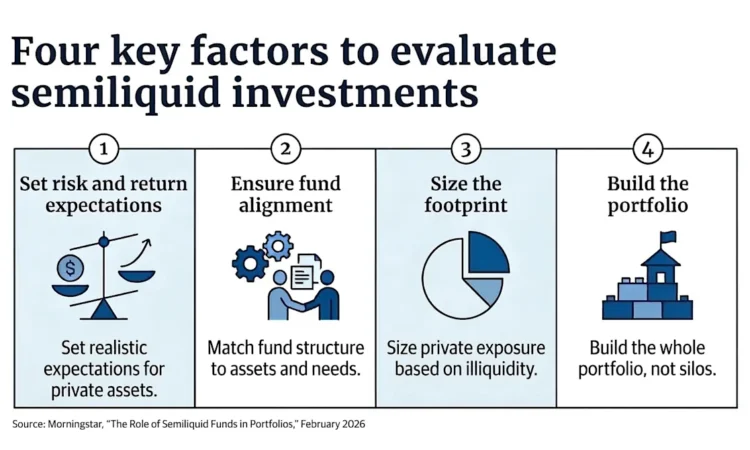
To effectively invest in private vehicles, financial advisors and clients must avoid buying into common myths about their returns and correlation with public funds, a Morningstar study said.
So-called semiliquid investment assets such as private equity, private credit, venture capital, real estate and other alternative vehicles require horizons of at least seven to 10 years and careful scrutiny of any managers’ claims that higher returns will justify their bigger expenses, the independent research firm said in the report. Released last month, the research came out a week before Blue Owl Capital announced it would cease filling investor redemption requests for one of its private credit funds ahead of the complete drawdown of the vehicle’s assets. It was the latest cautionary signal about the “democratization” of private investments.
Morningstar’s study argued that, as investors and advisors consider asset managers’ sales pitches, they should keep in mind that, for example, private equity funds bring diversification that is “hard to quantify and arguably overstated at face value.” These funds offer opportunities to expand stock allocation beyond publicly traded ones, rather than providing “market-neutral” exposure, the study said. While the draw of potentially higher returns and diversification in a time with fewer publicly traded companies is understandable, authors Sam Hui, Francesco Paganelli and Chris Tate prescribed some rules for evaluating any semiliquid investments.
“Contrary to common marketing claims, semiliquid strategies often carry traditional equity or credit risks and are not suitable to play the role of portfolio diversifiers,” they wrote. “Most semiliquid funds should be seen as expanding the equity or credit opportunity set rather than adding new risk factors. To genuinely reap the benefits of semiliquid funds, investors need three things: patience and long-term mindset, a return premium to compensate for complexity and illiquidity and proficiency in selecting the right managers. We suggest four key steps to drive portfolio construction: setting expectations on risk and returns; ensuring alignment across fund structure, assets, and investors; sizing the footprint; and building the portfolio.”
READ MORE: Mindful of risks, RIAs steer clients into private markets

Advisors on the receiving end of industry marketing have been educating clients about alternative investments with many of these principles in mind.