Synopsis: This article compares various global currencies and the fluctuations they faced due to the ongoing US-Iran war. This article will help you understand which currencies did well and which didn’t.
The US-Iran war started when the USA launched Operation Epic Fury, a joint military operation by USA and Israel against Iran on 28th of February, 2026. This war started due to years of tension between the US and Iran over the negotiation of multiple failed nuclear deals. This war has gripped the global economy with volatility over the course of the previous month, with many commodities, Including Stocks, bonds, and Currencies, seeing losses as the war continues. It has increased the bearish sentiments across the world, which has dragged these commodities lower over the past month.
This article will help you see how the major currencies across the world, such as US Dollar, Pound Sterling, Euro, Indian Rupee, Yen and Yuan performed, ever since the conflict started.
US Dollar($)
Currency Indices are designed to track changes in currencies’ values. In the case of the US dollar, we are going to use DXY, which is an index that compares the value of USD relative to a basket of 6 currencies. These 6 currencies are the Euro, Japanese Yen, Canadian Dollar, Pound Sterling, Swedish Krona and Swiss Franc, all of which are weighed at different percentages.
Note: The red trendline starts on 28th Feb, the day USA conducted Operation Epic Fury and ends on 2nd April (the day the article is being written)
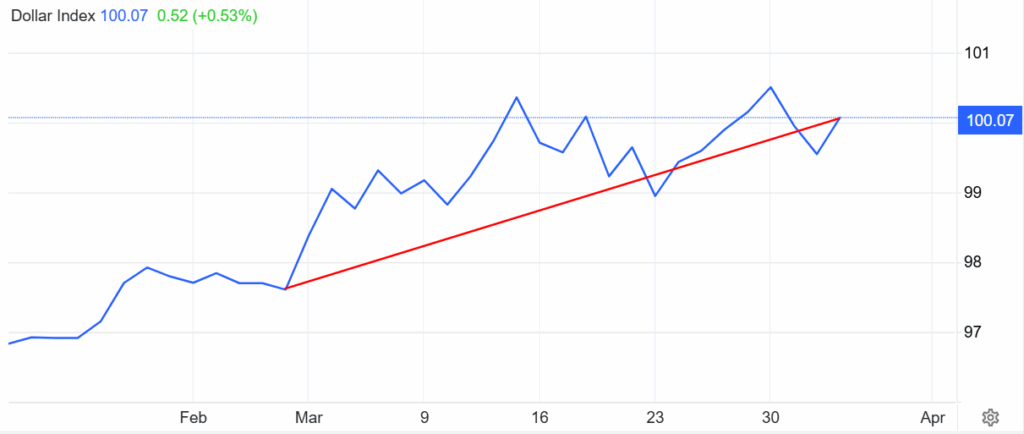
- This graph showcases the Dollar index’s (DXY) price fluctuations before and after the war started.
- The red trendline showcases an upward slope, which means the USD has strengthened over the course of the war
- It is good for the US Economy as the dollar continues to grow despite fluctuations that have been observed in the graph.
- It reduces importing costs for US companies while making it harder for companies to export, as it becomes more expensive for foreign buyers to buy their goods.
For the rest of the currencies, we will be looking at their values by comparing them with the US Dollar (USD) and how these currencies performed against it.
Euro(€)
- Since the war started, we can see that there has been a slight downward trend.
- This trendline shows that the Euro has weakened against the USD.
- Weakening of the Euro makes it harder for European companies to import goods.
- It is beneficial for the exporting companies as the Euro becomes cheaper, which will make it easier for them to sell their products.
Indian Rupee(₹)
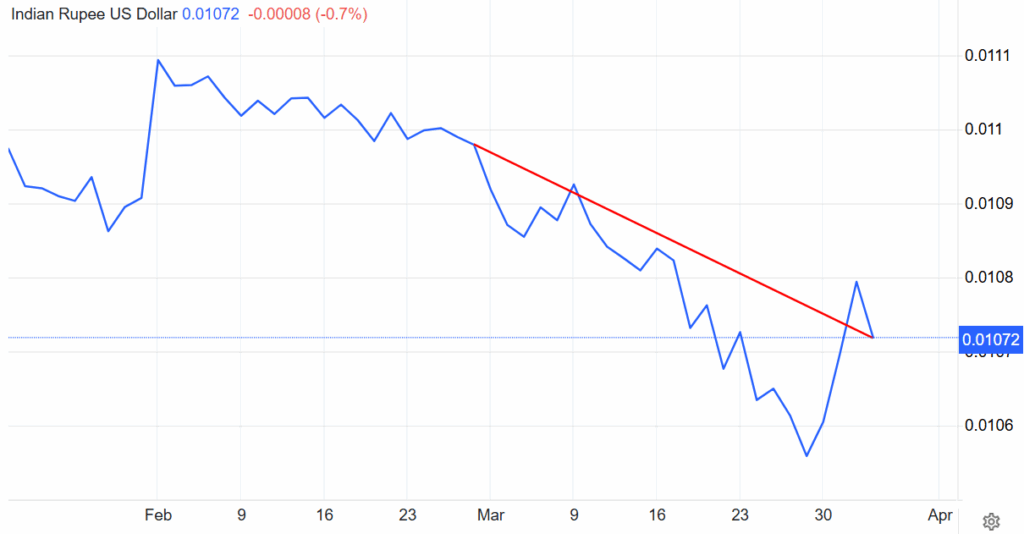
- Since the war started, we can see that there has been a steep downward trend.
- INR has faced a sharp decline in its value against the USD.
- This will make importing goods very hard for Indian companies, especially crude oil.
- As the rupee weakens, it enables Indian companies to export more as their products become cheaper.
Also read: Dollar-to-Indian Rupee (1947-2026): How the Rupee Depreciated from ₹3 to ₹94
Pound Sterling (£)
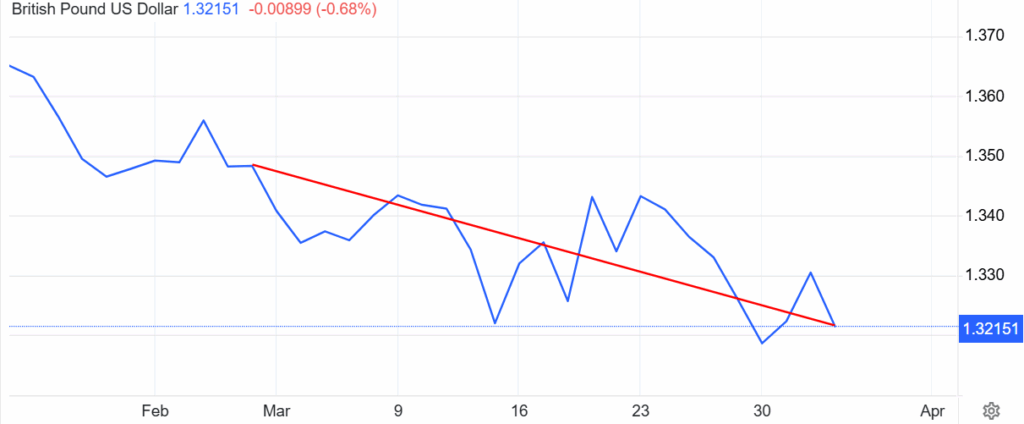
- This graph showcases a downward trend ever since the war began.
- Pound Sterling has declined compared to the USD.
- It will make it harder for the UK to import and easier for them to export their products.
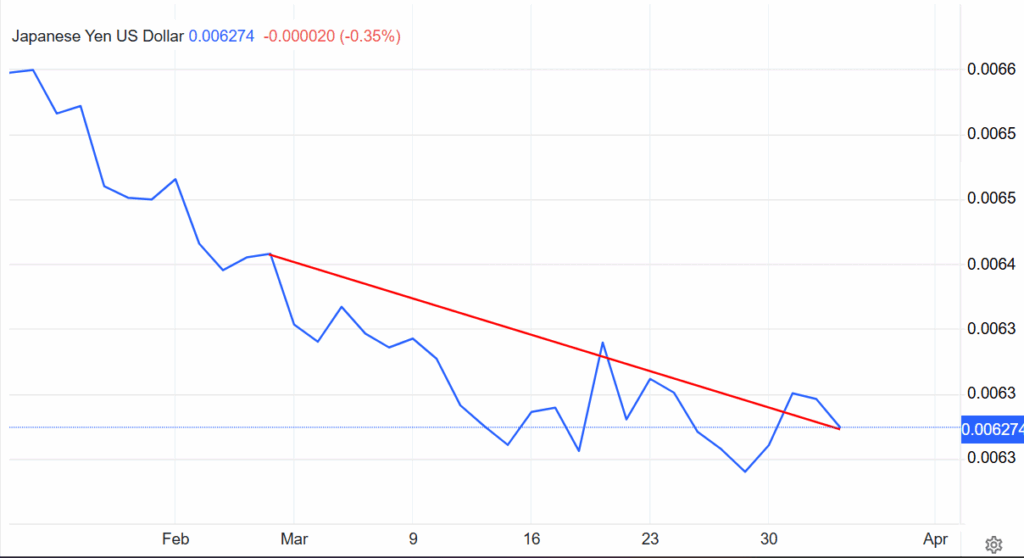
Japanese Yen (¥)
- The graph showcases a downward trend
- This means that the Yen has performed poorly ever since the war started.
- It makes it easier to export goods from Japan and makes it harder for them to import goods.
Chinese Yuan
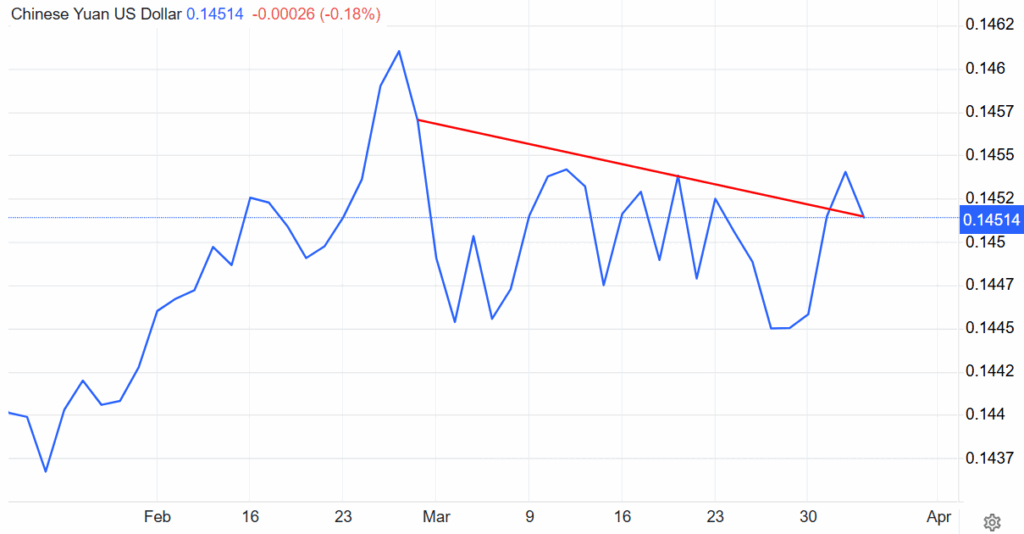
- We can see a slight downward trend in the graph, showcasing a poor performance by the Yuan.
- Its valuation has been very volatile ever since the war started.
- As per the trend, Yuan may get back to its previous valuation pretty soon.
- It will be more expensive for the Chinese to import goods
- They will be able to sell more of their goods as their currency gets weaker.
| Currencies | Value on 28th Feb | Value on 2nd April | % Change |
| USD | 97.606 | 100.07 | 2.52% |
| Pound | 1.3485 | 1.32151 | -2.00% |
| Euro | 1.1809 | 1.15254 | -2.40% |
| Rupee | 0.011 | 0.01072 | -2.55% |
| Yuan | 0.1457 | 0.14514 | -0.38% |
| Yen | 0.0064 | 0.006274 | -1.97% |
The Global Currencies had to face volatility due to the war, which caused uncertainties and a decline in their value. While certain currencies life Yuan, didn’t face a severe decline, the rest had lost around 2% of their values as shown in the Table. U.S. dollars, along with a few other currencies (Ruble, Canadian Dollar, etc.), performed well over the last month.
Note: The graphs and the values mentioned are taken from the website ‘Trading Economics’.
Conclusion
Whenever a conflict or war takes place, it tends to disrupt the market, especially the Forex market. The US-Iran war has also led to the closure of the strait of Hormuz, which has further caused volatility as countries are unable to import crude oil and natural gas. Countries like the USA and Russia, which export these energy resources, see an increase in their currencies’ value.
Conflicts tend to create panic, which has led to many currencies losing their value as investors sell them due to uncertainty over the war. Investors tend to pull money out of the Forex market to invest in stable assets to avoid risk. Governments that fund these wars end up printing more money, which often loses its value, as seen in Iran’s case. Only certain currencies benefit from such conflicts. But overall, conflicts like these tend to generate long-lasting volatility, which ends up adversely impacting all currencies’ value.
Written by Sagar V M