
Viewpoint: What the sale of the Imperatrice property will tell us about Ashland’s values – Ashland News
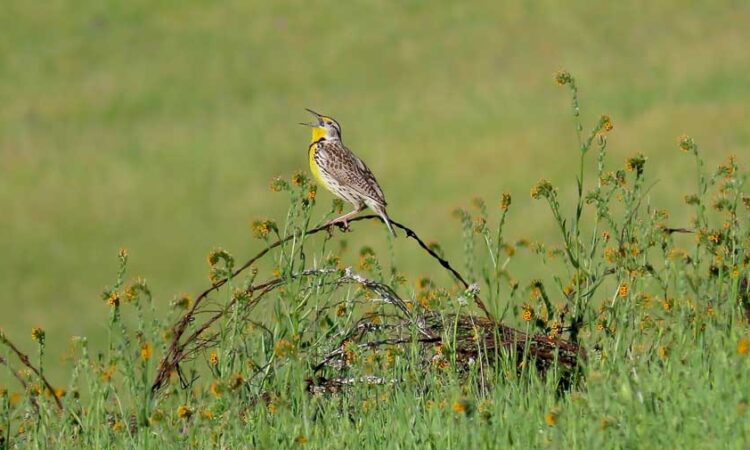
The upper 556 acres is home to a remarkably intact perennial grassland community
By Pepper Trail
Many of us aren’t aware that the city of Ashland owns an ecologically precious 846-acre property, a remnant of the grasslands that once covered the lowlands of the Bear Creek valley.
Known as the Imperatrice, this rises east of I-5 above the truck weigh station, and is the undeveloped vista that can be seen as we look toward the base of Grizzly Peak. It was purchased as part of a long-discarded plan for dealing with effluent from the water treatment plant.
In recent years the lower area, below the Talent Irrigation Ditch, has been leased for livestock grazing, but the upper 556 acres is home to a remarkably intact perennial grassland community, with rare plants, abundant pollinators, and one of Oregon’s largest breeding populations of a threatened bird, the Grasshopper Sparrow.
The City Council, facing serious financial challenges, has decided to sell the Imperatrice. How this sale is conducted will be a critical test of Ashland’s values.
On March 16, the city of Ashland convened a “community conversation” at the Bellview Grange on the future of the Imperatrice. (The possible sale of the 15-acre Hardesty property near the Water Treatment Plant was also discussed, but no decision on that has yet been made.)

Mayor Tonya Graham moderated the discussion, and shared some important facts at the outset:
- The Imperatrice was purchased with a grant from the Land and Water Conservation Fund for $946,000, which must be repaid when the property is sold
- The land is appraised at $3.8 million ($2.4 million for the lower irrigated 290 acres, and $1.4 million for the upper unirrigated 556 acres). Several audience members expressed that this appraisal seemed much too low.
- The land is outside Ashland’s city limits, and thus is under county land use rules
- It is zoned EFU (Exclusive Farm Use). That limits but would not preclude a buyer dividing the property into a number of parcels with homes as long as there is “farm income.” EFU zoning would also allow placing solar arrays on the property.
Community members shared a diversity of views on the value and possible futures for the Imperatrice, with two main themes: prioritizing the preservation of the Imperatrice’s ecological values, and emphasizing the property’s value as grazing land.
Many participants noted that these were not mutually exclusive. For example, grazing could be conducted on the irrigated lower area, while protecting the native grassland above the ditch. Staff of the Southern Oregon Land Conservancy were present and expressed strong interest in helping to secure the land’s permanent conservation, potentially including conservation and/or working-lands easements.

What was not advocated by anyone in the audience was to simply sell the Imperatrice to the highest bidder, regardless of their plans for the property. Almost all the private land east of I-5 from Emigrant Lake to Medford is chopped up into ranchettes, vineyards and hemp farms. No one wants that to be the fate of this unique large intact grassland.
The Ashland City Council has fiscal responsibilities. But it also has responsibilities to honor the values which this town holds dear, and to assure that this city-owned property is sold to an owner who respects those values. Having made the decision to sell the Imperatrice, the council must proceed with due diligence to assure that this irreplaceable intact grassland will not be sacrificed to subdivision and development.
Pepper Trail is a longtime Ashland resident and advocate for the conservation of Oregon’s wildlife and wild lands. He is retired from a career with the U.S. Fish & Wildlife Service.


