By Saqib Iqbal Ahmed
NEW YORK, May 5 (Reuters) – The U.S. dollar edged down on Tuesday as markets weighed developments in the Iran war, while the yen nudged lower in muted trade after a suspected intervention by Tokyo last week sparked sharp gains.
The dollar index, which measures the U.S. currency against six peers, was 0.03% lower at 98.437 after rising 0.3% on Monday. The euro was 0.1% higher at $1.17005, while sterling was 0.1% higher at $1.35510.
“It’s a bit of a stasis for the markets,” said Shaun Osborne, chief currency strategist at Scotiabank.
“Yesterday we had these headlines suggesting that maybe the ceasefire was at risk of breaking down, but I think it was not lost on the markets generally that President Trump didn’t take advantage of that to launch another wave of attacks,” he said.
U.S. Defense Secretary Pete Hegseth said on Tuesday the ceasefire with Iran was not over, even as the U.S. and Iran exchanged fire in the Gulf as they wrestled for control of the Strait of Hormuz.
The U.S. military said on Monday two U.S. merchant ships made it through the strait, with the support of Navy guided-missile destroyers. Iran denied any crossings had taken place.
“I wonder, with this China visit coming up, it may give us a period here where that’s going to be the focus … (President Donald Trump) doesn’t maybe want to rock the boat geopolitically too much ahead of that meeting,” Osborne said.
Trump said on Monday he looks forward to seeing Chinese President Xi Jinping later this month.
Data on Tuesday showed the U.S. trade deficit widened in March as an artificial intelligence investment boom pulled in imports, more than offsetting an increase in exports, which were partly boosted by petroleum shipments amid the Middle East conflict.
“The dollar is still quite strongly valued from a long-run point of view … there’s still the potential here for the U.S. dollar to slip back a little more in the next few months,” Osborne said.
TRADERS KEEP YEN VIGIL
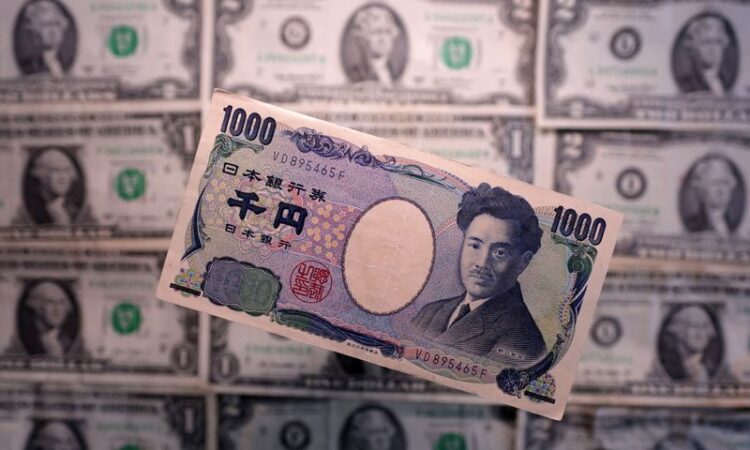
Against the yen, the dollar rose 0.4% to 157.85, after sharp losses since Thursday, when sources told Reuters authorities had stepped into the currency market to arrest a steep selloff in the Japanese currency.
Data last week pointed to roughly $35 billion in spending by Tokyo to boost the yen, although analysts think it is unlikely to help the battered currency in the long term.
The yen has languished for years, weighed down by Japan’s ultra-low rates and a widening gulf with higher-yielding developed markets, compounded by mounting fiscal unease. The war-driven energy shock has piled on the pressure.