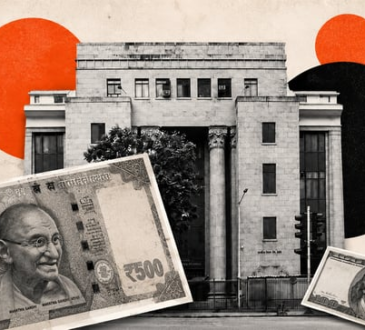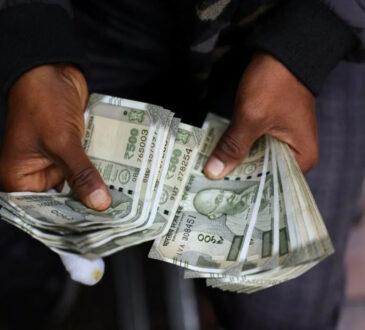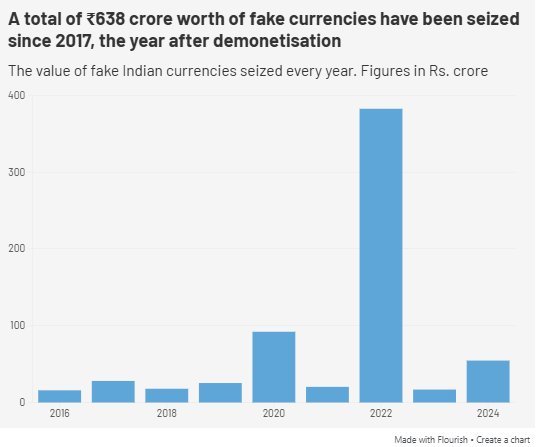
Context: Nearly a decade after the 2016 demonetisation, the latest ‘Crime in India’ report 2024 reveals that fake currency remains a major challenge, with over ₹54.61 crore in counterfeit notes seized this year.

About Prevalence of Fake Currency in India:
What it is?
- Fake currency, or Counterfeit Indian Currency Notes (CICN), refers to the illegal imitation of legal tender produced without the sanction of the Reserve Bank of India (RBI). These notes are often used to destabilize the economy, fund organized crime, and finance cross-border terrorism by mimicking the security features of genuine banknotes.
Key Data & Stats on Fake Currency:
- Massive Total Seizures: A total of ₹638 crore worth of fake currency has been seized since 2017, with 2022 seeing a massive peak of ₹382.6 crore.
- Denomination Trends: Seizures of new ₹500 notes in 2024 were four times higher than in 2016, indicating that counterfeiters have successfully replicated the new series.
- Geographic Concentration: Gujarat is the primary hotspot, accounting for ₹355.72 crore—more than 50% of the country’s total seizures between 2017 and 2024.
- Currency in Circulation (CiC): Despite digital pushes, CiC has surged by 137% to ₹42.12 lakh crore as of May 2026, compared to ₹17.74 lakh crore in November 2016.

Factors Leading to Fake Currency in India:
- Replication of Security Features: Advanced printing technologies allow criminals to mimic the complex features of the new Mahatma Gandhi (New) Series.
Example: New ₹200 and ₹500 notes now account for a significant portion of detected counterfeits in the banking system.
- Cross-Border Smuggling: Hostile neighbors and international crime syndicates use porous borders to pump fake notes into the Indian economy.
Example: High-quality Super Notes are often smuggled through the Three Frontiers and traditional transit routes in the North East.
- High Cash Dependency: Despite the rise of UPI, India remains a cash-intensive economy, providing a large hiding space for fake bills.
Example: Currency in circulation has more than doubled since demonetisation, reaching ₹42.12 lakh crore in 2026.
- Sophisticated Distribution Networks: Organized gangs use MSMEs and rural markets where manual verification of notes is less frequent.
Example: State-wise data shows high seizures in trade hubs like Maharashtra and Karnataka, where high-volume cash transactions are common.
Implications of Fake Currency:
- Economic Instability: Counterfeit money leads to inflation as it increases the money supply without any corresponding increase in goods or services.
Example: The injection of ₹638 crore in fake notes since 2017 devalues the purchasing power of honest citizens.
- Funding Terrorism: Proliferation of fake currency is a known tool for financing proxy wars and domestic insurgency.
Example: Investigative agencies often link large CICN seizures to terror modules active in border states.
- Loss of Public Trust: Widespread circulation of fakes undermines confidence in the national currency and the formal banking system.
Example: Detection of 11 lakh fake notes within banks creates panic among common users regarding the authenticity of their savings.
- Fiscal Burden: The government and RBI incur heavy costs in frequently updating security features and detecting/destroying fakes.
Example: The massive clean-up of ₹2,000 notes in 2023 was partly driven by the need to mitigate long-term counterfeiting risks.
Challenges to Counter Fake Currency:
- Technological Race: Counterfeiters quickly adapt to new security measures, such as color-shifting ink and micro-lettering.
Example: Within a year of the 2016 demonetisation, fake versions of the un-counterfeitable ₹2,000 note had already appeared.
- Fragmented Enforcement: Coordination between state police, the NCRB, and central agencies like the NIA is often hampered by data silos.
Example: While Gujarat reports high seizures, other transit states may be under-reporting due to a lack of interoperable monitoring tools.
- Low Awareness in Rural Areas: A large section of the population cannot distinguish between genuine security threads and high-quality fakes.
Example: Counterfeiters target rural MSMEs where lack of UV-detection lamps makes the passing of fake ₹500 notes easier.
- Digital Limitations: While UPI reduces small-value cash use, high-value transactions still rely on physical notes, which are the primary target for fakes.
Example: The ₹500 note remains the most counterfeited denomination because it is the workhorse of the Indian cash economy.
Way Ahead:
- Periodic Security Upgrades: RBI should introduce new security features (like polymer notes or advanced holographic threads) every few years to stay ahead of counterfeiters.
- Strengthen Inter-Agency Coordination: Empower the National Functional Analysis Centre to provide real-time, district-level data to all state police forces.
- Public Awareness Campaigns: Launch massive Know Your Note drives, especially in rural and border areas, using visual aids and mobile apps.
- Incentivize Digital Payments: Further lower transaction costs for MSMEs to reduce the total volume of high-value cash circulating in the market.
- Stricter Judicial Action: Establish fast-track courts for CICN cases to ensure that traffickers and super-distributors face swift and deterrent punishment.
Conclusion:
The persistent reality of fake currency post-demonetisation highlights that structural changes alone cannot eliminate counterfeiting without continuous technological and enforcement upgrades. With Gujarat emerging as a major seizure hub and cash in circulation at an all-time high, the threat to India’s economic sovereignty remains potent. Only a combination of aggressive digitization and robust security standardisation can ensure the integrity of the Indian Rupee in the long term.