
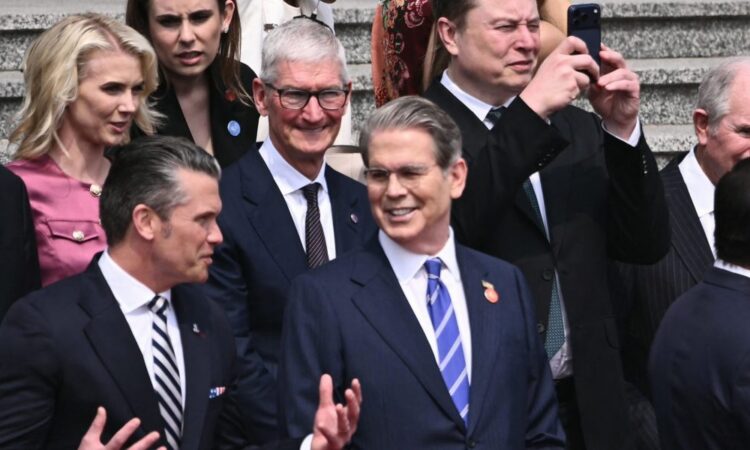
In 1992, a 29-year-old Scott Bessent looked at the Bank of England and saw something no one else did.
The Bank of England couldn’t afford to keep its promises. It had committed to keeping the pound trading within a narrow radius against the German mark, requiring it to spend whatever it took to defend the currency’s value. The trouble was that the British economy was fragile—most mortgages in the UK at the time had variable rates, so raising interest rates would devastate British homeowners. Bessent convinced his boss, George Soros, to bet against the pound. When it crashed a week later, Bessent made $1 billion for the firm and made himself and Soros famous.
The lesson Bessent learned on that “Black Wednesday” is simple: when a central bank is artificially holding its currency at a level the market wouldn’t otherwise support, eventually the market will win. Though the yuan is harder to trade than the pound—China has a number of capital controls—the same logic, more or less, should apply to China today.
Thirty-four years later, Bessent is flying to Beijing, where he will sit across from a central bank, the People’s Bank of China (PBOC), that is, by his private firm’s research, artificially holding the yuan at a level the market wouldn’t otherwise support. But Bessent isn’t working for that firm now; he’s the Treasury Secretary of the United States.
The dynamics in 2026 are the opposite of 1992 in the UK: Beijing has spent decades suppressing the yuan to keep its exports cheap, as opposed to propping it up to defend a peg. Throughout the 2010s, the scandal of America looking the other way on this plagued Ben Bernanke’s Fed and Bush and Obama’s presidencies, propelling Trump to classify China as a “currency manipulator” on the 2016 campaign trail, and then officially in 2019. That designation became the justification for the Mar-a-Lago Accord, which built the financial structure of Trump’s tariff regime: something Bessent called on Bloomberg “an answer to currency manipulation.”
The yuan, by the estimate of Brad Setser, a Council on Foreign Relations senior fellow who tracks Chinese capital flows and who previously served at Treasury, is about 20% undervalued. “If you assume the financial account stays closed as it is now, I think you could easily see the yuan trade up to six or stronger,” Setser told Fortune. “Ten to twenty percent higher is relatively straightforward.”
How China quietly depresses the yuan
China has been the “world’s factory” since joining the World Trade Organization in 2001, and since then they’ve bought up dollar-denominated assets to keep the yuan cheap, and their exports competitive. It has done so through its foreign exchange agency, the State Administration of Foreign Exchange (SAFE), which currently holds about $1.8 trillion in dollar reserves.
The trouble is that these purchases are public, and have drawn the ire of Washington. So, since 2015, China has tried a new strategy; buying treasuries through state-owned commercial banks, policy banks or its sovereign wealth fund. Right now, Setser estimates, China has about $1.1 trillion at state commercial banks, close to $1 trillion in policy bank claims abroad, and a majority of the China Investment Corporation’s $450 billion portfolio; around $2.5 trillion off balance sheet in total.
“China, Inc. could hold more dollars off SAFE’s balance sheet than on SAFE’s balance sheet,” Setser wrote for the Council of Foreign Relations. “Nice little trick.”
It seemed to partially work to stave off Washington. In June 2025, six months into his tenure, Bessent’s Treasury Department declined to designate China a currency manipulator, citing only the country’s “lack of transparency.”
The case for designation is, by most technical measures, stronger now than it was in 2019, when Trump’s first Treasury actually pulled the trigger. “I don’t think China met the criteria in 2019,” Setser said. “I think that was a very political designation.” At the time, he explained, there was not a buildup of foreign exchange and China’s global trade surplus was actually much smaller. Now, he said, China actually does meet the criteria, if you consider that state regional banks are essentially doing the FSOB’s bidding off-balance sheet. So why the silence?
Bessent’s own answer came last September, in Madrid. Asked whether he had raised yuan devaluation with Chinese Vice Premier He Lifeng, the Treasury Secretary told reporters: “Well, they haven’t done it to the U.S. The RMB is actually stronger this year versus the dollar. Now it’s at an all-time low versus the euro, which is a problem for the Europeans.” Asked whether the decline was manipulation, he said only that the yuan is “a closed currency.”
Other analysts see game theory. “Xi is coming into the summit feeling confident he has solved Trump,” Jeremy Chan, a senior analyst at Eurasia Group and former U.S. diplomat, told Bloomberg. Beijing controls 90% of the world’s processed rare earths—the inputs vital for defense systems and AI chips. The U.S. ran tariffs up to 145% earlier in the year and walked them back to 30% when China retaliated by tightening export controls on those minerals; a moment that exposed a severe lack of preparedness to answer China’s points of leverage.
Jon Hilsenrath, who runs the economic advisory firm Serpa Pinto and covered the Federal Reserve for 26 years at The Wall Street Journal, has puzzled over the same issue, and reads the silence as a form of triage. “They’ve got so many other bigger issues on their mind that it just hasn’t risen to the level of something they want to make a fuss about,” he told Fortune.
Plus, he added, the Chinese are actually letting the yuan appreciate a little bit. The yuan has climbed about 7% against the dollar over the past year, moving from 7.3 in January 2025 to around 6.80 today. “So they’re probably happy to see that,” Hilsenrath said.
But really, the broader dynamic of the relationship isn’t pulling one way or the other; just stagnation. Hilsenrath likes to call it tangping, borrowing the post-Covid Chinese internet term for “lying flat.”
“Our relationship with China is lying flat. It’s not changing, it’s stable,” Hilsenrath said.
That’s the bar for the summit. While Bessent and analysts might once have wanted a structural fix: a yuan that actually reflects China’s surpluses, or an economy rebalanced away from export dependence, none of that is on the table. All Trump wants out of the trip, in Hilsenrath’s read, is “headline material”—a Chinese commitment to buy $50 billion in soybeans, or a Boeing order. Just a handshake. “That’s more concrete than saying they’re going to let the yuan appreciate another percentage point.”


