
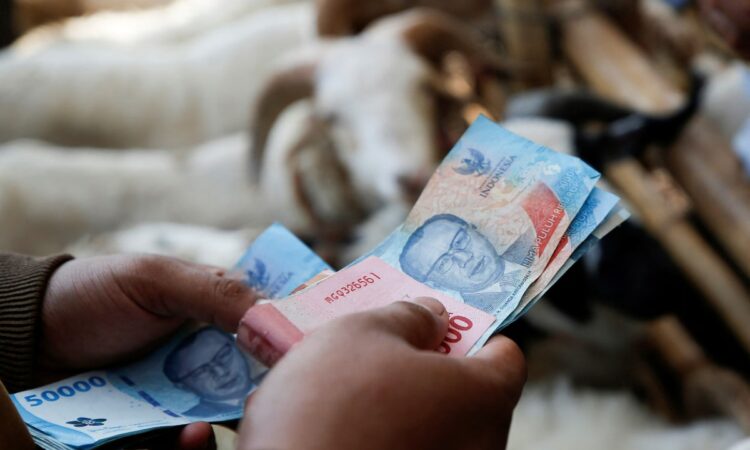
BENGALURU (May 18): The Indonesian rupiah hit a record low on Monday, leading declines across emerging Asian currencies, as fresh drone attacks in the Gulf lifted oil prices and bond yields, boosting the safe-haven dollar and pressuring assets in net oil-importing economies.
The Middle East conflict intensified as drone strikes hit UAE assets, Saudi Arabia intercepted incoming drones, and Iran moved to assert control over the Strait of Hormuz, constricting a key oil transit route.
The rupiah, one of the region’s worst-performing currencies, slumped 1.19% to 17,668 per US dollar, its biggest intraday percentage loss since early September.
The move marked the local unit’s second record low in a week and put the unit on track for its worst May since 2016, as Indonesian markets reopened after a holiday and came under renewed pressure.
The rupiah’s losses have widened beyond an oil-led shock, as concerns over Indonesia’s fiscal discipline, foreign outflows, central bank independence, and stock-market governance following MSCI’s latest index removals.
Stocks in Jakarta tumbled more than 4% to 6,425.95 in a fifth straight session of losses, touching the lowest level since late April 2025. The benchmark index has lost over 25% this year.
Bank Indonesia (BI) has repeatedly sought to lean against rupiah weakness, intervening through spot, domestic and offshore non-deliverable forwards and the secondary government-bond market, while pledging to use monetary-policy tools to ease pressure on the currency.
That puts this week’s policy meeting firmly in focus, with the BI rate still at 4.75% after seven straight holds and Citi expecting a rate hike as policymakers weigh growth support against the need to restore confidence in the currency.
The Indian rupee also hit an all-time low of 96.185 per dollar, down 0.2%, extending a slide that has gathered pace since the Iran conflict pushed oil prices higher in late February. The currency has weakened roughly 5.5% since then, making it one of Asia’s worst-performing currencies in 2026.
Asian EM currencies have borne the brunt of a stronger dollar, higher US real yields, and elevated energy prices, with oil importers such as the rupee and peso facing a double hit and yield-sensitive units like the rupiah also pressured by domestic headwinds, MUFG analyst Michael Wan said.
Among other currencies, the Malaysian ringgit weakened 0.7% to 3.9750, hovering near the psychologically key 4.000 level and on course for a third straight session of losses. The South Korean won and Taiwan dollar slipped 0.4% and 0.3%, respectively.
The US dollar index edged higher in its sixth straight session of gains, adding over 1.5% in that run, while MSCI’s emerging-market currency gauge fell 0.2% for a third day as a global bond selloff tightened financial conditions across risk assets.
Importantly, the bond sell-off has not been driven solely by inflation expectations, with inflation-adjusted yields also rising sharply — a development that typically weighs more heavily on risk assets and emerging market currencies, Wan said.
Uploaded by Chng Shear Lane


