
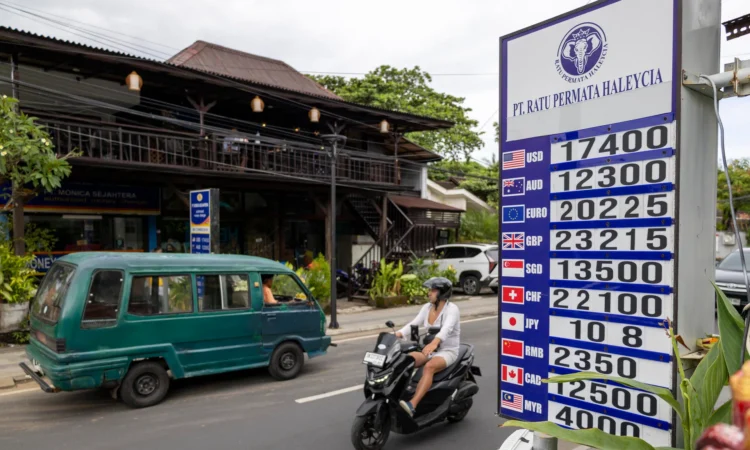
The region is reeling from a more than 40% surge in crude prices since the war broke out in late February
Published Thu, May 21, 2026 · 01:03 PM
[MUMBAI] The Iran war is piling pressure on emerging Asian markets, pushing some currencies and bond yields towards levels once considered unlikely.
As the conflict drags on, some analysts are mapping out more extreme bearish scenarios. That includes India’s rupee weakening to 100 per US dollar, the Indonesian rupiah sliding to 18,000, and the Philippine peso depreciating to 65 as high energy prices fuel inflation and weigh on import-dependent economies.
Bond markets are also feeling the strain. Benchmark yields in India may test peaks last seen in 2022, while the head of the money market association in the Philippines says yields may climb towards 8 per cent, a multi-year high.
Asia is reeling from a more than 40 per cent surge in crude prices since the war broke out in late February. The pain is being felt most acutely in India, Indonesia and the Philippines, which rely on foreign capital to fund current-account deficits.
Rising US Treasury yields have further dent the appeal of emerging-market assets, pressuring central banks to tighten policy even as the economic fallout from the conflict deepens.
Indonesia has already moved to defend the rupiah, with the central bank surprising markets on Wednesday (May 20) with a larger-than-expected rate hike and a pledge to step up currency intervention.
Navigate Asia in
a new global order
Get the insights delivered to your inbox.
“The deterioration in import costs relative to export prices will continue to weigh on the currencies of net oil importers” if energy prices continue to rise, said Rajeev De Mello, global macro portfolio manager at Gamma Asset Management. Higher crude prices may also hurt bonds, as they stoke inflation or widen fiscal deficits where authorities absorb part of the shock through fuel subsidies, he said.
The rupiah, rupee and the peso have been among the worst-performing emerging-market currencies, falling between 4.5 per cent and 6.5 per cent since the war began.
Aberdeen Investments and MetLife Investment Management are among those that see the possibility of the rupee weakening to 100 per US dollar. DBS has revised its forecast range to 95-100 from 90-95. The consensus estimate compiled by Bloomberg shows 94.75 by year-end, while the one-year US dollar-rupee forward breached 100 for the first time on Wednesday.
SEE ALSO

In South-east Asia, Gamma’s De Mello said that the peso could weaken beyond 65 if oil prices continue to climb. HSBC now expects the peso to end the year at 60.8, compared with its previous forecast of 59.8, while projecting the rupiah to hit 17,400 from an earlier estimate of 17,300.
BNY Mellon strategist Wee Khoon Chong wrote in a May 13 note that the rupiah could slide to 18,000 in the near term. Bloomberg consensus estimates see the peso ending the year at 60.3 and the rupiah at 17,100.
As strains on Indonesia mounted, President Prabowo Subianto on Wednesday announced plans to tighten state control over commodity exports. He estimated the country loses as much as US$150 billion annually through “leaks” such as under-invoicing, where exporters fail to declare the full value of shipments.
The losses have spread to local currency bonds in the region, which had been favoured by global investors before the war. A Bloomberg index of average 10-year yields across seven emerging Asia economies has risen over 120 basis points from the start of the conflict, its highest since November 2023.
At a weekly auction on Wednesday, yields on India’s 364-day treasury bill jumped the most in about four years.
Rate outlook
Investors are starting to expect India to follow Indonesia and the Philippines in tightening policy when the central bank announces its next rate decision on Jun 5. Indian swaps are now pricing in about 125 basis points of hikes over the next year, according to Standard Chartered.
In the Philippines, interest-rate swaps are pricing in about 70 basis points of hikes over a three-month period as inflation concerns mount. Consumer prices rose in April at the fastest pace in three years, strengthening expectations for a half-point increase at the central bank’s June meeting.
“We definitely have not seen the worst,” said Jonathan Ravelas, managing director at eManagement for Business and Marketing Services in Manila. He sees 10-year yields hitting double digits if the conflict worsens, and the peso weakening to 62-63 over the next six to 12 months, and to 65 over two years.
Some analysts argue the region is better positioned to withstand shocks than before, such as during the 1997 Asian financial crisis. The economies today have larger foreign-exchange reserves and lower levels of dollar-denominated short-term debt, according to Nomura.
“While these are very challenging times, we think most Asian economies can navigate through it,” said Sonal Varma, Nomura’s chief economist for Asia ex-Japan.
Still, global funds have pulled back from the region. Since the war began, more than US$500 million has exited Indonesia’s local bond market, while India has seen outflows of US$1.2 billion, reinforcing pressure on currencies and yields. BLOOMBERG
Decoding Asia newsletter: your guide to navigating Asia in a new global order. Sign up here to get Decoding Asia newsletter. Delivered to your inbox. Free.


