
Nicolas Makeiew used to consider finance solely from a mathematical perspective. That was when he worked for Crédit Agricole’s London branch building financial products.
His day-to-day involved wading through piles of data to help advise clients with government or corporate bonds what their next profitable move might be.
Slowly, ‘finance’ started taking on other meanings as the human cost became all too apparent.
“I started realising the wider effects of it,” he said. Some decisions involved bets on a company’s demise, which in turn saw firms forced to let go of hundreds or even thousands of employees.
Hired in May 2013, it took him five years to see the full picture. He quit in September 2018 before settling in Morlaix, a town of 15,000 inhabitants in northern Finistère, in 2020.
There, he eventually learned about Buzuk, an association founded in 2016 to promote a local currency of the same name with the aim of bolstering the area’s economy.
The project made sense. He joined it as a coordinator.
Local currencies spread in France
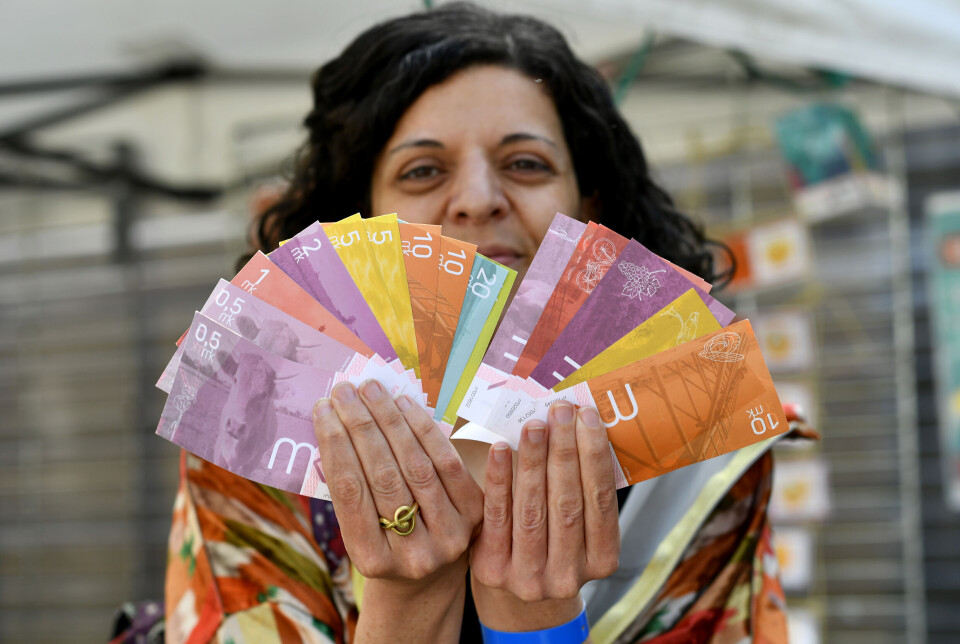
Buzuk is one of more than 65 local currencies (LCY, or monnaie locale in French) spread across the country. Bordeaux has La Gemme, Dieppe L’Agnel, Nantes La Moneko, and Auxerre La Cagnole.
Bayonne prides itself on the success of the Eusko, the biggest LCY in Europe.
Bas-Rhin accepts Stück; Haut-Rhin takes La Cigogne.
See here to check if your department has one.
They are exchanged, like-for-like, against euros from the association itself, and can be spent only in participating shops.
While LCYs only account for a fraction of currency in circulation, they play by the same rules of the current monetary system. The core difference is that they channel the flow of money to a much smaller area.
Supporting the local economy is one of the grassroots principles shared by many associations, along with ecological concerns.
‘Participatory’, ‘redistributive’, ‘resilience’ and ‘solidarity’ were some of the key words mentioned in interviews.
“Paying in buzuk guarantees that it benefits local producers and shopkeepers,” Mr Makeiew said, “unlike in euros where it is funnelled to Paris to feed speculation on the financial markets.”
Global origins
LCYs are no French invention, however. They originated in the US, where they were fairly popular up until the late 2000s.
Many took their city’s name and simply added ‘hours’ or ‘bucks’ after, such as the ‘Ithaca Hours’, based in Ithaca (New York), and the ‘Bay Bucks’ in Traverse City, Michigan.
The UK also adopted them, the most well-known being the Totnes Pound in Devon, which has also since been discontinued due partly to an increasingly cashless economy.
In 2006, Bloomberg dismissed local currencies as “funny money”, but the economic crisis of 2008 saw them treated more seriously, as people blamed traditional financial markets for the greatest stock market crash since 1929.
“What relationship does a machine buying a fraction of a company’s stock in a millionth of a second have with the employees of that company?” said Jean-Paul Quentin, co-president and founder of Le Trèfle, a local currency operating in Excideuil (Dordogne).
“It is called dehumanisation.”Mr Quentin took an interest in LCYs as early as the mid-1990s and was involved in L’Abeille, France’s first LCY in Lot-et-Garonne in 2010.
Many more cropped up in the following years before the government legalised their use in the 2014 loi Hamon, named after then deputy economics minister Benoît Hamon.
However, it was the release of Demain (Tomorrow), a 2015 French documentary looking at solutions to environmental and social challenges of the 21st Century, that brought local currencies to wider public attention. In it, the crew travelled to the UK to interview Totnes Pound founder Rob Hopkins.
Benefits of local currencies
But do local currencies actually offer measurable benefits?
“That is what I asked myself watching Tomorrow and why I picked LCYs for my PhD thesis,” said Oriane Lafuente-Sampietro, an economics lecturer at the University of Rouen Normandy and one of France’s leading experts on LCYs. “It works for certain things.”
Her studies looked at 10 LCYs in France and found SMEs which accepted them saw a 10% increase in turnover.
“It’s not spectacular, but it’s something,” she said. “Now is it worth the investment, considering the amount of hours, energy and activism it requires? That I do not know.”
Mostly, the success of LCYs in France depends on the efforts of the associations that set them up. Many say that it has been difficult convincing mairies to get on board – Bayonne and Nantes are two of only a handful that have agreed to officially ‘partner’ with the schemes.
Efforts are being made to address this: last April, Socialist MP Colette Capdevielle organised a meeting in Paris to highlight the positive impact of LCYs in France, introduced by Benoît Hamon.
A greater problem, perhaps, is that the majority of French people remain oblivious to their existence, even if proponents insist they have never been more important.
“The current system is unsustainable. I do not believe in unfettered growth,” said Pascal Stefani, co-director of Dieppe’s L’Agnel currency.
“I’d like more people to realise that they can make a small difference.”


