
In financial academia circles, Nassim Taleb is well-known, having authored books like “Black Swan” and “Antifragile: Things That Gain From Disorder.” In an interview with Bloomberg, Taleb challenged the notion of the U.S. dollar as the reserve currency. He asserts that gold has effectively taken its place.
As a former options trader turned academic, Taleb has witnessed his fair share of volatile events. Those include more impactful tail events. In the interview, he chronicled the rise of developed nations and how they need to rely more heavily on debt to sustain their economic advantage. This is certainly the case with the U.S. as the nation continues to add to its deficit.
With mounting, out-of-control debt, it becomes more difficult for the U.S. to keep the proverbial lights on. As an economic powerhouse, said lights will certainly stay on for some time. However, a recent credit downgrade by Moody’s signals that investors could start to worry. Worried investors, especially those domiciled in foreign nations, could translate to less capital investment.
Another byproduct is lesser faith in the U.S. dollar. Compounded by high inflation, the greenback — as seen in the performance of the U.S. Dollar Index — has been sliding. Consequently, gold has rallied, with a gain of over 40% within the last 12 months. Seeing this, investors are looking at the dollar and then back at gold. Many are then opting to choose the latter over the former.
“The dollar is losing its status as a reserve currency,” Taleb said. He cited the accumulation of gold by central banks over the past 12 months as a key indicator for this statement. Key findings from a more recent World Gold Council survey show that central banks indeed view gold favorably.
“Gold is effectively now the reserve currency,” he added. “Transactions take place in dollars, euros, usually dollars at the same rate. However, they get converted back into gold.”
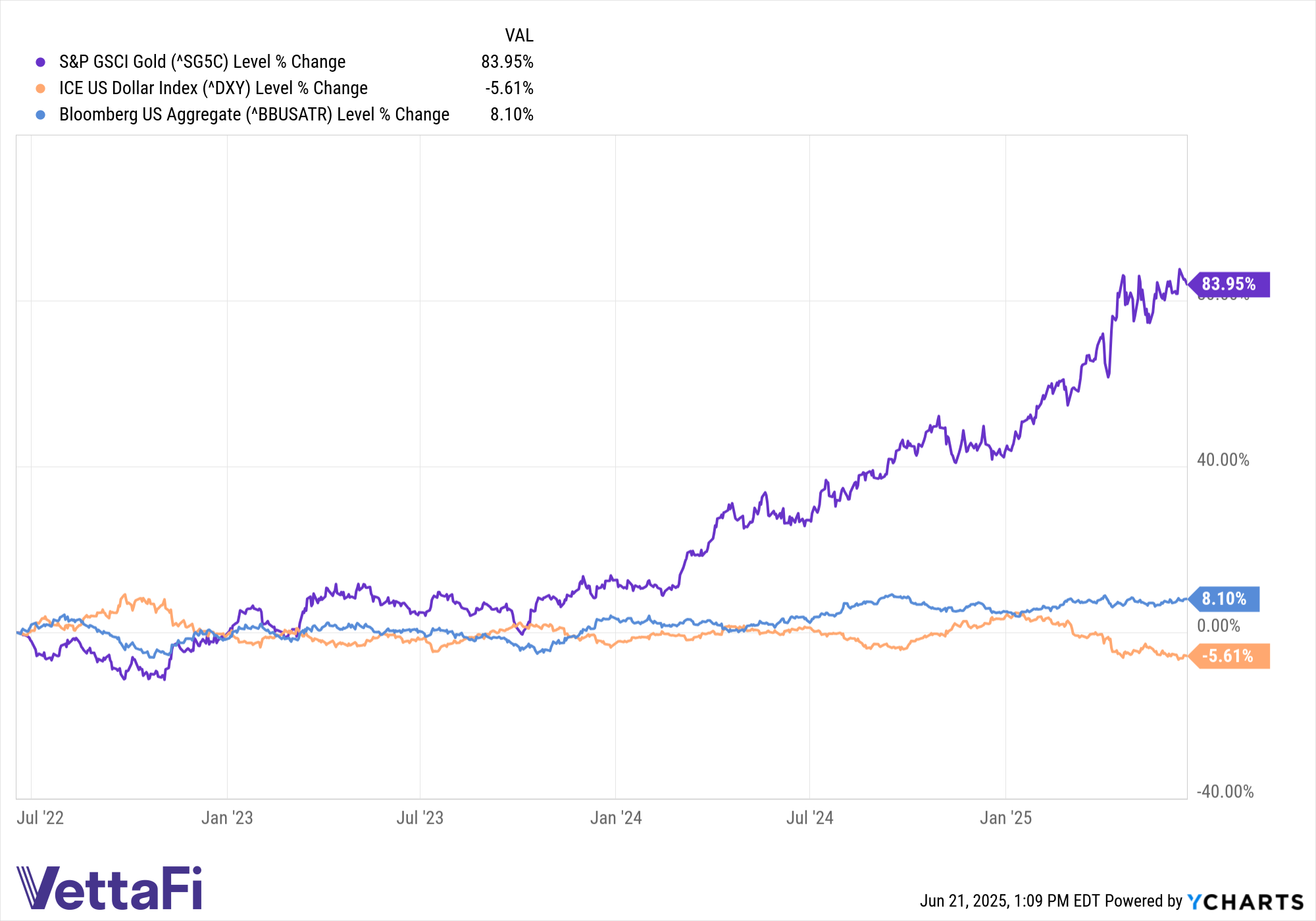
Source: YCharts, as of 6/21/25. S&P GSCI Gold Index tracks the performance of gold futures, serving as a benchmark for gold investment exposure. ICE U.S. Dollar Index (USDX) tracks the value of the U.S. dollar relative to a basket of six major world currencies. Bloomberg U.S. Aggregate Bond Index tracks the performance of U.S. investment-grade bonds.
Where to Get Gold Exposure
Investors fearing missing out on gold’s rally don’t have to go out and purchase bars of gold bullion, then safely figure out a safe way to store it. They certainly can, but there’s an alternative: the Sprott Physical Gold Trust (PHYS).
The fund offers investors easy ingress to pure-play gold exposure without having to store physical gold. But doesn’t PHYS mean physical? This is where PHYS adds a degree of flexibility by allowing investors to convert their fund shares into physical bullion. With PHYS, investors may opt to avoid the logistics of storing gold. However, for those looking for a more tangible investment experience, PHYS offers that flexibility to hold physical gold by converting their shares.
For those looking for a more indirect play to gold prices, Sprott Gold Miners ETF (SGMD) may be ideal. Greater demand for the precious metal can typically translate to bullishness for ancillary services in the gold industry, like mining. This is where SGDM provides that level of indirect exposure.
As opposed to investing in individual mining stocks, SGDM adds broad-based exposure to miners all in the convenience of an ETF wrapper. In turn, that eschews the concentration risk inherent in shares of single companies.
Large-Cap Tilt
SGDM’s tracking of the Solactive Gold Miners Custom Factors Index means it’s exposed to the performance of large-cap gold companies that trade on Canadian and U.S. exchanges. The large-cap tilt may give investors exposure to relatively more established gold mining companies as opposed to those with potentially higher volatility, often associated with small- and micro-cap companies.
“Bullishness” is the expectation that prices are rising and will continue to do so.
For more news, information, and analysis, visit the Gold/Silver/Critical Minerals Content Hub.
An investor should consider the investment objectives, risks, charges, and expenses of each fund carefully before investing. To obtain a fund’s Prospectus, which contains this and other information, contact your financial professional, call 1.888.622.1813 or visit SprottETFs.com. Read the Prospectus carefully before investing.
Sprott Physical Gold Trust (the “Trust”) is a closed-end fund established under the laws of the Province of Ontario in Canada. The Trust is available to U.S. investors by way of a listing on the NYSE Arca pursuant to the U.S. Securities Exchange Act of 1934. The Trust is not registered as an investment company under the U.S. Investment Company Act of 1940. The Trust is generally exposed to the multiple risks that have been identified and described in the prospectus. This material must be preceded or accompanied by the Trust’s prospectus.
Past performance is no guarantee of future results. One cannot invest directly in an index.
Funds that emphasize investments in small/mid-cap companies will generally experience greater price volatility. Diversification does not eliminate the risk of investment losses. ETFs are considered to have continuous liquidity because they allow an individual to trade throughout the day. A higher portfolio turnover rate may indicate higher transaction costs and may result in higher taxes when Fund shares are held in a taxable account. These costs, which are not reflected in annual fund operating expenses, affect the Fund’s performance.
Sprott Asset Management USA, Inc. is the Investment Adviser to the ETFs. ALPS Distributors, Inc. is the Distributor for the ETFs and is a registered broker-dealer and FINRA Member. ALPS Distributors, Inc. is not affiliated with Sprott Asset Management USA, Inc. or VettaFi.
Exchange Traded Funds (ETFs): SETM, LITP, URNM, URN, COPP, COPJ, NIKL, SGDM and SGDJ
Physical Bullion Funds: PHYS, PSLV, CEF, and SPPP