
Stock Market

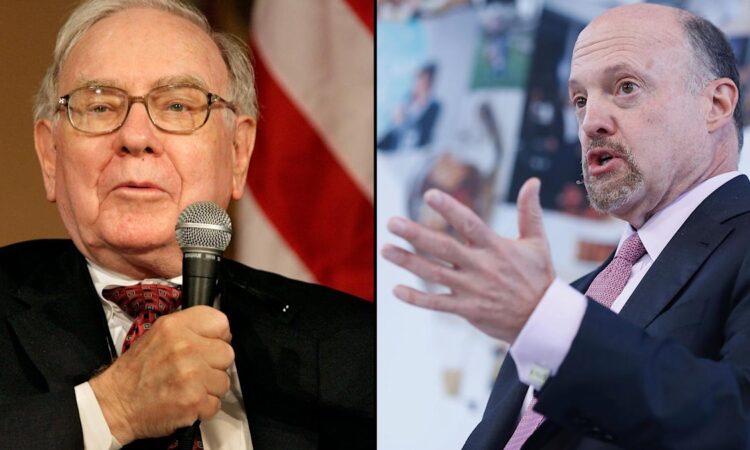
Jim Cramer says Warren Buffett is wrong about investors being addicted to ‘gambling’ — they’re addicted to the S&P 500

Moneywise and Yahoo Finance LLC may earn commission or revenue through links in the content below.

Warren Buffett sat in the audience at Berkshire Hathaway’s annual meeting in Omaha in early May — for the first time in six decades — and still managed to reframe an ongoing market argument.

Buffett, who announced his retirement as CEO of Berkshire Hathaway last year, told CNBC’s Becky Quick over lunch at the meeting that markets have never felt this speculative. “We’ve never had people in a more gambling mood than now,” he said (1).

Top Picks

But not everyone at CNBC agrees — like Jim Cramer, the host of Mad Money.

Cramer pushed back on X and argued that Buffett is pointing at the wrong behavior.

“We are addicted to S&P 500 buying no matter what,” Cramer wrote. “We have been taught to love ETFs no matter what kind. If individual stock investing hadn’t been so denigrated it would be less of a casino (2).”

Cramer’s point? Speculation isn’t just limited to gambling on individual stocks — it’s a growing issue across all levels of the market, including bets traditionally considered safe.

Buffett makes his case

Buffett compared today’s markets to “a church with a casino attached” and said the casino side has grown very crowded. According to Buffett, while more people remain in the church than the casino, the slots have gotten progressively more attractive.

He called out one-day options (also known as zero days to expiration or 0DTE) as an example of the problem. 0DTE are short‑term contracts bought and settled within a single trading session, which means someone can place a bet on a stock’s direction in the morning and collect or lose by market close.

Buffett explained that these aren’t really about owning a business or even making a thoughtful, longer‑term bet. They’re more like placing quick wagers on tiny price moves over just a few hours. “That’s not investing; it’s not speculating. It’s gambling, just totally,” he told Quick.

He also made an example of U.S. Army Master Sgt. Gannon Ken Van Dyke, who is accused of making $400,000 on a prediction market by betting on the success of the raid to capture Venezuelan President Nicolás Maduro, which he also participated in. Van Dyke was charged by the Department of Justice in April (3) and has pleaded not guilty.

Buffett’s point is that this shows what’s wrong with where market behavior has drifted. “And the quantity of those things is just incredible,” he said. “So we’ve never had people in a more gambling mood than now.”

Berkshire has responded to the current environment by accumulating cash rather than deploying it into stocks it considers overpriced. The company ended Q1 2026 with $397.4 billion in cash and Treasury bills (4).

Buffett believes the time to act is when markets are in panic, not when they’re elevated and speculative. “The most likely time to buy things is when nobody else will answer their phones,” he said.

He also said of the 60 years he’s been in business, only about five were “really juicy” with buying opportunities, and this isn’t one of them.

Read More: Here’s the average income of Americans by age in 2026. Are you falling behind?

Why Cramer’s counterargument lands differently

Cramer’s response on X doesn’t necessarily mean that markets are fine. It’s that the real gambling is happening inside the index funds (the products most Americans treat as the safe and responsible choice).

He argues that passive investing has become automatic. People pour money into S&P 500 ETFs month after month, regardless of whether the underlying prices make sense and regardless of what individual companies are worth. He argues that it’s a habit that could have consequences.

For example, according to Morningstar, the Vanguard S&P 500 ETF (VOO) alone drew in $143 billion in 2025, which was about 10% of every new dollar that went into U.S. ETFs last year (5). Instead of picking individual stocks, investors just throw money into these ETFs without knowing what they’re investing in.

The overall ETF industry pulled in $1.46 trillion, the highest annual total ever recorded, reported Morningstar. Investment Company Institute data also found that long-term index funds took in more than $109 billion in February 2026 alone, three times more than the $34.68 billion in active funds that same month (6). And a lot of that cash is chasing the same handful of big index funds, which means they just keep buying the same big stocks over and over.

The top 10 holdings in the S&P 500 now represent nearly 41% of the entire index (7). So when someone buys a standard S&P 500 fund thinking they’re getting broad diversification, they’re really just making a heavily weighted bet on a handful of big tech companies — whether they realize it or not.

Cramer’s broader point is that denigrating individual stock picking pushed investors into indexes, which concentrated money in a handful of mega‑caps, so the index started acting more like a bet on those few giants than on the whole market.

What this means for your money

Buffett and Cramer are diagnosing different patients. Buffett’s concern on zero-day options, prediction markets and meme-stock squeezes is real, but it mostly applies to a specific kind of investor who is actively seeking out short-term trades and wins. The average person contributing to a 401(k) isn’t trading 0DTE contracts.

Cramer’s concern, on the other hand, is that if you hold a standard S&P 500 index fund, you already have a portfolio where technology stocks make up roughly 30% of your equity exposure — a concentration that Artisan Partners’ research compared to conditions last seen during the dot-com bubble (8). Buying the same ETF every month without ever examining what you own or what you’re paying per dollar of earnings isn’t exactly the low-risk move the label implies.

That doesn’t mean you should ditch index funds. Buffett has spent years saying the S&P 500 is the right vehicle for most individual investors, and that advice hasn’t changed.

The question Cramer is raising is whether years of being told to “just buy the index” has created a different kind of unexamined risk, one hidden inside the most conventional advice in personal finance.

How to go beyond big tech

If you’d rather not bet the lion’s share of your holdings on big tech, you may want to diversify your portfolio with tangible, alternative assets that have low correlation to traditional markets and can provide a hedge against inflation. After all, if Buffett and Cramer are right, the stock market as a whole could be in for trouble.

A coordinated drop could sink portfolios relying solely on the traditional split of 60% stocks and 40% bonds.

Here are three assets worth considering.

Go for the gold

Many consider gold a more secure place to invest and protect their wealth than traditional assets, as the precious metal has proven its resilience during times of financial and geopolitical instability.

Consider the yellow metal’s performance during the Great Recession. According to the Bureau of Labor Statistics, the producer price index for gold rose 2.6% in 2008 and 12.8% in 2009 (9). In contrast, the benchmark S&P 500 index fell 57% from its October 2007 peak to its trough in March 2009 (10). Gold also had a banner year in 2025, and is still up about 40% year-over-year in 2026 (11).

If you’re curious about adding precious metals to your broader inflation-hedging strategy, a gold IRA from Goldco lets you hold physical gold and other metals while still getting the tax advantages of an IRA.

Goldco is widely regarded as one of the leading companies in the space, with a 4.8/5 rating on Trustpilot and an A+ from the Better Business Bureau. They also offer a guaranteed buyback program, meaning they can potentially repurchase your metals at the highest price according to market value if you ever decide to sell.

If you want to explore whether precious metals could be a helpful hedge for your portfolio, download Goldco’s free gold and silver guide to see if it’s a good fit for you. Just keep in mind that gold is often best used as just one tool in your toolbox for building a diversified, shock-proof portfolio.

Diversify like the ultrawealthy

While overpriced traditional assets tend to pique interest in nontraditional investments like precious metals, there are other asset classes worth considering.

One such asset has posted positive returns over two decades, highlighting strong long-term investment potential. And with its moderate relationship with traditional financial markets, this alternative investment could help protect against inflation, especially amid market uncertainty. It’s also globally recognized, meaning that it has some insulation from dramatic shifts in the U.S. market confidence.

It’s also long been favored by the ultrarich as a resilient and lucrative addition to their portfolios. With an estimated value of over $2.5 trillion — projected to reach nearly $3.5 trillion by 2030 — it represents a massive asset class, according to Deloitte (12).

The asset in question? Fine art.

Until recently, this world was off-limits. Now, with Masterworks, you can buy fractional shares in multimillion-dollar works by icons like Banksy, Picasso and Basquiat. While art can be illiquid and typically requires a long-term hold, it offers unique portfolio diversification.

Masterworks has sold 27 artworks so far, yielding net annualized returns like 14.6%, 17.6% and 17.8%.

They recently acquired a work by Barbara Peyton and offered investment at $1.16M. Just 17 days later, Masterworks accepted a buyer’s offer of $1.5M — netting 22.9% back to investors.

Moneywise readers can get priority access to diversify with art: Skip the waitlist here.

Note that past performance is not indicative of future returns. Investing involves risk. See important Regulation A disclosures at Masterworks.com/cd.

Capitalize on real estate

Real estate is another tangible asset with a long history of adding stability to investors’ portfolios. According to the National Council of Real Estate Investment Fiduciaries, both residential and commercial real estate outperformed the S&P 500 over the 25-year period from 1996 to 2021 (13).

Today, you can tap into this market through real estate platforms like Arrived.

Backed by world-class investors, including Jeff Bezos, Arrived allows you to invest in shares of vacation and rental properties, earning a passive income stream without the extra work that comes with being a landlord of your own rental property.

To get started, simply browse through their selection of vetted properties, each picked for their potential appreciation and income generation. Once you choose a property, you can start investing with as little as $100, potentially earning monthly dividends.

Beyond single-family assets, multifamily and industrial rentals represent another excellent investment opportunity, as both have a strong outlook for 2026 (14).

Accredited investors can now tap into this opportunity through platforms such as Lightstone DIRECT, which gives accredited investors access to single-asset multifamily and industrial deals.

Lightstone DIRECT’s direct-to-investor model ensures a high degree of alignment between individual investors and a vertically integrated, institutional owner-operator — a sophisticated and streamlined option for individual investors looking to diversify into private-market real estate.

With Lightstone DIRECT, accredited individuals can access the same multifamily and industrial assets Lightstone pursues with its own capital, with minimum investments starting at $100,000.

You May Also Like

Join 250,000+ readers and get Moneywise’s best stories and exclusive interviews first — clear insights curated and delivered weekly. Subscribe now.

Article sources

We rely only on vetted sources and credible third-party reporting. For details, see our editorial ethics and guidelines.

CNBC(1), (4); @jimcramer/ X (2); U.S. Department of Justice (3); Morningstar (5); Investment Company Institute (6); Business Insider (7); Artisan Partners (8);Bureau of Labor Statistics (9); Federal Reserve History (10); APMEX (11); Deloitte (12); Investopedia (13); J.P. Morgan (14)

This article provides information only and should not be construed as advice. It is provided without warranty of any kind.


Source link

Leave a Response