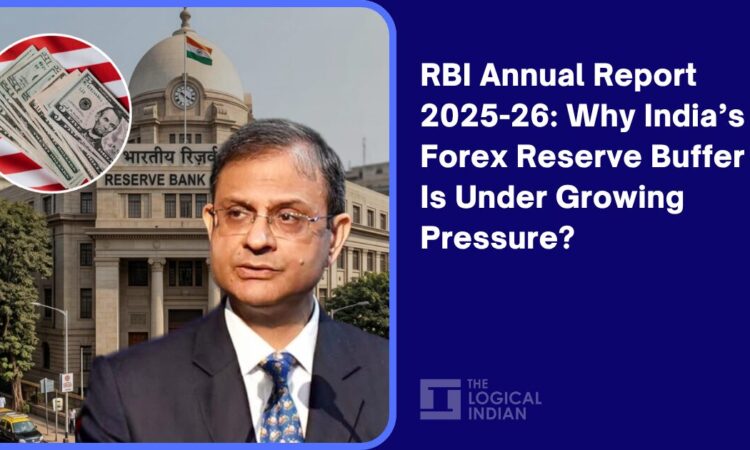
India’s foreign exchange reserves are once again in focus after the Reserve Bank of India’s latest annual report revealed both strength and stress inside the country’s financial system.
On paper, the numbers look reassuring. India still holds one of the world’s largest forex reserve piles. But underneath that headline is a more complicated story about rupee defence, rising gold dependence, volatile global markets and an RBI spending billions to stabilise the currency.
RBI Annual Report 2026
The RBI’s 2025-26 annual report showed that gains from foreign exchange transactions jumped 52% year-on-year to ₹1.69 trillion in FY26, compared to ₹1.11 trillion in FY25.
The surge came largely from RBI interventions in currency markets, where the central bank sold dollars to slow the rupee’s fall. The report also revealed that the RBI balance sheet expanded 20.61% to ₹91.97 trillion by March 2026.
India Forex Reserve Data
India’s foreign exchange reserves stood at $681.4 billion for the week ending May 22, 2026, according to RBI data. That marked a sharp weekly fall of $7.5 billion from $688.89 billion. The decline came as the central bank intensified efforts to support the rupee amid global oil price shocks and capital outflows.
The RBI annual report also highlighted a major shift in reserve composition. India’s gold holdings rose to 880.52 metric tonnes by March 2026.
More importantly, gold’s share in total reserves increased from 13.92% in September 2025 to nearly 16.7% by March 2026. Over 77% of these reserves are now stored domestically, compared to 59.2% a year earlier.
That matters because central banks globally are increasingly treating gold as a hedge against geopolitical uncertainty and dollar volatility.
RBI Rupee Defence Strategy
The RBI has spent much of FY26 defending the rupee from external shocks. The Indian currency weakened sharply after geopolitical tensions in West Asia pushed oil prices higher and triggered foreign investor exits.
At one point, the rupee touched a record low near 96.96 against the US dollar before RBI intervention helped stabilise it around the 95 mark.
Reuters reported that the RBI likely used state-run banks to sell dollars directly in currency markets. This strategy allows the central bank to reduce panic without appearing overly aggressive. But it comes at a cost. Continuous intervention can drain foreign currency assets over time if inflows do not recover.
Interestingly, the RBI also launched a $5 billion dollar-rupee swap auction in May 2026, which received bids worth nearly $9.8 billion. The strong response suggested banks still see confidence in India’s currency management framework despite rising volatility.
RBI Gold Reserves Rise
One of the biggest takeaways from the annual report is India’s growing reliance on gold reserves. The value of gold held by the RBI surged 64.1% in FY26 to ₹3.88 trillion from ₹2.37 trillion a year earlier. This was driven mainly by higher global gold prices.
At the same time, the Currency and Gold Revaluation Account jumped from ₹13.03 trillion to ₹21.69 trillion. That rise reflects both gold appreciation and changes in foreign exchange valuations.
The trend mirrors what many central banks are doing globally. Countries are reducing overdependence on dollar assets and increasing allocations toward gold to build long-term financial resilience. For India, this strategy also provides a buffer during periods when the rupee faces pressure from imported inflation and crude oil spikes.
RBI Dividend And Risks
The RBI’s forex operations also helped generate a record ₹2.87 trillion surplus transfer to the central government for FY26. That payout gives the government extra fiscal space ahead of major spending commitments and infrastructure expansion plans.
But economists warn that India cannot rely indefinitely on forex intervention alone. While reserves remain comfortable by global standards, sustained dollar selling during external crises can weaken reserve adequacy over time. The RBI itself noted risks from volatile energy prices, geopolitical conflicts and global financial tightening.
India’s reserves are still strong enough to cover around 11 months of merchandise imports, according to RBI Governor Sanjay Malhotra. Yet the latest data shows the central bank is walking a delicate line between protecting the rupee, managing inflation and preserving long-term reserve strength.
For now, India’s forex reserves remain a symbol of economic stability. But the FY26 report makes one thing clear: maintaining that stability is becoming more expensive in an increasingly unpredictable global economy.
The Logical Indian’s Perspective
India’s strong foreign exchange reserves continue to provide economic stability, but the RBI’s latest report shows that maintaining this buffer is becoming increasingly challenging amid global uncertainty.
Rising oil prices, geopolitical tensions and pressure on the rupee have forced the central bank to intervene more actively in currency markets.
At the same time, the RBI’s growing gold reserves reflect a broader global trend of reducing dependence on the US dollar. The developments highlight both India’s financial resilience and the long-term risks of an increasingly volatile global economy.
Also Read: India Could Soon Get Polymer Notes; RBI Revisits Decade-Old ‘Plastic Currency’ Plan