
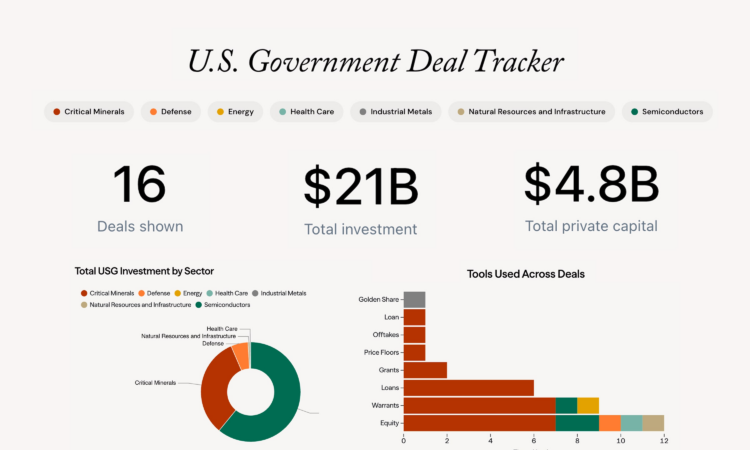
Warrants are becoming another preferred tool with flexible terms. They allow the U.S. government to buy shares at a set price within a defined timeframe. For example, the Department of Defense has a ten-year call option to acquire an additional 3.75 percent of Trilogy Metals for just $0.01 a share, with another portion of the warrant conditional on construction of the Ambler Road project, which will facilitate access to the company’s mines in Alaska. In its deal with the nuclear power company Westinghouse, the U.S. government insisted on the ability to force the company to launch an initial public offering if it is valued above $30 billion, and it secured a five-year option to buy 20 percent of the firm at a $17.5 billion discount. Warrants have also been mentioned in announcements for Korea Zinc, ReElement, and Vulcan.
The U.S. government is also working with a range of partners and has mobilized an additional $4.75 billion in investment. Private co-investors include J.P. Morgan, Goldman Sachs, and others. Foreign partners have also begun participating in deals. The Emirati sovereign wealth fund ADQ contributed to minerals deals, and Japanese investors have contributed to energy-related ones. Now that foreign partners have pledged to invest trillions of dollars in the United States as part of their trade negotiations, their participation in U.S. government equity deals is likely to expand.
As the number of new deals increases, U.S. officials may have to devote more time to managing existing ones to ensure that companies are progressing toward agreed-upon milestones. U.S. officials will have to decide whether and how to exercise the range of shareholder rights the government has secured, from not at all to agreeing to vote with management to retaining the right to vote independently. Several deals have milestones slated for 2028 that will be important to monitor. These include opening USA Rare Earth’s facilities to produce heavy rare earths previously dominated by China; testing XLight’s prototype for extreme ultraviolet lithography used in advanced semiconductor production; and scaling MP Materials’ mine-to-magnet facility, the only one of its kind in the United States.
Those deals are only the tip of the iceberg. The Department of Commerce is exploring ways to support the robotics, automation, and advanced manufacturing sectors. Congress has expanded the Development Finance Corporation’s investment ceiling from $60 billion to $205 billion and broadened its authority to take equity stakes. The Department of Defense is expanding its team of finance professionals to pursue deals in critical minerals, energy, global logistics, manufacturing, telecommunications, and other technologies.
In the months ahead, the tracker will be updated as more information becomes available, and CFR fellows will offer additional insights in accompanying articles. Stay tuned for more, and please contact us with relevant information and suggestions for improving the tracker.


