
Stock Market

Stock market today: Dow futures rise, Nasdaq futures sink after Broadcom earnings flop


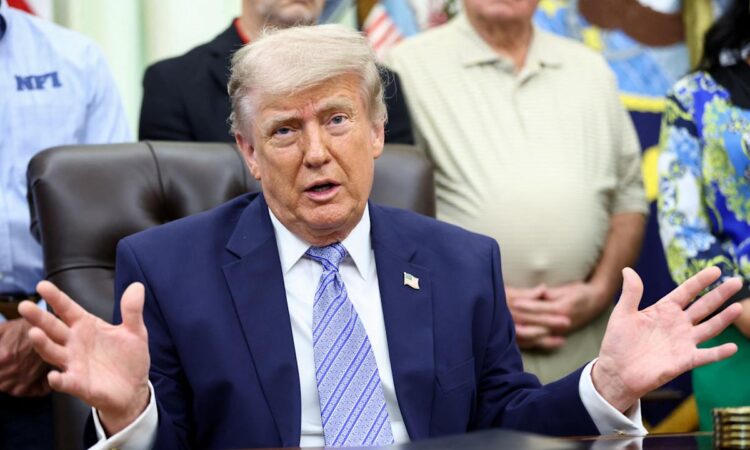
US stock futures were mixed early Thursday amid fresh doubts about President Trump’s ability to end the war with Iran and a potential shake-up to the booming AI trade.

Futures attached to the Dow Jones Industrial Average (YM=F) rose around 0.5%. Futures attached to the benchmark S&P 500 (ES=F) fell roughly 0.5%, while futures attached to the tech-heavy Nasdaq 100 (NQ=F) tumbled around 1.3%.

Broadcom (AVGO) shares sank in premarket trading after its AI chip forecast disappointed, raising questions about the strength of the broadly booming AI trade. Broadcom tumbled over 12%.

Meanwhile, on Wednesday evening, following the most serious escalation between the US and Iran since the April ceasefire took effect, the House of Representatives voted to end the war in a rebuke to Trump. Earlier in the day, stocks retreated from records, and oil rose as hopes for a quick Iran deal faded.

Elsewhere, SpaceX confirmed in a new filing that it plans a record-breaking $75 billion IPO, and Broadcom (AVGO) earnings disappointed investors on projected AI chip sales.

On Thursday, ahead of Friday’s May jobs report, Wall Street digests two additional readings on the labor market: weekly jobless claims from the Bureau of Labor Statistics and layoff data from outplacement firm Challenger, Gray & Christmas.

Finally, earnings season continues to wrap up with Ciena Corporation (CIEN), Lululemon Athletica (LULU), and DocuSign (DOCU) set to report their results on Thursday.

LIVE 2 updates

  • SpaceX confirms it will seek $75 billion in record IPO

    In a filing on Wednesday, SpaceX (SPAX.PVT) confirmed it’s seeking to raise $75 billion from its initial public offering, a record amount for any IPO.

    Yahoo Finance’s Pras Subramanian reports:

    In the filing, the company said it would offer 555,555,555 shares at $135 each, raising $75 billion. That would amount to 4.2% of the entire float, with the remaining 95.8% held by CEO Elon Musk and other insiders. SpaceX authorized the underwriters to sell additional shares if needed, bringing the total raised to $85.7 billion.

    At that share price, it would give SpaceX a hypothetical market cap of around $1.785 trillion.

    SpaceX plans to use the proceeds for purposes “including the expansion of our AI compute infrastructure, enhancements to our launch infrastructure and launch vehicles, increases in the scale and capacity of our satellite constellations, and any remaining amounts for general corporate purposes.”

    Read more here.

  • Oil prices drop after Isreal agrees to pull back from attacks in Lebanon

    Bloomberg reports:

    Oil slipped after three days of gains after the US said Israel and Lebanon agreed to a ceasefire, which would remove a key sticking point in talks between Washington and Tehran.

    West Texas Intermediate (CL=F) fell toward $95 a barrel, after rising almost 10% in the week’s first three sessions, while Brent (BZ=F) settled near $98 on Wednesday. “The ceasefire is contingent on a complete cessation of Hizbollah fire and the evacuation of all Hizbollah operatives from the South Litani Sector,” the US State Department said.

    While the US and Iran have agreed on a rough framework to extend their truce by two months and reopen the Strait of Hormuz, negotiations over the final details are dragging on, even as the two sides stepped up strikes. “No tangible progress has been achieved” in talks with Washington and Tehran is prepared to target objectives inside Israel if its attacks on Beirut continue, the semi-official Tasnim news agency reported the Islamic Republic’s foreign minister as saying.

    Oil has erased last week’s drop as a flare-up in clashes evaporated optimism over a deal to extend the current ceasefire, and potentially see flows resume through the strait. As talks drag on, the world’s supply cushion is rapidly running out – with US government data on Wednesday showing crude stocks at Cushing, Oklahoma, the delivery point for WTI, fell for a sixth week to near what is known as a minimum operating level.

    Read more here.


Source link

Leave a Response