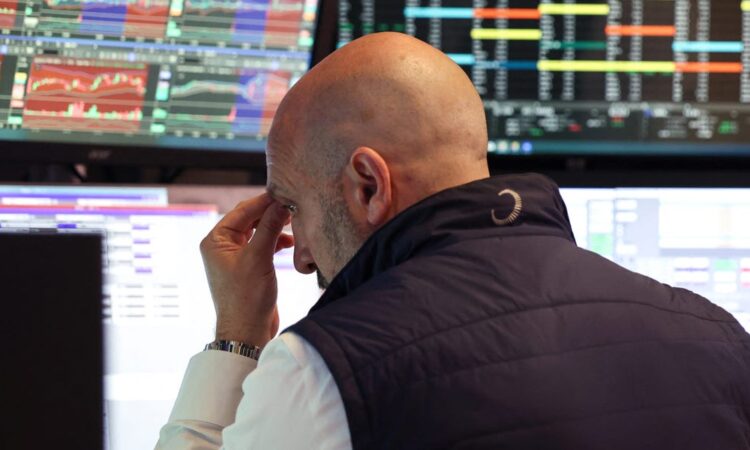
As a full-time trader, Erik Smolinski is always watching the markets. Lately, he says, conditions have become especially interesting.
“It’s actually really anomalous where the market is right now,” Smolinski, who started trading in 2007 and consistently beats the S&P 500, told Business Insider.
Stocks have been on a record-setting run lately, with investors shrugging off the Iran war while stellar earnings fuel unbridled bullishness. At the same time, the interest-rate backdrop has become more complicated, as investors weigh whether the Federal Reserve will need to keep rates higher for longer — or even raise them — if inflation pressures persist.
Smolinski said that the combination makes the current market unusual. It is not, in his view, a reason for investors to panic, but it’s a reason to pay attention and potentially make some changes.
His advice for everyday investors: Don’t make emotional decisions just because stocks are near highs, but do review what you own.
Don’t panic-sell because stocks are at records
“The market is hovering right around all-time highs, and the train is never late,” Smolinski said. “I will happily beat this horse to death: The market spends most of its time here.”
It’s natural for investors to get nervous when stocks are near records, he said, adding that it can be tempting to hedge portfolios, reduce exposure, or avoid risk altogether in anticipation of a pullback. In his view, that’s the wrong mindset for long-term investors, since owning stocks generally means accepting risk in exchange for the possibility of higher returns.
“Realistically, most people are spending time in equity markets actually looking for risks,” he said. “It’s how you make money. If you get too hesitant on risk, it’s kind of like, what are you doing here? This isn’t the party for you.”
Smolinski’s overarching point: All-time highs alone are not a reason to sell.
“Don’t start overreacting because the pundits are going to be out in force talking about how the market is going to collapse,” he said.
Bond yields are the signal to watch
While investors shouldn’t make rash decisions about their money, they shouldn’t be complacent about their current setup either. After all, “the market is in a weird place,” Smolinski said.
The signal he’s watching most closely is coming from the bond market, but not simply because the 10-year Treasury yield is approaching a particular round number.
He said he cares more about the speed of the move in yields than the level itself.
“A slow grind toward 5% on strong growth is a completely different animal than a fast, disorderly spike. A 40-to-50-basis-point move in a couple of weeks tells me far more than the round number does. That kind of velocity is what tends to break equities.”
He is also watching real yields, which adjust for inflation, rather than just nominal yields. In his view, a 5% 10-year Treasury yield means something very different when inflation is 2% compared to when it’s at 4%.
“When the 10-year real yield pushes toward the top of its post-2022 range, that’s when bonds start genuinely competing with stocks for capital,” he said, adding that he also tries to understand what’s driving yields higher. “A selloff because growth is hot is one thing. A selloff driven by inflation re-accelerating, or by worries about supply and the deficit, is the one that historically gets ugly for risk assets.”
At the time of the interview, Smolinski said the bond market was also signaling that investors should not assume rates will move lower smoothly. He pointed to the CME FedWatch Tool, which tracks market-implied expectations for Federal Reserve interest-rate moves, as one way investors can externally validate what the market is pricing in.
Smolinski is adamant about investors verifying market claims for themselves, rather than relying solely on commentators: “My biggest recommendation to everybody is: Don’t listen to anybody. If you can’t externally validate it, ignore it.”
At the time of the interview, he said the bond market was pricing in the possibility of a rate hike next year — not a cut. Smolinski said the setup is notable because stocks are near highs while rate expectations have become less favorable.
“We’re at all-time highs with, I don’t want to call it extreme leverage, but compared to historic precedent, extreme leverage,” he said. “That isn’t necessarily a recipe for completely smooth sailing.”
Review what you own
While investors shouldn’t be making any dramatic moves — “it’s not necessarily a time to go dump everything and go buy gold,” Smolinski said — what they can do is review their portfolios.
Make sure you’re comfortable with what you own if the rate environment becomes more challenging, he advised.
For regular investors, that could mean checking whether their portfolios are too concentrated in a single stock, sector, or theme and ensuring they understand why they own each investment. You can also confirm that your asset allocation still aligns with your time horizon and risk tolerance.
It’s not about predicting exactly what the Fed or the market will do next, he emphasized. The important thing is to understand what you own well enough to hold onto it if conditions change.
The bottom line is that record highs are not a reason to run for the exits, but it is a good time to make sure your portfolio still makes sense.