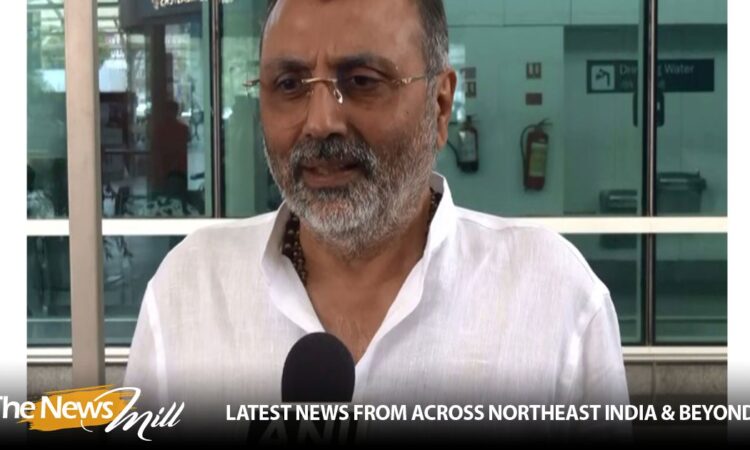
BJP Lok Sabha MP Nishikant Dubey criticised the Congress party on June 7 for India’s economic decisions that linked its fate to the US dollar. Speaking in Patna, Bihar, Dubey accused Congress leaders of repeatedly raising concerns about the rupee’s value and the country’s economy.
“What is the biggest topic of discussion in this country? Every day there is a debate that the dollar’s value is rising, or it is falling, the economy is collapsing, and that this is a ‘Banana Republic.’ These are the kinds of things that Rahul Gandhi or the Congress opposition keep saying. The things I have said today are worth knowing for this country: why did our dependence on the dollar finally come about? What is the relationship between the dollar and the rupee?” he said.
Referring to the Bretton Woods Agreement, Dubey explained that Britain sought America’s support during the Second World War and signed the agreement in 1945. He alleged that after Independence, the Indian government led by Prime Minister Jawaharlal Nehru signed the agreement in 1949.
“When these matters came to Nehruji in the independent Indian government, he signed the Bretton Woods Agreement in 1949. That continued; we used to trade in pounds, rubles, yen, and other currencies of the world. With Pakistan, we traded in rupees; Bangladesh was a part of Pakistan at that time, but we traded with Nepal, and our currency even circulated in Nepal. However, for the balance of payments or for import-export, we finally signed under the Bretton Woods system in 1949,” he stated.
Dubey added that in 1962 the requirement for gold to back US dollars was removed, which changed the global monetary system, and alleged that India’s leadership then had signed decisions under international pressure.
“In 1962, it was decided that for the dollars they printed, the collateral–the gold that had to be provided–would no longer be required. If no gold is required, then print as many dollars as you want. After this, the government was so weak–because Nehruji needed support during the China war, they attacked Tibet at America’s behest–that they signed the agreement,” he said.
Regarding former Prime Minister Indira Gandhi, Dubey accused her of devaluing the Indian rupee by 37 per cent against the US dollar on June 6, 1966, calling it unprecedented in global history. He also claimed that although the Bretton Woods system ended in 1971, the Congress government continued policies that deepened India’s dependence on the dollar.
“When Indiraji became Prime Minister, she devalued the rupee against the dollar on June 6, 1966. A 37 per cent devaluation; in the history of the entire world, no country has ever carried out such a massive devaluation. By 1971, Bretton Woods ended because the whole world realised that there was no accountability for how your dollars were being printed, so how could we trust it? Bretton Woods ended in 1971, but Indiraji continued with it,” Dubey added.
The BJP MP also asserted that India entered into agreements with the United States due to economic needs.
“On June 7, 1974, because we needed wheat from America, as well as loans, goods, and dollars–since America had influence in the World Bank and the IMF–she signed a document of slavery. And I feel that the Congress should answer why they finally made a fool of this country and why they tied India’s fate to the dollar,” he said.