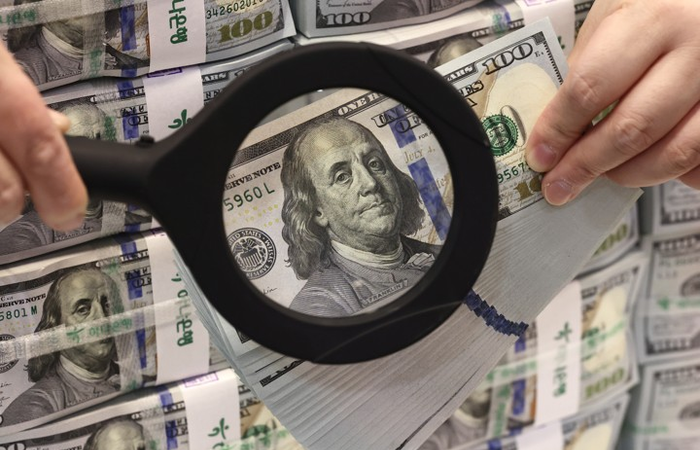

The South Korean won has weakened beyond 1,560 won per U.S. dollar, reaching its highest level since the aftermath of the Asian financial crisis.
According to the Seoul foreign exchange market on Sunday, the won-dollar exchange rate climbed as high as 1,561.5 won during overnight trading on Saturday. This marks the highest level since March 2009, during the global financial crisis.
The average exchange rate in the second quarter has also reached its highest level since the Asian financial crisis.
Data from the Bank of Korea showed that the average won-dollar exchange rate from the start of the second quarter through June 5 was 1,490.98 won, the highest quarterly average since the first quarter of 1998.
At airport exchange counters, dollar cash rates have already surpassed 1,600 won. Hana Bank‘s quoted rate at airport branches stood at 1,624 won per dollar on Saturday.
Market participants noted that the recent depreciation of the won cannot be explained solely by the strengthening of the U.S. dollar.
The decline in the won’s value has significantly exceeded movements in other major Asian currencies, including the Japanese yen, down 0.65 percent, the offshore Chinese yuan, down 0.38 percent, and the Taiwan dollar, down 0.55 percent.
It has also underperformed several emerging-market currencies, including Indonesia‘s rupiah, down 0.87 percent, Chile’s peso, down 2.71 percent, and Thailand‘s baht, down 1.1 percent.
Other currencies, including the British pound, Swiss franc, euro, Canadian dollar, Swedish krona, Turkish lira, Malaysian ringgit and South African rand, also posted smaller declines than the won.
Market participants largely attribute the currency‘s weakness to heavy foreign selling of Korean equities.
Foreign investors have sold more than 118 trillion won worth of Kospi-listed stocks this year. Analysts said profit-taking following a sharp Kospi rally, coupled with renewed expectations of higher U.S. interest rates, has increased demand for dollars as investors sell local shares and repatriate funds.
Foreign investors sold more than 44 trillion won worth of Korean stocks in May alone and have continued to reduce holdings this month.
Another concern is that dollar inflows from Korea‘s record current account surplus have failed to offset upward pressure on the exchange rate.
Exporters expecting further gains in the dollar have delayed converting export proceeds into won, while rising volatility in the offshore non-deliverable forward market has added to pressure on the currency.
Authorities have repeatedly warned against excessive market moves, but the impact has been limited.
Koo Yun-cheol, deputy prime minister and minister of economy and finance, recently said the government would take “immediate action” if one-sided market moves became excessive. The won continued to weaken after the remarks.
Analysts remain divided on the outlook.
Some said the exchange rate could rise toward the 1,590 level reached during the global financial crisis if foreign selling persists, noting overseas investors still hold substantial positions in Korean equities.
Others argued the current level is excessive given Korea‘s economic fundamentals, including a large current account surplus and the possibility of further interest-rate increases by the Bank of Korea. They said the won could recover to the mid-1,400 range if foreign flows stabilize and Middle East tensions ease.
Market participants warned that a prolonged period of currency weakness would raise import costs, fuel inflation and add pressure on low-income households and domestically focused businesses.
By Bahng Young-douk and Chang Iou-chung
[ⓒ Pulse by Maeil Business News Korea & mk.co.kr, All rights reserved]