
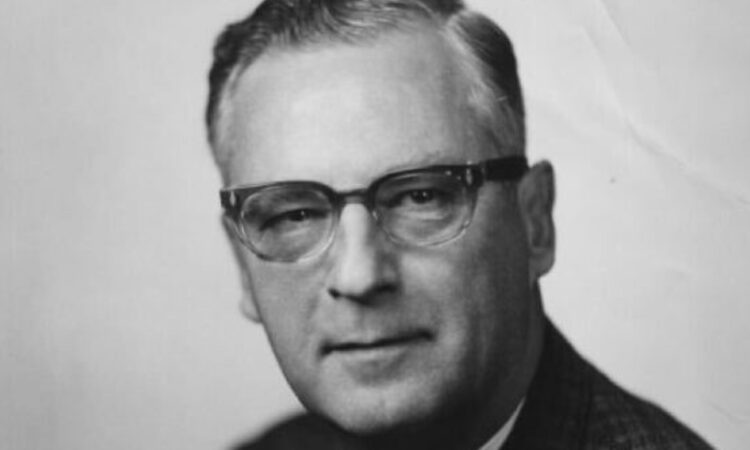


The eldest daughter and son-in-law of the small-town Arkansas man who played a pivotal role in getting “In God We Trust” on U.S. paper currency more than 70 years ago reflected on their late father’s legacy of obedience to God’s prompting.
“It’s so exciting, because I can really see God work; and looking back on it now, I see God’s plan for it to happen all through my dad’s life, […] to know the right people at the right time in the right place to do it,” Alice Rothert Nelson told Billy Hallowell following The Christian Post’s recent reporting on the story of her father, Matthew Rothert Sr.
“It’s a wonderful story, and Daddy gave God all the credit. He didn’t take any credit, he just said, ‘I’m in the right place at the right time, and my Dad’s using me,'” she said.
Matthew Rothert Sr., born 1904, was a furniture manufacturer and avid coin collector living in Camden, Arkansas, who was passing the offering plate at church on June 21, 1953, when he believed the Holy Spirit moved him to lobby for getting “In God We Trust” on paper money.
What began as a private moment at the historic Fourth Presbyterian Church in Chicago, where he happened to be visiting that summer for an annual furniture show, became a nationwide effort involving determination, thousands of hand-typed letters, key relationships, persistent faith and what the family believes was God’s providential hand at every step.
Nelson explained that the fact the idea came to her father in the sanctuary where he was married further convinced him that it was a personal and God-given assignment.
“When he’d go back, he would go to that church, and the offering plate was being passed, and he felt God say, ‘Matt, you know, the coins have ‘In God We Trust’ on them, but the bills don’t.’ And it was just such a special church for my dad, that he really knew it was God speaking to him through His Spirit,” she said.

Rothert was able to accomplish God’s will for him through the many relationships he had developed over his years as a businessman in Arkansas, said Nelson’s husband, Jim, who noted Arkansas at the time was “a small state [where] everyone knew each other.”
Rothert’s role as founder and president of the Camden Furniture Company positioned him to befriend Mike Monroney, a U.S. senator from Oklahoma who was also in the furniture business. Also among his friends were Oren Harris in the U.S. House of Representatives, as well as Arkansas Senators John L. McClellan and J. William Fulbright.
All of them played key political roles in helping realize Rothert’s vision, which he persistently pushed for by giving speeches, rallying support and sending thousands of letters to public officials, organizations and other individuals.
“Every step of the way, he had a contact that wanted to help him,” Jim Nelson said of his father-in-law. “We just give the Lord the credit for setting all that up. And it was built on a relationship that he had with these people long before he came to them for help, so they trusted him. They wanted to be a part of helping him, and he was very proud of this.”
After Rothert began his initiative in earnest during the fall of 1953, a bill to put “In God We Trust” on the paper currency was on President Dwight D. Eisenhower’s desk by July 1955, following unusually swift and bipartisan action. Congress unanimously established the phrase as the national motto the next year.

Alice Nelson, who was a junior in high school when her father’s efforts finally succeeded, said she and her family were “all very excited” when Congress passed the legislation.
“It was just God’s timing, and God was in control. God knew it was going to happen. It was just amazing,” she said. “But Mama did write all the letters, and we all supported Daddy, and prayed every day about it.”
During a previous interview with CP, the Nelsons joined Rothert’s other two living children in noting that their father was dismayed before his death in 1989 that Americans appeared to be drifting from living up to their motto of trusting in God. Speaking to Hallowell, Jim and Alice echoed their assessment that he would be “concerned” and “disappointed” at the present state of the country, though Alice said he would “still be praying for it.”
Alice concluded by reading a hand-written prayer she found in her father’s billfold after he died, which she believes epitomizes his life: “I am a place that God shines through, for He and I are one, not two. I need not fret, nor will, nor plan; He needs me where and as I am. If I just stay relaxed and free, He’ll carry out His plan through me.”
Jon Brown is a reporter for The Christian Post. Send news tips to jon.brown@christianpost.com


