
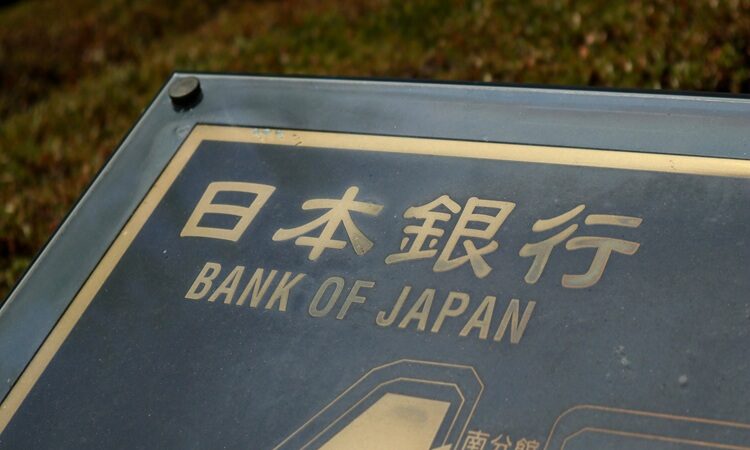
Einstein famously remarked that a sign of insanity was repeating the same experiment and expecting a different result. If ever this statement had salience, it has to be in the field of foreign exchange intervention to support a flailing currency. Despite all too many past cases, including its own, of foreign exchange intervention failing to provide anything more than temporary currency support, the Bank of Japan now has added its name yet again to the list of failed foreign exchange intervention experiments.
A key irritant in Japan’s trade relations with the United States has been its very weak currency. That weakness has been an important factor underlying Japan having one of the world’s largest external current account surpluses. It also been a factor in the US Treasury placing Japan on its “monitoring list” as a major trading partner that potentially has unfair macroeconomic and exchange rate practices. This has been particularly the case at a time when Japan’s currency exceeded a 40 year low of 160 Japanese yen to the dollar making it at least 15-20 percent undervalued with respect to the dollar.
Over the past two months, with the endorsement of US Treasury Secretary Scott Bessent, Japan’s Ministry of Finance has engaged in large scale foreign exchange intervention to the tune of $70 billion to prop up the currency. Yet, unsurprisingly, this intervention has failed to move the needle very much. After briefly rallying to 156 yen to the dollar, the yen has again slumped to over 161 to the dollar. At the same time, long-term Japanese bond yields have increased to decade-long highs as underlined by the 30-year Japanese bond yield approaching 4 percent.
Leaving aside relatively high energy import costs in the wake of the US-Iran war, there appear to be two main drivers of Japanese currency weakness. The first is a high-interest rate differential in favor of the US dollar that favors the Japanese carry trade. Whereas the Bank of Japan (BOJ) has its short-term rate at 1 percent, the Federal Reserve has its funds rate at 3.5 percent.
The second is Japan’s unsustainable public finances that limits the degree to which the Bank of Japan (BOJ) can raise interest rates to contain inflation. At 230 percent of GDP, Japan has the highest public debt ratio among the G-7 countries. With a government contemplating a supplementary budget at a time when it is already running a primary budget deficit (that is a budget deficit excluding interest payments), there is little prospect that Japan will reduce its public debt anytime soon.
Any serious effort to support the Japanese yen on a durable basis as well as to reduce the government’s long-term bond yields would be to put the country’s public finances on a sustainable basis that would restore investor confidence. In part, that could be done by having the government use some of its large asset holdings to pay down the debt. However, the heavy lifting to restore debt sustainability would need to be for the government to start generating primary budget surpluses. In turn, that would require the government to take measures to raise tax revenues and to reduce public spending.
A strengthening of Japan’s public finances would reduce the government’s long-term borrowing costs and provide the Bank of Japan the room to raise short term interest rates without stirring fear of a public debt spiral due to rising interest payments. Higher short-term interest rates in turn would reduce the interest rate differential in favor of the dollar, thereby encouraging the unwinding of the Japanese yen carry trade. The government might also give thought to funding the government increasingly at the short end of the curve with a view to increasing short term rates and flattening the interest rate curve.
All too many instances of public debt crises arising from unsustainable public finances would suggest that Japan has a clear choice. It can take remedial measures mow to restore order in its public finances and thereby avoid a government debt crisis down the road. Or it can be forced to take such measure by the onset of such a crisis. For Japan’s sake and for the sake of the rest of the world economy, we have to hope that the Japanese government has the foresight to take early action to put its public finances on a sustainable path.


