
The Proposed Baloch Currency and the Historic Link Between Money and Sovereignty: From Azad Hind to Swadhin Bangla
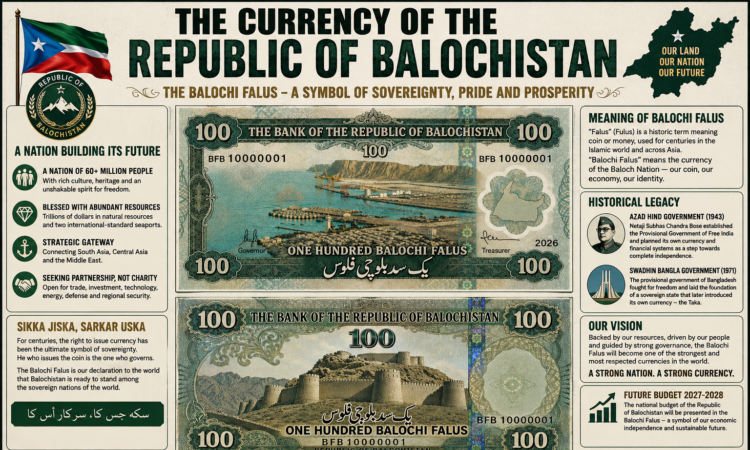

“Sikka Jiska, Sarkar Uska” — Why the Right to Issue Currency Has Long Been Seen as a Declaration of Statehood
By Suman Munshi, Chief Editor,
IBG NEWS International Affairs & Strategic Studies Desk
June 2026: A recent announcement by supporters of the proposed Republic of Balochistan regarding the development of a national currency, tentatively named the “Balochi Falus,” has reignited an important historical and geopolitical discussion: can the issuance of a currency serve as a declaration of sovereignty?
The statement, circulated by Baloch nationalist circles, argues that the foundations of statehood have already been established through the adoption of national symbols such as a flag, passport, anthem, institutions, and the proposed national currency. Advocates describe the future Balochi Falus as a symbol of economic independence, national identity, and sovereign authority.
While the proposal has generated considerable attention, it is important to note that the proposed Republic of Balochistan is not currently recognized as a sovereign state by the United Nations or the international community. Consequently, the proposed currency remains a political and symbolic initiative rather than a recognized legal tender in international finance.
The term “Balochi Falus” appears to be derived from the historical word “Falus” (فلوس / Fulus), which has deep roots in Middle Eastern, Persian, Arabic, and South Asian monetary history.
Meaning of “Falus”
The word Falus comes from the Arabic “Fulus” (فلوس), which originally referred to copper coins used in the early Islamic world.
Its linguistic origin can be traced further back to the Byzantine Greek word “Follis”, a copper coin used during the Byzantine Empire.
Over time:
- Fulus/Falus became a generic term for small-denomination currency or money.
- In modern Arabic, “fulus” is still commonly used colloquially to mean money, cash, or coins.
- In Persian, Urdu, Balochi, and several regional languages, the term has historically been associated with coinage and currency.
Historical Usage
Examples include:
- Abbasid Caliphate copper Fulus
- Ottoman Fulus
- Various Persian and Central Asian copper coin systems
- Medieval Islamic coinage across South Asia
Meaning of “Balochi Falus”
Literally, “Balochi Falus” can be interpreted as:
“The Baloch Coin” or “The Currency of the Baloch Nation.”
Symbolically, the proposed name seeks to connect a future Baloch national currency with the region’s historical and cultural heritage while emphasizing sovereignty and economic identity.
Historical Parallel
Just as:
- India adopted the Rupee
- Bangladesh adopted the Taka
- Pakistan retained the Pakistani Rupee
the proposed Balochi Falus is intended by its proponents to serve as a national monetary symbol representing a distinct Baloch political identity.
What Does “Balochi Falus” Mean?
The proposed “Balochi Falus” derives from the historical Arabic and Persian term Falus (or Fulus), traditionally used to describe copper coins and later money in general. The name literally means “Baloch Currency” or “Baloch Coin” and is intended to symbolize economic sovereignty, national identity, and the aspirations of the Baloch nationalist movement.
Yet history shows that currencies have often played a powerful role in independence movements and nation-building efforts.
“Sikka Jiska, Sarkar Uska”
Across South Asia, one political maxim has survived for centuries:
“Sikka Jiska, Sarkar Uska”
“He who issues the coin is the one who governs.”
This phrase emerged from the traditions of medieval and early modern statecraft across the Indian subcontinent. Historically, two acts were considered the ultimate symbols of sovereignty:
- Issuing currency in the ruler’s name.
- Having the ruler’s name proclaimed during the Friday Khutba (sermon).
For centuries, emperors, kings, sultans, nawabs, and independent rulers demonstrated their authority through coins bearing their names, titles, and emblems. Control over currency represented far more than economics—it signified control over taxation, trade, administration, law, and political power.
In many respects, the ability to mint currency was considered one of the most visible declarations that a government exercised sovereign authority.
Currency as a Declaration of Nationhood
Political scientists generally identify several attributes of statehood:
- A permanent population
- Defined territory
- Functioning government
- Capacity to conduct international relations
- National symbols including flags, passports, stamps, and currency
Among these symbols, currency occupies a unique position because it combines political legitimacy with economic authority.
Throughout history, revolutionary governments and liberation movements have frequently viewed the creation of a national currency as a declaration that they were not merely resistance movements, but governments-in-waiting.
The proposed Balochi Falus therefore belongs to a long historical tradition in which currency serves as an expression of national aspirations.
One of the most significant examples in Indian history was the Provisional Government of Free India (Azad Hind Government) established by Netaji Subhas Chandra Bose in October 1943.
Recognized by several countries during World War II, the Azad Hind Government sought to establish the institutional framework of an independent Indian state while fighting British colonial rule.
Among its initiatives were:
- Establishment of the Azad Hind Bank
- Plans for independent currency arrangements
- Government ministries
- Diplomatic representation
- Military administration through the Indian National Army (INA)
Although the Azad Hind Government controlled limited territory and its financial instruments saw restricted circulation, historians regard these efforts as important because they represented practical exercises in sovereignty rather than merely symbolic declarations.
Netaji understood that a government aspiring to independence needed institutions capable of exercising state authority—including monetary authority.
In this context, the proposed Balochi Falus echoes a historical pattern in which emerging political entities use currency as a symbol of their claim to nationhood.
A second and perhaps even more relevant example emerged during the Bangladesh Liberation War of 1971.
The Mujibnagar Government, popularly known as the Swadhin Bangla Government, functioned as the provisional government of Bangladesh while the liberation struggle against Pakistan was underway.
During the conflict, the government established:
- Administrative structures
- Diplomatic missions
- Financial systems
- Military command structures
Although Bangladesh did not immediately issue a separate wartime currency, the provisional government took several steps to demonstrate its sovereign identity and economic independence.
Following the victory of the Liberation War and the establishment of an independent Bangladesh, the newly formed state introduced the Bangladeshi Taka, replacing Pakistani monetary authority.
The adoption of a national currency became one of the most visible manifestations of Bangladesh’s sovereignty.
The lesson from 1971 is clear: successful state formation eventually requires monetary independence alongside political independence.
Historically, currencies have served four major functions beyond economics.
Political Legitimacy
A currency symbolizes the authority of a government to regulate economic activity and exercise sovereign power.
National Identity
Currencies often feature national heroes, historical events, cultural symbols, and state emblems that reinforce collective identity.
Economic Independence
Control over monetary policy enables governments to manage taxation, trade, inflation, and public finance.
International Recognition
A stable currency helps facilitate international trade and diplomacy, although recognition ultimately depends upon other states and international institutions.
Supporters of Baloch nationalism argue that the region possesses significant economic and geopolitical potential.
Balochistan contains substantial reserves of:
- Natural gas
- Copper
- Gold
- Rare earth minerals
- Other strategic resources
The region also hosts Gwadar Port, one of South Asia’s most strategically important maritime facilities and a key component of the China-Pakistan Economic Corridor (CPEC).
Because of its location at the crossroads of South Asia, Central Asia, and the Middle East, Balochistan occupies a position of considerable geopolitical importance.
These factors explain why developments involving Baloch political aspirations continue to attract international attention.
History also offers an important caution.
While designing a currency can be accomplished relatively quickly, building a stable monetary system requires:
- Effective governance
- Territorial control
- Functioning institutions
- Foreign exchange reserves
- Banking infrastructure
- Public confidence
- International recognition
Many revolutionary governments throughout history have issued symbolic currencies, but only a smaller number have succeeded in transforming those symbols into durable national monetary systems.
The success of a currency ultimately depends not on its design, but on the strength of the institutions that stand behind it.
The proposed Balochi Falus should therefore be understood primarily as a political statement and an expression of national aspiration.
History demonstrates that currencies have frequently accompanied struggles for self-determination. From Netaji Subhas Chandra Bose’s Azad Hind Government to the Swadhin Bangla Government that paved the way for Bangladesh’s independence, monetary symbols have often served as declarations of sovereign intent.
The famous maxim “Sikka Jiska, Sarkar Uska” continues to capture this enduring relationship between currency and power.
Yet history also teaches that while a coin may symbolize sovereignty, true statehood rests upon a broader foundation of governance, territory, institutions, economic stability, and international recognition.
Whether the proposed Balochi Falus remains a symbol of aspiration or evolves into the currency of a future sovereign state will ultimately depend on political realities far beyond the printing of banknotes or the minting of coins.
In the final analysis, currency may announce the ambition of a nation, but history determines whether that ambition becomes a state.
This news is based on the tweet made by Mr Yar Baloch as an analysis from academic interest
— IBG NEWS International Affairs & Strategic Studies Desk


