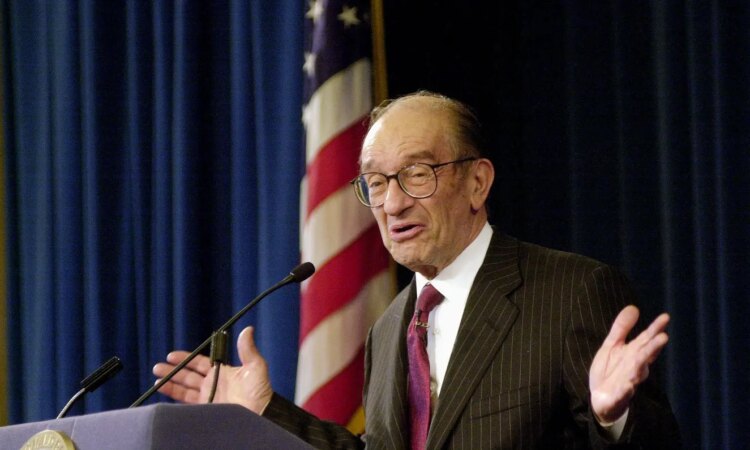
Alan Greenspan speaking at the Ronald Reagan Presidential Library and Museum in 2003.
Ringo H. W. Chiu/Getty Images
Alan Greenspan hasn’t set foot in Asia for years, but in 2026 his shadow is everywhere again.
Greenspan — the larger‑than‑life former Federal Reserve chairman — died Monday at 100. The timing is almost theatrical: two pillars of his 1990s Asia legacy are flaring back to life at once. Asian currencies are sliding under the weight of a resurgent dollar, and markets are whispering again about “irrational exuberance,” his most famous phrase.
It feels like a final cameo for the so‑called “Greenspan put” — the belief that his Fed, from 1987 to 2006, would always step in to steady markets. Nowhere did that idea carry more emotional and political charge than in emerging Asia, where Greenspan’s imprint is deepest and most tangled. And in 2026, it’s as if he’s reminding the region one last time that its markets still need defending.
Today’s rising dollar is fueling a sense of déjà vu. The Greenspan Fed had a real hand in precipitating Asia’s 1997 crisis. Between 1994 and 1995, it doubled short-term rates in just twelve months. The shock tipped Mexico into crisis, shuttered bond giant Kidder, Peabody & Co., and bankrupted Orange County, California. The dollar’s surge eventually made the currency pegs in Indonesia, South Korea, and Thailand untenable.
Those ghosts are stirring again. A suddenly hawkish Fed is fueling a dollar rally that’s battering the region. Expectations that Kevin Warsh’s arrival as Fed chair on May 22 meant rate cuts proved to be a head fake. Markets are pricing in at least one, perhaps two, rate hikes by year-end.
Asia is bracing for a fresh capital flight to the dollar. The Indonesian rupiah sits at an all-time low. Bangkok and Seoul are wrestling with weak currencies just as global oil prices climb. The Indian rupee recently hit a fresh record low. Tokyo has been intervening to defend the 161 line against the dollar, even as the yen flirts with 40-year lows.
Alongside King Dollar’s return, Asia is riding a ginormous AI-fueled equity boom. South Korea’s and Taiwan’s tech-heavy markets are up 96% and 56% year-to-date, respectively — gains driven by a strikingly narrow cluster of chipmakers. That narrowness is the risk.
If investors decide the frantic data center buildout has gone too far, or that AI monetization is further off than hoped, Korea and Taiwan are directly exposed — and today’s exuberance will look exactly as irrational as Greenspan once warned.
Even Japan’s Nikkei 225 Stock Average is riding the AI wave, up 33% this year. A number of Japanese companies supply the essential hardware, materials, and infrastructure needed for data centers. The benchmark recently topped 70,000 for the first time ever.
One red flag for Tokyo stocks: the broader economy is mired in stagflation. The Bank of Japan’s 2.8% year-on-year inflation rate runs 5.6 times ahead of this year’s expected 0.5% GDP growth. Yet the Nikkei is going gangbusters.
The irony cuts deep. When Greenspan coined “irrational exuberance” in 1996, he was looking through the lens of the Nikkei’s late-80s bubble. Now the Nikkei is blowing up again.
Amid so many imponderables, it’s tempting to ask what the “Maestro” would do — though his legacy offers cold comfort. Greenspan’s blunders were consequential: lobbying against derivatives regulation; championing the demolition of Depression-era firewalls between savings, commercial and investment banking; arguing in favor of massive cuts just after Washington had finally balanced its books. Only when Wall Street imploded in 2008 did he acknowledge, to Congress, that his worldview had flaws.
Yet, there are no wise elders to consult in 2026. Nobody has navigated a Middle East war, a tariff-obsessed White House torching the global trading order, and a machine-learning revolution rewriting the socioeconomic rulebook — simultaneously, in real time.
Greenspan, one suspects, might be appalled by Warsh’s early moves. Fed watchers sense Warsh may be about to dismantle the transparency doctrine – one Greenspan himself pioneered in the 1990s. That deliberate shift toward predictability – Greenspan’s “glasnost” – that replaced the opacity William Greider anatomized in his 1987 Volcker-era critique, “Secrets of the Temple.” Warsh may try to turn back that clock. Whether markets will thank him for it is another matter entirely.
In 2026, the only certainty is that the old playbook — Greenspan’s included — no longer exists.