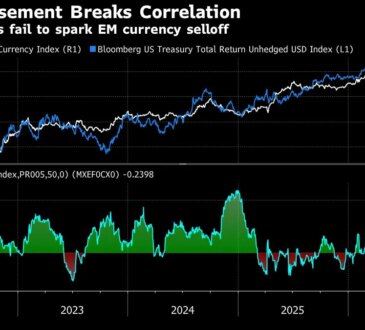
Currency dynamics also undermine the EU’s strategy of encouraging Chinese firms to localize production in Europe: Exporting from China becomes more attractive, and firms have lower incentives to convert RMB earnings into euros for European investments. Rhodium Group’s China Cross-Border Monitor shows subdued Chinese investment in Europe in Q2 and Q3 2025. Auto and EV investment has not increased following the imposition of EV duties. Instead, newly announced auto investment in the EU has fallen sharply—from a $15 billion peak in 2023 to $4.5 billion in 2024, and just $2 billion in Q1–Q3 2025.
Absent stronger trade protection measures, this trend complicates any discussion about conditioning FDI on job creation, IP sharing, or use of local supply chains, simply because there may be fewer investment projects to condition in the first place.
Europe’s options
The RMB is unlikely to strengthen considerably against the euro in the coming months, absent a series of hawkish signals from the US Federal Reserve that would suggest interest rate cuts are on hold. China has no interest in a brokered “Plaza Accord”-style exchange rate adjustment that would appreciate the currency, particularly when trying to combat domestic deflationary pressures. Persistent capital outflows from China would similarly undermine the sustainability of any negotiated currency adjustment. Even if Beijing wanted to hold the RMB “up” or reduce intervention in the foreign exchange market temporarily, the real exchange rate is likely to remain under pressure from weak consumer demand and overcapacity in China.
This leaves European policymakers in a difficult position, as there are no easy asks from Beijing. Continued RMB depreciation will undermine the effects of EU tariffs and trade defense measures. Non-tariff barriers and other technical controls, safeguards, and requirements become more attractive to limit the flood of Chinese exports. The EU may need to adapt its trade defense regime accordingly. After all, even without the PBOC intervening in the foreign exchange market to keep the currency weak, overcapacity and domestic deflationary pressures are inherently tied to China’s zombifying financial system and pervasive state intervention that has been at the heart of China’s political economy.
One option would be to incorporate a measure of China’s currency undervaluation into existing EU trade defense instruments. Anti-dumping investigations are already “currency proof,“ as they rely on “out-of-market” benchmarks (i.e., non-Chinese prices) to address domestic distortions. But the EU could, in principle, use the currency argument in future countervailing duties. The United States has already created a legal pathway to treat currency undervaluation as a countervailable subsidy in CVD cases via Commerce Department regulations that took effect in 2020. The EU could choose to pursue a similar approach. Even then, however, weaving currency dynamics into existing trade defense instruments would not solve a core limitation: They are not agile enough to adjust as exchange rates and domestic price levels move.
A more structural, though more controversial, approach would be to impose an across-the-board, unilateral tariff mechanism that adjusts with trends in China’s domestic prices (and potentially currency moves), effectively compensating for persistent RMB weakness. Although non-WTO compliant in itself, such action could be justified using GATT Article XV, which holds that members should not “frustrate” the intent of the agreement through exchange rate actions (and vice versa). That could be framed either as a basis for legal challenge or as part of the justification for measures taken outside the normal WTO trade-remedy toolbox, ideally in coordination with other major economies.
Both routes face serious technical and political hurdles. On the technical side, assessing currency undervaluation is inherently model-driven and sensitive to current account data and assumptions. Countries rely on the IMF’s assessment framework, and that framework itself relies on China’s official current account data from the State Administration of Foreign Exchange. That data appears understated in China based on improbable adjustments in interest income and less transparent methodologies of measuring goods trade relative to official Customs data. On the political side, the EU and the IMF have previously expressed concern about the US approach of using foreign currency undervaluation as a basis for CVD actions. The EU may also be cautious about elevating currency issues given its own trade surplus and the risk of drawing additional unwanted scrutiny from Washington.
A more realistic route would be to lean more heavily on instruments that are less sensitive to price and exchange rate swings, such as non-price criteria and resilience criteria in procurement—safeguards triggered by import volumes rather than values—and other technical or regulatory controls that limit import surges without relying primarily on price-based trade remedies. These instruments are already increasingly used by the EU Commission and will likely feature in the upcoming Industrial Accelerator Act. Local content requirements—planned for the auto sector and potentially others—could also be relatively immune to exchange rate fluctuations, depending on how they are designed (see our note Made in Europe 2025). To constrain China’s EV exports, the EU could mandate or tie fiscal incentives for corporate fleet purchases to local content thresholds. This would effectively shut China-based EV makers out of 60% of new car sales in the EU unless they produce and source locally. BYD, for example, sells roughly 89% of its vehicles in Germany into corporate fleets.
Barring an unlikely shift in China’s growth model, Europe should assume that Chinese goods will become even cheaper in euro terms over the next few years. A weak RMB, persistent deflation and excess capacity in China will keep undercutting EU producers and steadily erode the bite of conventional trade defense tools. That leaves European policymakers with hard choices: Either accept ever-growing exports from China and weaker incentives for localization, or move toward structural action that restricts trade.