There are thousands of crypto coins, from bitcoin and Ethereum to litecoin and solana. Just the sheer number of available cryptos can seem overwhelming when you’re new to investing.
Forbes Advisors developed cryptocurrency screens to show the best crypto to buy now if you’re looking for momentum as well as the top 10 cryptocurrencies with strong market caps and good project theses.
10 Best Cryptocurrencies To Invest In
We filtered cryptocurrencies by utility or store of value alongside other metrics, such as seven-day performance and 24-hour trading volume.
This selection of cryptocurrencies has market capitalizations greater than $5 billion. Cryptos with at least $5 billion in market cap are typically more stable with greater institutional adoption.
1. Bitcoin (BTC)
Market Cap: $1.175 trillion
7-Day Change: -5.86%
Price News: As of 8:50 a.m. ET, the price of bitcoin, or 1 BTC, traded at $58,586.58. Bitcoin’s highest 52-week intraday price was $126,198.07 on October 6, 2025.
BTC has risen from roughly $0.06 in July 2010 to around $58,586.58 as of June 30, 2026, with a staggering increase of 94,664,574%.
Bitcoin:
Created in 2009 by the pseudonymous Satoshi Nakamoto, bitcoin is the original and most recognized cryptocurrency.
The “OG” of crypto runs on a decentralized blockchain network. The network uses an energy-intensive, proof-of-work consensus system. On the network, miners validate transactions on the chain by solving complex puzzles. For each validated block, miners earn a reward of 3.125 BTC per block, currently worth $183,083.06.
The proof-of-work consensus model is often criticized for its carbon footprint. The U.S. Energy Information Administration estimates that crypto mining, which bitcoin uses, represents up to 2.3% of U.S. electricity consumption.
Pros:
- Viewed as a “digital gold” and a store of value.
- High liquidity and market stability relative to other coins.
Cons:
- High energy consumption due to the proof-of-work system.
- Slower transaction speed and higher fees compared to newer networks.
Market Dominance: 57.77%
2. Ethereum (ETH)
Market Cap: $188.06 billion
7-Day Change: -5.91%
Price News: Ethereum, or 1 Ethereum, traded at $1,558.31, as of 8:49 a.m. ET. The highest intraday price that Ethereum reached in the past year was $4,953.73 on August 24, 2025.
From $2.83 in August 2015 to about $1,558.31 as of June 30, 2026, ETH has grown by 54,907%.
Ethereum:
Ethereum harnesses a powerful blockchain platform for building decentralized applications, known as DApps. This crypto was the brainchild of Vitalik Buterin, created to apply blockchain technology to programmability.
So, how is Ethereum used in the programming world? Well, developers use Ethereum for smart contracts. These are self-executing agreements coded directly onto the blockchain. There are many use cases for DApps, as they can be applied to finance, supply chain management and more.
Ether is the native coin on the network. Developers use ETH to pay “gas” fees. These fees compensate network validators for their computational work in completing transactions and smart contracts.
Pros:
- Large developer ecosystem.
- A vast array of tokens and services use the Ethereum network.
Cons:
- Scaling challenges (a.k.a. large volumes of traffic can cause bottlenecks).
- High gas fees.
Market Dominance: 9.23%
3. BNB (BNB)
Market Cap: $73.40 billion
7-Day Change: -5.02%
Price News: BNB stood at $544.56 per coin as of 8:49 a.m. ET, with its annual high being $1,370.55 on October 13, 2025.
BNB has soared by 472,523% since CoinMarketCap started tracking it in 2017.
BNB: Originally launched to pay trading fees on the Binance exchange, BNB has grown into a utility token used for transactions, payments and DApps within the Binance ecosystem.
As an added perk, users can get a discount on trading fees when using BNB on a Binance crypto exchange. But there’s also a utility aspect. The token can be used to pay transaction fees on the BNB Smart Chain, which supports smart contracts and DApps.
Pros:
- Binance’s growing ecosystem.
- Ongoing quarterly coin burns to reduce supply.
Cons:
- High reliance on Binance’s success.
- Regulatory scrutiny of centralized exchanges.
Market Dominance: 3.60%
4. XRP (XRP)
Market Cap: $64.05 billion
7-Day Change: -6.55%
Price News: XRP’s price was $1.03 at 8:50 a.m. ET. Its highest point in the past year came on July 17, 2025, when it hit $3.65.
XRP hit $1.03 on June 30, 2026, up 17,419%.
XRP: XRP was created by Ripple Labs to facilitate fast and low-cost, cross-border payments. It acts as a bridge between currencies, enabling instant transfers with minimal fees.
Unlike bitcoin and other mined cryptos, XRP tokens enter circulation whenever Ripple chooses to sell coins. For that reason, there are concerns over the centralized nature that controls XRP’s supply.
Pros:
- Strong use cases in global finance.
- Backed by institutional partnerships.
Cons:
- Ripple co-founder Chris Larsen, worth $7.6 billion, owns a sizable portion of XRP.
- Centralization concerns due to Ripple’s control over XRP’s supply.
Market Dominance: 3.15%
5. Solana (SOL)
Market Cap: $41.94 billion
7-Day Change: 4.68%
Price News: Solana traded at $72.20 as of 8:50 a.m. ET. The highest price in the last 12 months was $253.21, reached on September 18, 2025.
Since its launch in April 2020, SOL has risen to $72.20 as of June 30, 2026 for a gain of 32,715%.
Solana: Solana is designed for speed and scalability, using a hybrid proof-of-stake and proof-of-history system to process thousands of transactions per second.
SOL is recovering developer and user activity despite its well-known network outages of the past. Fans of solana believe it’s a good alternative to Ethereum, rivaling its competitor in terms of speed and cost factors.
Pros:
- Active DeFi and non-fungible token ecosystems.
- Innovative consensus model.
Cons:
- Periodic network outages and stability issues.
- Centralization concerns due to validator control.
Market Dominance: 2.06%
6. TRON (TRX)
Market Cap: $30.06 billion
7-Day Change: -3.73%
Price News: TRON traded at $0.32 as of 8:50 a.m. ET. Its yearly high was $0.38 on May 26, 2026.
TRX has grown from $0.0019 in 2017 to about $0.32 as of June 30, 2026.
TRON: Tron originally launched in 2017 on the Ethereum token network until it moved to its own chain. Its proof-of-stake consensus makes it energy efficient, while TRX, its native token, fuels transactions and smart contracts.
One of the original premises of the crypto was to help original content creators receive income for their work. The platform supports smart contracts and DApps.
Pros:
- Low-cost transactions.
- Strong presence in the entertainment and gaming sectors.
Cons:
- Leadership under Justin Sun. The Securities and Exchange Commission charged Sun in 2023 with alleged market manipulation regarding the supply of TRX.
- Fewer institutional use cases than competitors.
Market Dominance: 1.48%
7. Hyperliquid (HYPE)
Market Cap: $16.32 billion
7-Day Change: 2.94%
Price News: At 8:49 a.m. ET, 1 HYPE was priced at $64.50. The highest price that hyperliquid hit was $76.85 on June 16, 2026.
Since launching in November 2024, HYPE is up 1,916%.
Hyperliquid:
HYPE is a decentralized exchange, known to those versed in crypto as a DEX. Unlike many other exchanges, HYPE has its own blockchain. It also offers a vast ecosystem of cryptocurrencies. The investment thesis around HYPE is that it solves a real problem in decentralized trading for speed and execution quality.
A notable feature of hyperliquid is its features, such as offering futures contracts. It’s even heralded by HYPE bulls as being the future for on-chain derivatives.
Pros:
- High-speed performance without compromising decentralization.
- Strong appeal to pro traders in DeFi.
Cons:
- Ecosystem and liquidity are still developing.
- Regulatory risks around derivatives trading.
Market Dominance: 0.80%
8. Rain (RAIN)
Market Cap: $10.41 billion
7-Day Change: -0.36%
Price News: As of 8:50 a.m. E.T., 1 RAIN was worth $0.02. Its highest value in the past year occurred on June 29, 2026, hitting $0.02.
Rain:
Rain is a toolkit for building prediction markets on open infrastructure. The platform is essentially positioning itself as foundational infrastructure for powering decentralized prediction markets. It’s a tool so developers and users can create forecasting applications and markets on top of its protocol.
On May 26, 2026, Rain announced a $100 million liquidity commitment to launch a “V2” version. With this move, Rain is on course to become a large prediction market ecosystem by Total Value Locked (TVL). TVL is a way to measure the market value of all digital assets locked, staked, or committed to the blockchain.
The RAIN token can be used for transaction fees, market creation and liquidity. The maximum token supply is 1.15 trillion RAIN.
Pros:
- Added liquidity before the FIFA 2026 World Cup (a large sports prediction event)
- Fully decentralized and permissionless infrastructure
Cons:
- Limited real product adoption, still in its early stages
- Speculative-driven growth in May 2026
Market dominance:
9. UNUS SED LEO (LEO)
Market Cap: $8.72 billion
7-Day Change: -0.75%
Price News: UNUS SED LEO’s market price stood at $9.48 as of 8:51 a.m. ET, with a 12-month high of $10.39 set on April 27, 2026.
UNUS SED LEO:
LEO is a utility token launched by iFinex, the company behind Bitfinex. It is designed to be used across iFinex’s ecosystem, including platforms like Bitfinex, Finex and Netnex.
LEO provides users with benefits such as reduced trading fees and access to platform privileges. Discounts are applied based on the amount of LEO tokens a user holds from a tokenomics perspective: LEO was launched with a maximum supply of 1 billion tokens. A key feature of the token is its deflationary model. Additional burning mechanisms are also in place to further reduce supply over time. Current holder benefits include trading fee reductions, enhanced withdrawal privileges and access to exclusive features on the platform.
Pros:
- Strong deflationary model.
- Meaningful user benefits, including fee discounts and platform perks.
Cons:
- Utility is largely dependent on the success and usage of the iFinex ecosystem.
- Limited use case outside of affiliated platforms.
Market dominance: 0.43%
10. Zcash (ZEC)
Market Cap: $6.52 billion
7-Day Change: -7.95%
Price News: Zcash was priced at $389.23 at 8:51 a.m. ET, with its highest intraday level over the past year being $737 on November 7, 2025.
Zcash:
Zcash uses a privacy technology called zero-knowledge proofs to shield transaction details on the blockchain. ZEC was created by scientists at MIT and Johns Hopkins, using the original bitcoin code base.
What makes Zcash interesting is that the privacy feature is optional. Many Zcash transactions remain transparent unlike Monero, where privacy is enabled by default. That said, “20% to 25% of circulating ZEC” is held in encrypted addresses and “about 30% of transactions” are shielded, according to CoinDesk Research.
ZEC, the native coin of Zcash, has a maximum supply of 21 million, like bitcoin, appealing to investors who value digital scarcity.
Pros:
- Financial privacy
- An alternative to Monero for financial transactions
- Digital scarcity with a cap of 21 million coins
Cons:
- Low adoption
- High price volatility
Market dominance: 0.32%
Methodology
To determine our list of top cryptocurrencies, we applied a series of screeners designed to highlight assets that demonstrate both market momentum and a credible underlying thesis. Our methodology focuses exclusively on cryptocurrencies with an investment thesis. These are projects whose value is expected to appreciate over time as adoption and utility grow.
Market Capitalization:
We used market capitalization as a primary screening tool. Bitcoin and Ethereum, widely recognized as the “gold and silver” of crypto, currently hold the largest market caps, at $1.2 trillion and $188.1 billion, respectively. Together, they account for approximately 67% of the total cryptocurrency market.
But our focus extends beyond the top two. To capture promising but relatively stable projects, we looked at crypto assets in the midcap to large-cap range. Given crypto’s higher volatility, we chose a more conservative cutoff: screening only for projects with a market cap of at least $5 billion.
Investment Thesis:
We considered the fundamental purpose of each crypto asset. For example, bitcoin is widely recognized as a store of value, whereas Ethereum serves as a platform for decentralized applications, including smart contracts and NFTs. For that reason, we excluded:
- Stablecoins
- Wrapped cryptocurrencies
- Liquid staking cryptos
- Meme coins
Cryptos To Buy or Watch Now
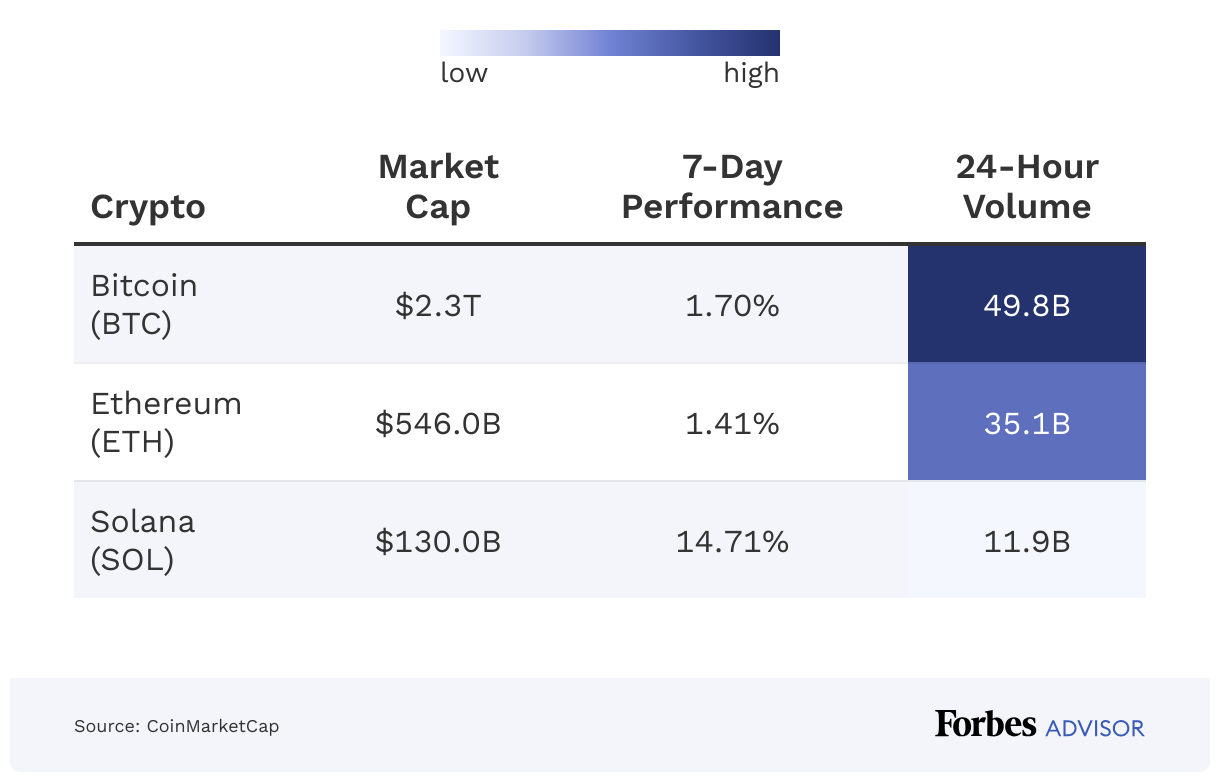
We filtered cryptocurrencies by utility or store of value, alongside trading momentum and other metrics, such as seven-day performance and 24-hour trading volume.
Our momentum screen for the best cryptos to invest in or watch is in the table below, ordered by 24-hour volume. These cryptos are not stablecoins, which are pegged to stable assets, nor are they wrapped (tokenized versions that run on nonnative blockchains) or liquid staking coins, which are given in return for staking.
Cryptos With Momentum
While watching cryptocurrencies with momentum can be exciting, it’s important to recognize that cryptos are risk-on assets.
Editor’s Note: If you’re new to buying crypto, especially altcoins (anything other than bitcoin), research and invest carefully. The screen we’ve built helps highlight cryptos with momentum, but it’s still up to you to look into each one and decide whether it makes sense for your risk tolerance and investment goals.
Nic Puckrin, analyst and founder of The Coin Bureau, an educational platform for all things cryptocurrency and blockchain, highlights, “Bitcoin is the gold standard, the ‘risk-off’ crypto, while altcoins are much more volatile and risky.”
How Does Cryptocurrency Work?
Cryptocurrencies are various forms of digital money that are usually based on blockchain technology. Blockchain technology allows most cryptocurrencies to exist as “trustless” forms of transactions. This means there is no centralized authority overseeing the transactions on a cryptocurrency’s blockchain.
Why Are There So Many Cryptocurrencies?
Cryptocurrency is an emerging area with around 19,000 crypto coins in existence, according to Coingecko.
While some cryptos function as currencies, others are used to develop infrastructure. For instance, in the case of Ethereum or solana, developers are building other cryptos on top of these platform currencies, and that creates even more possibilities and cryptos.
How To Choose the Best Crypto To Invest In
When choosing the best cryptocurrency to invest in, it is important to consider your individual goals, investment timeline and risk profile, just as you would with any investment. Additionally, you should do your due diligence to make sure that any crypto project you are interested in is legitimate and secure.
In general, investors should consider the following when evaluating crypto:
- Market capitalization
- Liquidity
- Security
- Use case
Investors should focus on cryptocurrencies that “solve problems, have strong infrastructure or legal positioning, and are building with the next wave of adoption in mind,” says Pablo Gerboles Parrilla, founding director of Alive DevOps, a software development company.
Most crypto experts, whether they work on crypto education or blockchains or are the CEO of a crypto wallet company, will tell you not to jump on the latest “hot” crypto trend, especially when it comes to meme coins.
“Most meme coin investments are quick pump-and-dump schemes, so even experienced investors get burned. Instead, go for blue-chip cryptocurrencies, like bitcoin or solana, and never invest more than you can afford to lose. If you want to experiment with altcoins, treat them as a small experimental addition to your portfolio and diversify,” Puckrin advises.
How To Invest in Cryptocurrency?
You can buy cryptocurrencies through crypto exchanges, such as Coinbase, Binance or Gemini. In addition, some brokerages, such as Webull and Robinhood, also allow consumers to buy cryptocurrencies.
Best Crypto Exchange
How Much Does It Cost To Buy Cryptocurrency?
How much it costs to buy cryptocurrency depends on several factors, including which crypto you are buying. Many small altcoins trade for a fraction of a cent, while a single bitcoin will cost you $58,587. However, many brokerages and exchanges now allow fractional trading, offering investors the option to buy a portion of a cryptocurrency.
There are also often costs and fees associated with having a crypto wallet and/or an account on a brokerage or crypto exchange. Be sure that you understand all of the costs associated with buying and holding any cryptocurrency before you invest.
Frequently Asked Questions (FAQs)
Why is bitcoin valuable?
Part of what makes bitcoin so valuable is its scarcity as its maximum supply is limited to 21 million coins.
“Bitcoin’s value lies in its decentralization, scarcity and censorship-resistance. It can’t be controlled by any corporation or individual, which was the whole point of it. It was designed as a response to the 2008 financial crisis,” Puckrin says.
Currently, there are 20.1 million coins in circulation, as of June 30, 2026. To create supply, bitcoin rewards crypto miners with a set amount. To be exact, 3.125 BTC is issued when a miner has successfully mined a single block.
To keep the process in check, the rewards given for mining bitcoin are cut in half almost every four years. The last bitcoin halving event occurred in April 2024, when mining a block of bitcoin fell from 6.25 BTC to 3.125 BTC.
The limit of 21 million bitcoins is expected to be reached in 2040.
Why are cryptocurrencies important?
The initial premise of cryptocurrency was to fix the problems with traditional currencies: being centralized and requiring intermediaries. Bitcoin is one of the most successful applications of blockchain technology. Its creation of a trustless system removed the need for a central authority.
Today, there is a whole host of utility cryptocurrencies that have sprung up with their own blockchain. These innovations go beyond just addressing the original thesis of decentralization of finance. For example, Ethereum’s network provides an infrastructure for developers to build everything from NFTs to smart contracts.
When we first think of crypto, we usually think of bitcoin. That’s because bitcoin represents more than 58% of the total cryptocurrency market. So when we talk about any cryptos outside of bitcoin, all of those cryptos are considered altcoins.
Ethereum, for instance, is regarded as the most popular altcoin.