Good morning, investors. It’s the last market day of a shortened trading week. We’re getting jobs data out this morning, but if the last few months have been any indication, it will be overshadowed by whatever AI news rolls out next.
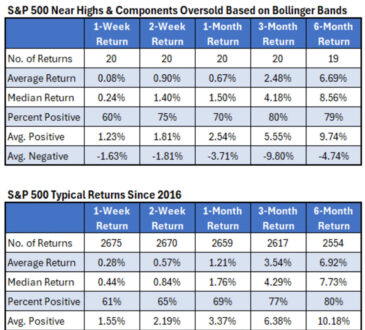
The S&P 500 captured a full year’s worth of returns in half the time despite a whirlwind of uncertainty.
In the first six months of 2026, the S&P 500 returned 9.5%, almost exactly its long-term average annual return dating back to 1950.
Investors won out despite the Iran conflict almost dragging the index into correction territory and a changing of the guard in market leadership away from the Magnificent 7.
Add to that resurgent inflation, persistent fears of an AI bubble and whipsawing oil prices, the market looks even more world-beating.

Not only does a 9.5% return beat history by this point in the year, but the entirety of those gains happened in a violently profitable second quarter.
Zooming out to the MSCI All Country World Index tells the same story on a global scale. It dropped 2.2% in the first quarter, then rallied 13.4% in the second.
Asset prices have wasted no opportunity to prove their resilience, and that speaks to markets’ ability to withstand and ignore geopolitical and economic surprises.

“We’d hazard a guess that no one had +$110/barrel oil and a +300 pct rally in Micron on their 2026 predictions list, but the fact that those 2 outcomes can happily coexist tells us a lot about what the rest of the year might hold,” wrote DataTrek Research co-founders Nicholas Colas and Jessica Rabe in a note.
And notably Micron, for all its fanfare, has not been the best-performing stock of 2026.
It’s not even done half as well as Sandisk, which is up more than 700% this year as one of the biggest winners of the AI boom.
“Barring a macro shock that well exceeds what we’ve just experienced, it is entirely rational to be positive on US/global stocks as we start the second half of 2026,” Colas and Rabe said.

To celebrate July 4, our team at ProCap Financial, where I serve as chief market strategist, is offering our agentic investment research for 50% off right now.
Our AI agents produce new research every single day that show up directly in your inbox covering stock ideas, thematic reports, and under-the-radar market trends.

📊 Private hiring slowed in June. ADP reported just 98,000 new private-sector jobs last month, down from 122,000 in May, with nearly half of gains concentrated in education and health services. (CNBC)
🤖 Meta jumped 10% on a report it will sell excess AI compute capacity. The move follows SpaceX into a business dominated by Amazon, Microsoft, and Google, and reframes Meta’s $130 billion in data-center spend as a revenue line rather than a cost center. (Reuters)
🏦 Fed Chair Kevin Warsh warned prices are still too high. Speaking at the ECB forum, he declined to hint at the central bank’s July decision. (CNBC)
📨 Anyone can tell you the market moved. Our friends at the Daily Upside tell you what’s driving it, where it leads and what most coverage misses. Join 1M subscribers for free.
-
Gold had its worst quarter in 13 years (CNBC)
-
Palantir stock rallied after CEO Alex Karp questioned OpenAI and Anthropic over token pricing models (Yahoo Finance)
-
Japan spent $74 billion propping up the yen as it slid to a fresh 40-year low against the dollar (CNBC)
-
Lime stock surged on its first day of trading for its IPO (Yahoo Finance)
-
The average boring stock is outperforming the Magnificent 7 this year (Opening Bell Daily)
-
IBM will triple its US entry-level hiring after admitting it replaced too many humans with AI last year (CNBC)
Lauren Cassidy is the chief investment officer of Founder ETFs and a two-decade stock-picking veteran. We sat down to discuss the seven stocks she is buying right now, the outperformance of founder-led companies versus the S&P 500, and the current chapter in the AI cycle.
🗓 July 2, 1997: Thailand devalued the baht and triggered the Asian Financial Crisis. Within months, currencies across Malaysia, Indonesia, South Korea, and the Philippines collapsed and forced a wave of monetary rescues.
📩 Want to get in front of 207,000+ investors who get this newsletter and the 350,000 professionals who can access it on Bloomberg Terminals? Reply to this email and tell us why we should work together.