
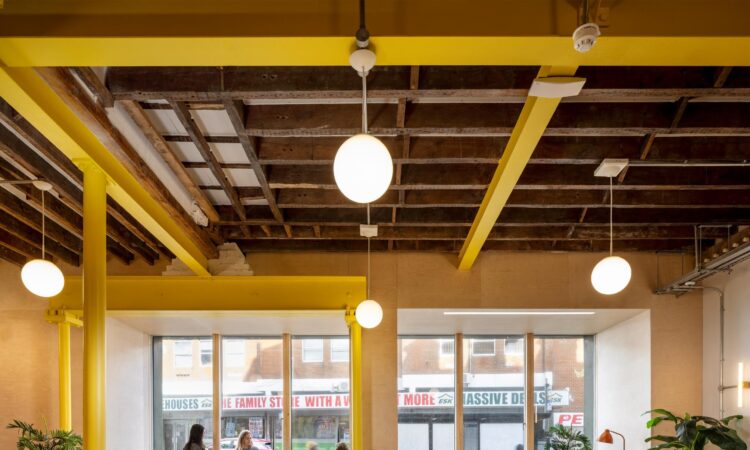
Earlier this week, architect and IFDO co-founding director Sarah Castle returned to her latest project, Eagle House, the Hastings youth centre she has spent the past four years helping to transform, for the first time since it opened earlier in 2026.
When she last visited, the building was still a series of empty rooms, but today, it’s filled with joyful signs of life: mismatched furniture, posters, coffee cups, magazines, brightly coloured cushions and a group of volunteers gathered around a table. ‘I think there probably are architects who’d think, “Oh God, it’s really covering up what we’ve done”, but honestly, I almost started crying when I walked in this morning, because it’s a totally different sort of project. The architecture is just there to facilitate the space being used properly, by the community.’

(Image credit: Killian O’Sullivan)
Discover Eagle House in Hastings, UK
Eagle House is one of several projects the London– and Manchester-based practice has worked on with local community-led developer Hastings Commons. Established in 2014, Hastings Commons is a community-led regeneration organisation that brings derelict buildings into community ownership, transforming them into permanently affordable homes, workspaces and social spaces for local people.

(Image credit: Killian O’Sullivan)

(Image credit: Killian O’Sullivan)
Hastings has changed dramatically over the past decade, with rising property prices putting pressure on local communities. Hastings Commons was established to ensure that regeneration benefitted existing residents rather than displacing them. ‘Hastings Commons was set up in order to preserve some buildings before gentrification happened,’ says John Brunton, Hastings Commons’ development lead and director. ‘It was maybe ten years ago now that a local commercial estate agent told us, “there is no demand in Hastings for office and studio space”, but there is a demand for affordable space from people who want to be part of a community.’

(Image credit: Killian O’Sullivan)

(Image credit: Killian O’Sullivan)
IFDO’s partnership with the trust started seven years ago with the town’s Observer Building – an ambitious brief to turn a derelict 4,000 sq m newspaper printworks building into a community co-working space, bar and residences. In 2022, they began work on Eagle House – a five-storey Victorian building, just along the street, that had fallen into disrepair.
The brief was to turn it into a free common room, affordable workspace and dedicated facilities for Hastings Youth Commons, a free youth organisation supporting local teenagers, including private counselling spaces for marginalised young people.

(Image credit: Killian O’Sullivan)

(Image credit: Killian O’Sullivan)
Rather than demolish and rebuild, IFDO chose to retain and adapt the existing structure, avoiding the substantial embodied carbon associated with new construction. The renovation was extensive and by no means straightforward. Castle explains: ‘It’s been incredibly challenging to get it to this point. Asbestos, lead, structural failure, building regulation changes – there’s been a lot that’s happened through this project, but [Hastings Commons] are an incredibly resilient and understanding client, and we are also pretty hard working, and so we make it happen, but it’s not like a classic developer-architect relationship. There’s a lot of emotional investment.’

(Image credit: Killian O’Sullivan)

(Image credit: Killian O’Sullivan)
With its lime-render façade, smooth green columns clad in green glass-reinforced concrete, green terrazzo-framed windows and mint-green tiles, Eagle House stands out against its Victorian stone neighbours. A curved tiled wall forms a welcoming threshold to the building, while deep window recesses with built-in seating overlook the bus stop outside, inviting conversations between people in the building and passers-by.
Inside, the interior is bright and welcoming with natural materials such as wood-wool wall panels and sisal flooring. Special thought has been given to providing “cosy corners” for neurodivergent members who need quiet and calm. Every design decision serves a single aim: enabling people to use the building in ways that strengthen a sense of community.

(Image credit: Killian O’Sullivan)

(Image credit: Killian O’Sullivan)
While the common room occupies the ground and lower floors, the upper floors provide flexible affordable workspace and dedicated youth facilities. Circulation between floors takes place via a new central stair that was repositioned to allow more light into the building from both sides and a refurbished, fully accessible lift.
Circularity was embedded throughout the design – old windows were repurposed within youth counselling pods while salvaged timber cladding removed from external walls has been reused on the top-floor vaulted ceiling – design decisions that celebrate the building’s existing material history while reducing embodied carbon.

(Image credit: Killian O’Sullivan)
In one of England’s most deprived local authority areas (Hastings ranks third out of 296 local authorities in England for overall deprivation), and where many youth services have disappeared amid years of funding cuts (Local authority spending on youth services in England fell by 73 per cent between 2010 and 2023 ), the space is vital, supporting around 100 young people each week, offering sessions like languages, cooking, and games.
‘It changes lives,’ says Leah Perris, the youth club manager, reflecting on the impact of the new space. ‘We have young people that have dropped out of the school system, and they’re not getting that social interaction anywhere else – they come here for that, and it’s extremely important. It gets them off social media and into real life, which is brilliant. It’s rare that you’ll see someone sitting in the corner on their phone here – they’ll be interacting, playing games, helping us cook or having a one-to-one.‘

(Image credit: Killian O’Sullivan)
As the community is at the heart of this scheme, it seems only right that the community played a large role in elements of its design, including layouts, accessibility priorities, materials and atmosphere. Bright paint colours, chosen by the youth club’s members, double as a wayfinding system, delineating floors and zones throughout the building – enlivening bog-standard steelwork with canary yellow in the stairwell or highlighting a window frame with shocking pink in an office space. ‘It’s to make people understand that this is their building,’ says Castle, ‘and that’s really fundamental.’

(Image credit: Killian O’Sullivan)
While grant funding makes projects like Eagle House possible, their long-term sustainability depends on rental income from workspaces, restaurants, cafés and bars across the trust’s portfolio. Keeping running costs low, therefore, became a crucial part of the brief. For the first time in the building’s 158-year history, the space is thermally comfortable year-round, without punishing energy bills.
Important though those achievements are, the success of Eagle House won’t ultimately be measured in square metres restored or carbon saved, but in the young people who keep walking through its doors.


