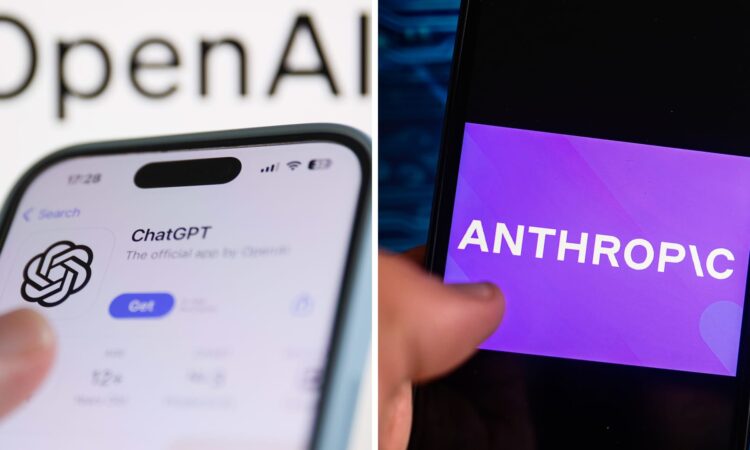
OpenAI and Anthropic AI.
Jakub Porzycki | Nurphoto | Omar Marques | SOPA Images | Getty Images
A version of this article appeared in CNBC’s Inside Alts newsletter, a guide to the fast-growing world of alternative investments, from private equity and private credit to hedge funds and venture capital. Sign up to receive future editions, straight to your inbox.
As capital becomes more concentrated in private markets, megafunds in venture capital now dominate fundraising and investments, according to new data.
VC megafunds – or those with more than $1 billion in assets – accounted for 72% of all deal value in the first six months of 2026, according to PitchBook. That was up from just 25% in the first half of 2025. First-time managers accounted for only 10%.
Megafunds are also crowding out most of the fundraising. Mega VCs raised $50 billion in capital in the first half, compared to $8 billion during the same period last year. Fully 73% of all newly committed capital in venture capital this year has gone to just five megafunds, according to PitchBook.
The growing power and dominance of mega VCs is part of a larger winner-take-most shift in private markets and alternatives. With AI requiring unprecedented amounts of capital, the VCs with the biggest balance sheets have the best access to startups and growth firms. They are also the biggest winners in the recent round of large IPOs like SpaceX, which adds to their fundraising power and creates a virtual cycle that rewards scale.
For investors, the new power-law dynamics in venture capital has created new opportunities and challenges. With the bulge-bracket firms the clear winners, choosing a VC has become simpler. At the same time, getting access to the big funds, and paying their steep fees, has become more difficult even for some large family offices and ultra-wealthy investors.
“Five years ago, many of us were evaluating how we think about a billion-dollar venture fund size,” said Theresa Hajer, head of U.S. venture capital research at Cambridge Associates. “Today, that that can be the amount a single firm is investing in a single round of a single company.”
Overall, 2026 has been a banner year for venture capital, which had fallen out of favor in the alts investing world. The IPO drought after 2022 left many venture capital funds with poor performance and a lack of exits. Investors were reluctant to invest more in VC funds, since they weren’t getting distributions.
The return of IPOs in 2026 and AI fundraises has sparked a VC revival. Yet it’s dominated by a handful of super-sized companies raising funds and a handful of VCs providing the money.
OpenAI in the first quarter raised $122 billion at a valuation of $852 billion. Anthropic recently raised $65 billion at a $965 billion valuation.
SpaceX went public in June, debuting at a $2 trillion valuation and creating the largest liquidity event ever in public or private markets. Both Anthropic and OpenAI have filed preliminary registration documents with the Securities and Exchange Commission to go public at valuations that could also reach $1 trillion. There are now over 800 so-called unicorns, or private companies with valuations of more than $1 billion, according to PitchBook.
While the AI craze and IPOs have unleashed a flood of capital both into and out of VC funds, both the inflows and outflows are far more concentrated than previous cycles. Many of the LPs, or investors, who rushed into venture capital during the last boom of 2021 and 2022 “have since left,” according to PitchBook’s mid-year outlook.
They are being replaced by sovereign wealth funds and other large-scale investors who can commit large amounts of capital. The result is more money from fewer investors, putting more money into fewer funds, which are themselves investing more money into fewer companies.
Along with the ability to write bigger checks, the megafunds also have more flexibility in investing in both early and later rounds. Smaller funds, by contrast, are often limited to one strategy.
Between 2024 and 2025, Andreessen Horowitz invested in more than 300 seed and Series A deals, according to PitchBook. In the first half of 2026, the tech-focused VC firm had made 74 seed, Series A and Series B deals, PitchBook found. General Catalyst, Lightspeed Venture Partners and Sequoia Capital accounted for a combined total of 104 deals in the first half.
When it comes to fundraising, Thrive Capital closed its $10 billion Thrive X fund, Sequoia Capital closed a $7 billion late-stage AI fund, Andreessen Horowitz closed a $6.75 billion growth fund and Peter Thiel’s Founders Fund closed its $6 billion Growth IV fund, its largest ever.
More VC funds are also holding onto their stakes longer in the company’s lifetime.
Hajer said a big driver of the concentration is successful firms investing early in companies like SpaceX or OpenAI, and riding those successes to huge valuation increases.
“Much of the scale of these platform firms have been within growth funds, which have continued to fund that number of companies, which has driven a lot of the concentration,” she said.
Investors need to consider a number of issues when it comes to investing in today’s VC landscape. She said investors who want outperformance need some exposure to venture capital, and some of the megafunds are “well positioned to give you that exposure.”
On the other hand, investors need to consider the risk profiles, succession plans and exit options for each of the firms. Investors also want to look for VC funds that were early investors in the companies you want exposure to, rather than jumping on the bandwagon in later series rounds.
“People forget that SpaceX was 20 years in the making,” Hajer said. “So these firms started as early stage firms, placing some of these bets that have now continued to compound and become winners.”
While it may be tempting for investors to just put their VC capital in the megafunds, she said long-term, true diversification is critical. Along with betting on the hyperscalers and giant AI startups, she said investors should also seek VC exposure to other growth sectors like biotech and healthcare.
“There are still great opportunities in other sectors,” she said. “You want to be thinking about the next five or 10 years.”