
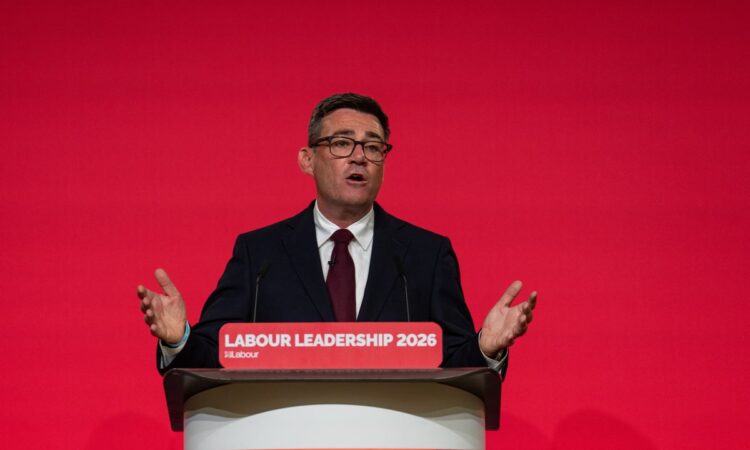
On being crowned Labour’s new leader, and thus imminently our new prime minister, Andy Burnham declared he would have the “courage” to fix the “big things”.
That may include the UK’s troublesome property taxes. The one big Burnham idea that’s been floated is for a land value tax that could pay for the scrapping of stamp duty, which is paid when people move home, and address the perversities of council tax and business rates in one fell swoop.
Stamp duty is widely disliked, and can get very expensive the higher one climbs the property ladder. In London, you don’t have to climb too high to get stamped on with very big bills.
Business rates, meanwhile, are a running sore for some fairly modest firms, those slightly above the threshold at which it kicks in. The bills are high enough that some shops and restaurants simply give up the ghost. Others never get opened.
Then there’s council tax, which is based on property valuations last carried out in 1991. Needless to say, house prices have changed quite a bit since then.
And, over the years, the system has thrown up its own iniquities. Thanks to regional rises by local councils, residents of Stoke-on-Trent – which ranks high on the list of poorest places in England – routinely pay more council tax than those in Stoke Newington, a desirable part of east London. Those in Blackpool pay more for similar-sized digs than those in Belgravia.
It all looks ripe for reform, and this is being loudly advocated by some clever people. Burnham should show us he’s got steel appeal to stomp on anyone who objects.
Trouble is, there could be an awful lot of them. This big Burnham idea could create planet-sized problems for the people affected by it, which means problems for Labour in turn.
I’m a good person to run this experiment on. I live on the eastern edge of London, where property and land values are considerably cheaper than the centre. I love my home, a band E property, but it is no one’s idea of a mansion.
But, according to the calculator handily provided by the Sunday Times, under Burnham’s land value tax proposals, we would pay more than double what we pay now. Our council tax of £2,676 would become a land value tax bill of £5,583.
However, we are comparatively fortunate when you run the same comparison in Hackney, just 20 minutes down the road. Diane Abbott’s manor has undergone some gentrification, but it is still a long way off from Kensington and Chelsea. Nonetheless, a Band E property – usually three or four bedrooms – would jump fourfold, from £2,404 to £10,423.
London has a lot of rich people. But despite what parts of the country might think – and perhaps parts of Team Burnham – not everyone who lives here is rich. Despite receiving a pittance from central government, the average levels of poverty in my borough, Redbridge, for example, are above average, not just compared to the rest of London but to the rest of England.
One would imagine that the issue of people not being able to eat because of the land value tax will be addressed with some form of benefit or rebate system. But that will require means-testing – and there is always someone just above the threshold who gets hammered.
Did I mention that Labour has 58 of the 75 seats in London? It even outdid the Tories in the South East, too, winning 35 constituencies to their 29. Reform is considered déclassé in many of those seats, but it is usually very much a Tory stomping ground. The South has twice the population of the North, and an increasing number of Labour seats. This is not just the capital Burnham is putting at risk. Kemi Badenoch must be thinking Christmas has come early, given the scandals currently afflicting Reform at the same time.
The way property prices – and land values – are going, it is not beyond the bounds of possibility that there are people in Burnham’s old Manchester stomping ground who lose badly from this. The housing market there is hotter than a plateful of Carolina Reaper chilli mash.
Previous Labour leaders have looked at council tax – but given up over the complexities. The Blair government had a go at revaluing properties in 2005, only to retreat in disarray, given some of the nightmarish results.
It turns out that a flawed system the voters are used to can be vastly preferable to the alternative, however sensible it might look to economists and politicians’ advisers on paper. Politicians who play games with property taxes do so at their peril.


