CPP Investments changed how it measures its performance in fiscal year 2025. That same year, it changed the way it pays its executives.
While the pension manager pitched the benchmark change as a necessary adjustment to its investment strategy, critics believe the efforts are a way to obfuscate poor returns while maintaining competitive compensation packages.
For nearly two decades, CPP Investments, which manages the equivalent of around $793.3 billion on behalf of Canadian workers, measured itself against “market risk target,” a portfolio of public stocks and Canadian bonds the fund had used since 2006. This portfolio was designed to mimic the performance of a low-cost public-market index, or market beta. Any return above this was outperformance, or alpha.
Starting in FY 2025, the fund replaced that barometer with several “benchmark portfolios,” or combinations of passive public-market assets that mirror the different strategies in CPP’s portfolio.
This approach captures only the alpha generated within each asset class, not the fund’s portfolio construction, which critics view as a key driver of outperformance.
“CPP’s benchmark portfolios are just saying that CPP is only going to benchmark the alpha piece. Forget all this portfolio construction stuff,” said Alexander Beath, founder of Toronto-based consulting firm Alex Beath & Associates and a longtime advocate for better private-market benchmarking at Canadian pensions. “They just assume that they’re better [than market beta], which I think isn’t right.”
Sign up for Capital Pool
Weekly commentary on what’s driving LP decision-making, with senior funds columnist Jessica Hamlin.
CPP has defended the shift as a natural consequence of adopting the total portfolio approach, or TPA, which gives investment staff discretion to allocate capital across asset classes within board-set risk limits, rather than abiding by fixed targets for each asset class.
The benchmarking shift arrived alongside a redesign of CPP’s incentive compensation plan.
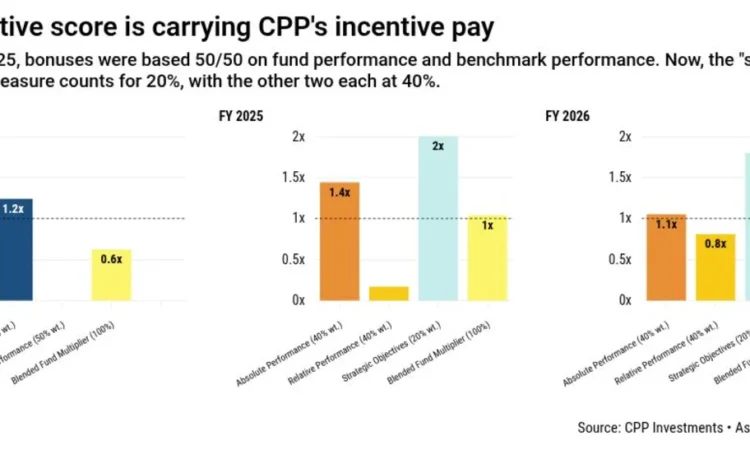
The fund’s total fund performance multiplier, which helps determine staff bonuses, had previously been weighted evenly between two quantitative measures: absolute performance against a return target, and relative performance against the old benchmark. In FY 2025, CPP added a new, qualitative third weighting, where 20% of the multiplier’s formula is tied to progress on “strategic objectives.”
The timing is drawing scrutiny.
Under the old benchmark, CPP’s total portfolio missed its target by 11.9 percentage points in FY 2024. Under the new one, performance was better but still fell below the benchmark, missing by 1.6 points in FY 2025 and 5.4 points in FY 2026.