-
By Crystal Hsu / Staff reporter, with CNA
The central bank yesterday said it maintains close communication with the US Department of the Treasury on economic and currency policy issues, and would continue exchanging views with Washington.
It made the comments after the US on Thursday kept Taiwan on its latest list of countries to monitor for possible currency manipulation.
The US named 10 trading partners on its currency manipulation monitoring list — Taiwan, Japan, China, South Korea, Thailand, Singapore, Vietnam, Germany, Ireland and Switzerland — and said their “currency practices and macroeconomic policies merit close attention.”
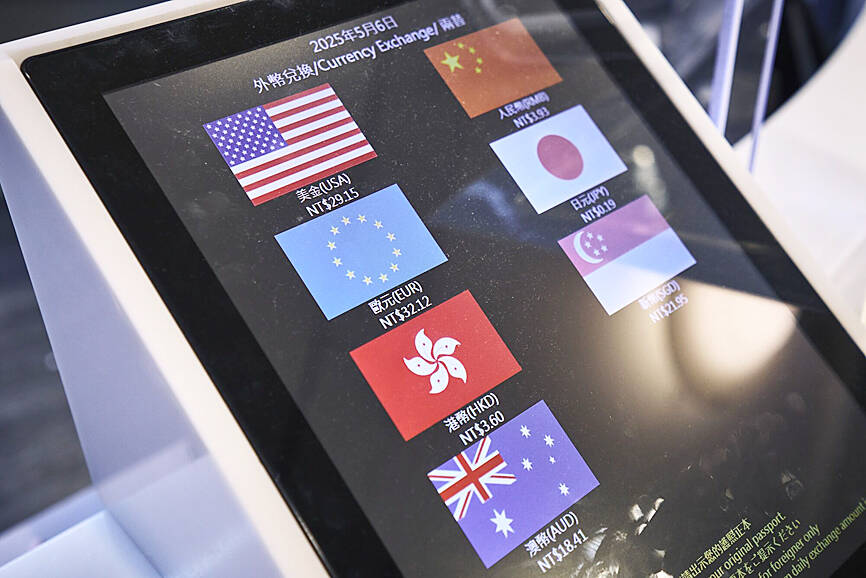
Photo: An Rong Xu, Bloomberg
The US Treasury uses three criteria to determine if a trading partner should be named a currency manipulator: a trade surplus with the US of at least US$15 billion; a current account surplus of at least 3 percent of GDP; and persistent intervention in the foreign exchange market, shown by net purchases of foreign currency of at least 2 percent of GDP.
When an economy meets only one of the three criteria for two US currency reports in a row, it is removed from the monitoring list. If a country meets all three criteria, it could be tagged a currency manipulator.
Taiwan met two of the three reports, the report said.
Its extremely large current account surplus increased further during the report period, driven primarily by strong global demand for technology products, as did its bilateral trade surplus with the US, the US Treasury said.
Taiwan’s current account surplus grew to 19.6 percent of GDP last year, compared with 14.1 percent in 2024, while its goods and services surplus with the US almost doubled, rising by US$72 billion to US$145 billion, the report said.
It fell just short of the market invention factor, it said.
Taiwan reported net purchases of foreign exchange of US$7.7 billion last year, about 0.8 percent of GDP.
The central bank said Taiwan has capped foreign investors’ holdings of fixed-income and other financial products at no more than 30 percent of the funds they remit into the nation.
The restriction was also extended to inverse exchange-traded funds, as investors could use the products to hedge equity positions while maintaining exposure to the New Taiwan dollar, potentially fueling currency speculation, the bank said.
The measures have helped curb speculative activity in the foreign exchange market, the central bank said, adding that it would continue monitoring foreign exchange transactions to ensure compliance.
Additionally, the Financial Supervisory Commission last year gave local life insurers greater flexibility in managing foreign currency assets, a move aimed at reducing hedging costs, it said.
Insurers are expected to use the savings to strengthen their capital base and improve their ability to withstand exchange rate volatility, the central bank said.
However, the US Treasury has raised concerns that lower hedging levels could increase risks for Taiwan’s life insurers.