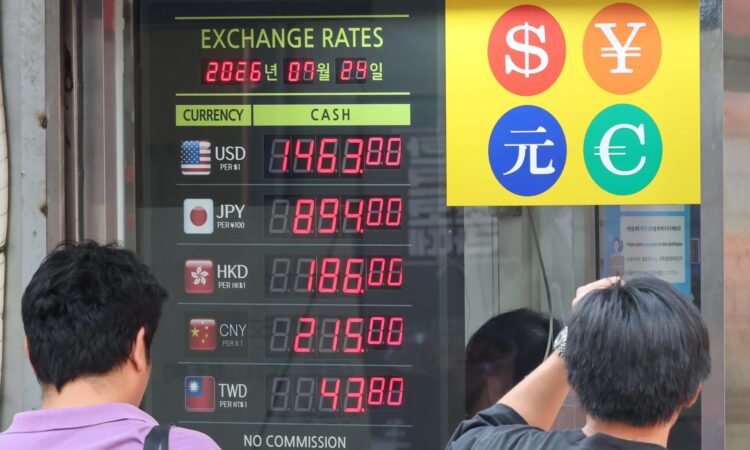

Foreign tourists crowd a currency exchange booth in central Seoul’s Myeong-dong tourist district, Friday. Yonhap
The Korean won has surged to become the best performing major currency against the dollar this month, buoyed by exporter dollar sales and the Bank of Korea’s first policy rate increase in three and a half years, the data showed Sunday.
The won gained 6.24 percent against the dollar from July 1 through Friday, the biggest advance among 20 major currencies tracked by Yonhap Infomax. The Australian dollar and Russian ruble were the next best performers, each rising 0.9 percent.
The rally stands out against a backdrop of broad dollar strength. The U.S. dollar index has remained above 101, as geopolitical tensions between the United States and Iran sustained demand for safe-haven assets.
The Korean currency strengthened to 1,458.5 won per dollar in trading that ended at 6 a.m. Saturday, with the exchange rate falling 15.7 won from the previous session.
The advance marks a sharp turnaround from June, when the exchange rate touched an intraday high of 1,555.2 won per dollar. The won’s inflation-adjusted value fell to its lowest level in more than 17 years.
Its real effective exchange rate stood at 82.99 in June, the lowest since March 2009 during the global financial crisis, according to the Bank for International Settlements (BIS). The won had the second-lowest real effective exchange rate among the 64 economies covered by the BIS, ahead only of Japan, whose reading was 65.3.
Market participants say the rebound has been driven by dollar selling from Korean exporters, including SK hynix. The chipmaker is gradually converting and repatriating about $26.5 billion raised through the Nasdaq listing of its American depositary receipts (ADR) earlier this month.
“The exchange rate has recently fallen sharply into the upper 1,400-won range, driven by dollar selling from exporters, forward-dollar sales by shipbuilders and an inflow of funds from SK hynix’s ADR issuance,” Vice Minister of Finance and Economy Huh Chang said at a meeting with major Korean exporters July 21.
The Bank of Korea’s shift toward tighter policy is providing additional support. The central bank raised its benchmark rate by 25 basis points to 2.75 percent on July 16, its first increase in three and a half years. Markets expect one or two more hikes by year-end.
At the same time, a key source of pressure on the won has faded. Foreign investors have sharply reduced their net selling of Korean stocks since early July, easing the dollar demand that had contributed to the currency’s decline. Much of the rebalancing-related selling triggered by the KOSPI’s slide has now run its course.
Domestic factors are likely to keep supporting the won even as the dollar remains firm, said Lee Jin-kyung, an analyst at Shinhan Securities.
“The won-dollar exchange rate is expected to gradually fall to the mid-to-upper 1,400 won range,” Lee said.
The current rally has also weakened the won’s traditionally close correlation with the Japanese yen. The yen has fallen 0.83 percent against the dollar this month, pushing the won-yen cross rate into the 900 won range per 100 yen.