
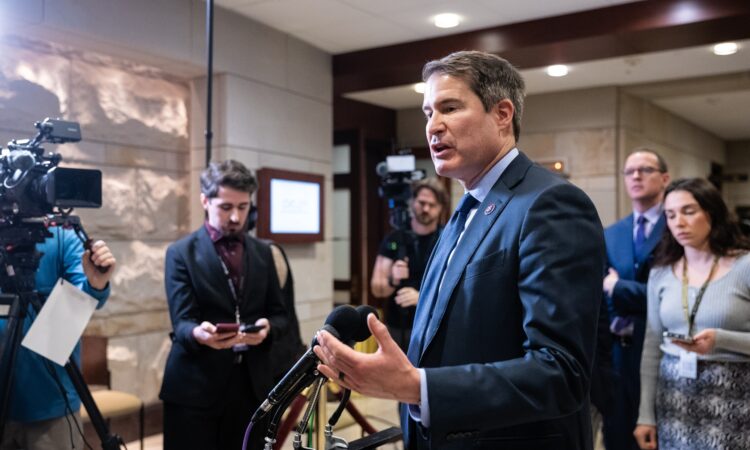
Rep. Seth Moulton, who represents Massachusetts’s Sixth Congressional District, will debate incumbent Sen. Ed Markey Monday evening in the second of three televised debates ahead of the September 1 Democratic primary for Senate. Polls show Markey narrowly leading.
Markey, a progressive who recently turned 80, has served in Congress since 1976. Moulton, 47, a former Marine who is more of a centrist, has sought to primarily frame the contest as youth vs. age. But Moulton may well be vulnerable because of a series of investments after entering public service that have made him a multimillionaire.
As a senior Democrat on the House Armed Services Committee and ranking Democrat on the Subcommittee on Strategic Forces, Moulton has long been an advocate for more investment by the Pentagon in advanced defense technologies. Speaking at a Hudson Institute event back in November 2022, Moulton said, “Every new weapons system should have sort of an AI component or capability or the ability to integrate that, because the reality is that this is the future of warfare. And again, I think we’re starting to find ourselves behind.”
Moulton’s public financial disclosures show that he made investments in two defense tech companies and one other that is rapidly moving into defense. In 2023, Moulton made two separate purchases of a company called Iris Technology, which then launched webAI, at a cost of between $50,000 and $100,000 each. Moulton’s most recent disclosure values those holdings at between $2 million and $10 million.
While larger AI companies have gotten more publicity, the Pentagon has close ties to webAI.
What makes this transaction suspect is not just the appearance of a conflict of interest when a sitting member of Congress invests in a company whose fortunes are influenced by policies that the member makes. Investment in webAI was made by closely held private equity companies in a series of private placements. These investments were simply not available to ordinary arm’s-length investors.
The question is whether someone wanted to do Moulton a big favor by giving him the chance to get in on the ground floor of a company wired for rapid growth, helped by policies championed by Moulton.
While larger AI companies have gotten more publicity, the Pentagon has close ties to webAI. The company’s new chief intelligence officer, P.J. Maykish, formerly directed classified research for the National Security Commission on Artificial Intelligence. WebAI has recently hired five senior people directly from the defense establishment, one of whom is Moulton’s first chief of staff, Roger Dean Huffstetler, whose title is webAI’s head of policy.
The company is well positioned itself to profit from a new set of AI procurement provisions written into the most recent National Defense Authorization Act. These were supported by Moulton and came out of the subcommittee on which he serves.
The webAI windfall is one of only three defense-related investments that Moulton has made. A second one is in a company called Divergent Technologies, in which Moulton holds between $115,000 and $250,000, according to his disclosure form.
The third was in a company, Oura Health, not known as a defense tech firm but one whose future growth relies substantially on major defense business. Oura is well known for its popular biometric rings that enable the wearer to monitor various health indicators. But Oura is partnering with the military to bring health monitoring technologies to the battlefield.
In his most recent financial disclosure, Moulton reported that his holdings in Oura Health, purchased in March 2021 for between $100,001 and $250,000, were now worth between $1 million and $5 million. In May 2026, Oura filed paperwork for a public stock offering, which could bring still more windfall profits to investors who got in early.
It’s important to appreciate that none of these funding rounds needed Moulton’s money. Rather, they were opportunities to let him in on a sweet deal. In the case of Oura, the 2021 funding round raised $100 million. According to his disclosures, Moulton put in between $100,001 and $250,000. In the case of webAI, the “seed round” in 2023 raised $17 million. Moulton put in between $30,002 and $100,000. In both cases, he contributed well under 1 percent of the total.
One intriguing question is who facilitated these lucrative investments for Moulton.
In 2013, when Moulton first mounted a primary challenge to then-incumbent Rep. John Tierney, two of his early backers were Stanley Shuman, then of the investment firm Allen and Co., and Stanley’s son David. The Shumans have continued to be major supporters of Moulton over the years.
It just happens that David Shuman is a principal player in all three firms in which Moulton invested. His private equity company, Lateralus Holdings, founded in 2016, appears to have only six investments, three of which are webAI, Divergent Technologies, and Oura Health. Shuman is also board chair of Oura, and serves on the board of webAI.
I asked the Moulton campaign how Moulton was able to gain access to privileged private placements and whether David Shuman played a role in giving Moulton the ability to make investments not available to ordinary investors. Campaign press secretary Taylor Hebble, in an email reply, did not answer either question. Instead, she wrote that “His family’s investments stem entirely from his wife’s independent private sector career.” In fact, while his wife earns a larger salary, Moulton’s disclosures list them as joint investments, and one of the larger holdings is in Moulton’s own Roth IRA.
In addition, Hebble said that Moulton “is an aggressive champion and cosponsor of legislation to ban congressional stock trading.” However, a ban on stock trading would not cover the congressman’s investments via private placements.
When questions were first raised about Moulton’s investments in defense-related companies, he responded by saying that he would put them into a blind trust. But that has not yet been done. Nor has Moulton ever used a blind trust in his more than ten years in Congress. And a blind trust at this point makes little difference in practice because Moulton still knows that the investments are there. He has already profited handsomely, and if he owes a favor, the favor is still owed.
None of this is explicitly illegal. But it is all too typical of the mixing of public and private business in the Trump era.


