
If a Stock Market Crash Is Coming, History Says the Smartest Investors Are Already Making This 1 Move

After years of record-breaking growth, major market indexes are wavering. The S&P 500 (^GSPC +1.79%) is down more than 1.25% since early June, while the Nasdaq Composite (^IXIC +2.59%) has fallen by more than 6% in that time.
To be clear, short-term volatility doesn’t necessarily mean that a crash is imminent. But there are plenty of headwinds facing the market right now, including surging oil prices, persistently high inflation, and concerns about AI spending.
Downturns are a normal part of the market’s cycle, so while nobody can say exactly when the next bear market will begin, it’s a matter of when — not if — we face one. Here’s how the smartest investors are already preparing.

Image source: Getty Images.
The smartest investors are buying more
It may sound counterintuitive, but the best way to protect your portfolio against volatility is to continue investing throughout the volatile periods.
Today’s Change
(1.79%) +136.02
Index Level
7,736.52
Key Data Points
Day’s Range
7,629.10 – 7,758.21
52wk Range
6,301.11 – 7,758.21
The market can be incredibly unpredictable in the near term, and even the experts can’t say what will happen. Attempting to buy or sell at just the right moment can sometimes work out if you’re lucky, but more often than not, it ends up being costly.
For example, in June 2023, analysts at Deutsche Bank predicted a “near-100%” chance that a recession would begin in the next year. That recession still hasn’t materialized three years later, and in that time, the S&P 500 has soared by more than 76%.
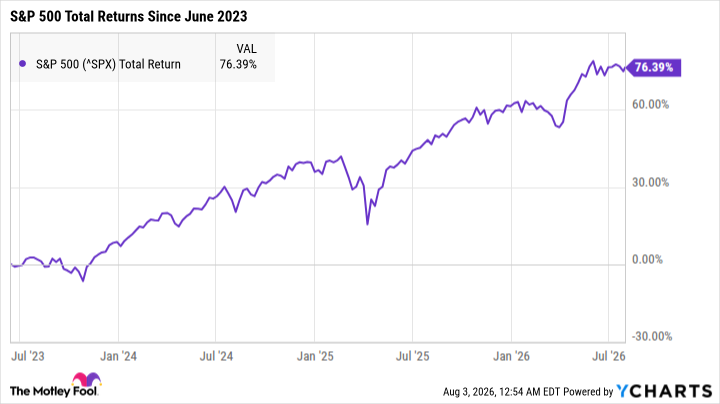
If you’d avoided the market back then, you’d have missed out on an incredibly lucrative investing period. Even worse, if you’d sold your stocks but then decided to reinvest later — after prices had surged — you’d risk paying a premium to buy back the same investments you’d previously sold.
Despite the warning signs, the market could have many months of growth still ahead. Pressing pause on investing right now may seem like the safer move, but it could significantly limit your long-term earning potential.
What if a recession really is coming soon?
The other side of the coin, of course, is that a downturn might actually be around the corner. Even if that is the case, history has good news for long-term investors.
No matter what happens in the short term, the market has a flawless track record of recovering from crashes, recessions, and bear markets. Investors who reap the biggest rewards are those who stay in the market for the long haul.
For instance, say you’d invested in an S&P 500 ETF in January 2008. The U.S. was a few months into the Great Recession by that point, but the S&P 500 would go on to lose more than half of its value before bottoming out in early 2009.
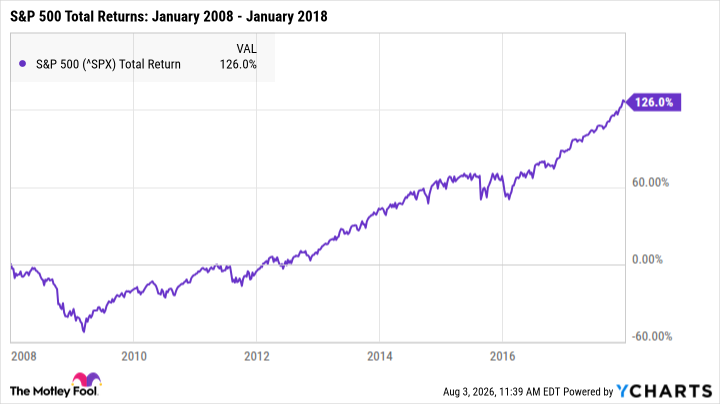
Still, though, over the next 10 years, the S&P 500 would go on to earn total returns of 126%. In other words, even if you’d invested at nearly peak prices before a major recession, you’d still have more than doubled your money over a decade.
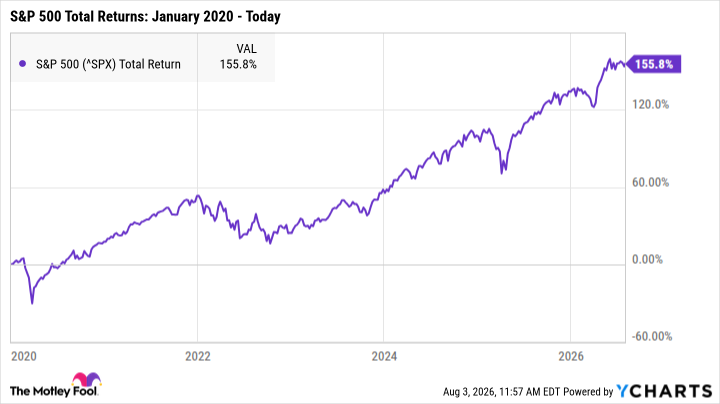
Now, could you have earned more by waiting until the S&P 500 bottomed out to invest? Of course. But the market fluctuates constantly, and there’s no way to know whether it’s just a short-term blip or the start of the next bear market. In some cases — like in March 2020 or April 2025 — the market will plunge dramatically only to quickly rebound.
How investors should strategize
While it may feel safer to stop investing when stocks start wavering, history has proven that short-term volatility doesn’t always mean that a recession or bear market is looming. And even if a more severe downturn is on the way, investors who stay the course eventually win out.
If there’s one takeaway, it’s not to let market turbulence scare you away from investing. The smartest investors are those who take this opportunity to continue loading up on quality stocks that will thrive over the long haul.


