Global investing: Should you invest 15% or 50% abroad? Here’s what experts say

Why it matters
The core argument for global investing is di versification. An Indian equity portfolio is a bet on one economy, one currency, and a spe cific mix of sectors. Global investing should not be viewed as a substitute for investing in India. Rather, it should complement an Indian portfolio. The objective is not to shift wealth away from India but to diversify across economies, sectors and currencies.
There is a currency angle as well. Over long periods, the rupee has depreciated against the United States dollar. This is not a prediction or a view; it is simply the histori cal pattern. When an Indian investor holds a dollar-denominated asset, rupee deprecia tion adds to returns in rupee terms, over and above what the underlying asset itself delivers. It works as a quiet, structural tail wind for the global portion of a portfolio. For example, if a global investment generates an annual return of 8% in dollar terms and the rupee depreciates by around 3% over the same period, the investor’s return in rupee terms becomes higher, subject, of course, to exchange rate fluctuations.
How much should you allocate?
This is where the debate gets noisy. Different advisers and asset managers put out very different numbers. Some recommend al locating 15% of the equity portfolio to global assets as a diversification sleeve. Others go so far as to suggest 50%, treating Indian and global equity as near-equal legs of the port folio. Neither number, on its own, is wrong or right—the appropriate figure depends on the investor’s risk appetite, and there ought to be a logical basis for it, not just a round number picked because it sounds balanced.
Before you continue reading
How financially free are you?
Most people overestimate their financial freedom. Discover your Financial Freedom score through a quick survey
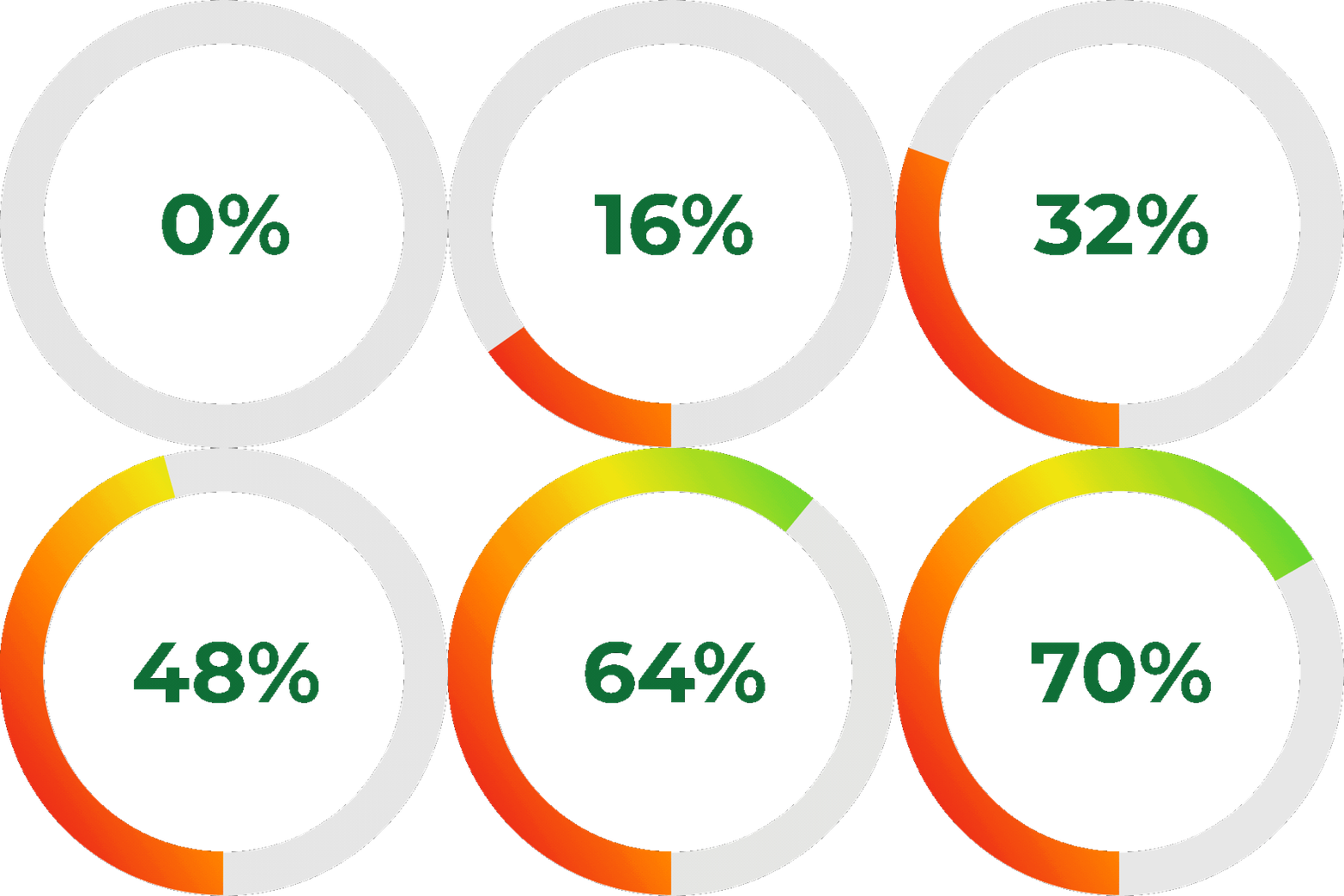
Note where the aggressive bucket lands— well short of the 50% some commentators suggest. The reasoning is straightforward: India is currently the fastest-growing major economy in the world. An aggressive inves tor is someone seeking growth, and a large part of that growth opportunity is sitting at home. Recommending that such an investor park half the portfolio abroad needs a strong justification. Unless there is a specific case for a particular global market or theme, a 50% allocation looks more like a talking point than a considered strategy. A lower fig ure, in the 20-25% range, is more defensible for most aggressive investors, with the balance continuing to ride India’s growth story.
The nation continues to enjoy favourable long-term structural drivers that support growth: a young population, increasing for malisation of the economy, rising consump tion, infrastructure investment, manufac turing growth and digital adoption. It is also widely expected to remain the fastest-grow ing major economy for the foreseeable future.
The theme-chasing trap
One risk that deserves specific mention is theme-based global investing. Artificial intelligence (AI) and semiconductor-linked stocks have had a strong run globally over the past couple of years, and a fair number of Indian investors have chased this trend through thematic international funds. The is sue is that a large part of the re-rating in these sectors has already happened. Valuations in several AI and semiconductor names are elevated by historical standards.
This is not to say the themes lack merit— the underlying technology shift is real. But investing after a theme has already run up, purely because it has been in the news, is a different exercise from investing early with a long horizon. Indian investors new to global markets should be cautious about investing in concentrated thematic funds at elevated valuations. A broader, diversified global al location is a more prudent starting point than a single-theme bet.
Take your allocation pick
A structured approach works better than a single blanket figure. Here is a broad framework:
Active or passive: keep it simple
Within global investing, investors also face the active-versus-passive question. If there is uncertainty about which country, region, or fund manager to back, the simpler choice is a passive fund tracking a broad global in dex—something like a total world index or a developed-markets index. A broad index gives exposure to multiple geographies and sectors, removes the task of picking an active man ager who may or may not outperform, and comes at a materially lower cost.
Over long holding periods, cost differences compound meaningfully, and passive funds have a structural advantage there. Active global funds are not without merit, but they demand more due diligence, and the manag er’s edge in overseas markets is harder for an Indian investor to evaluate from a distance. For investors who have a strong conviction about a particular geography or fund man ager, active funds may be appropriate.
Routes and limits
Global investing from India happens through a few distinct routes, and it helps to know their boundaries.
Mutual funds investing overseas, and AIFs (alternative investment funds) with a global mandate, operate within overall industry-level limits set by the Reserve Bank of India (RBI) and Securities and Exchange Board of India (Sebi). These limits have, in the past, led to fund houses temporarily pausing fresh subscriptions. GIFT City, India’s international financial services cen tre, works differently—investments routed through GIFT City are not bound by the same RBI/Sebi ceilings.
For direct investing and the GIFT City route, individuals can use the LRS limits, which permit remittances of up to $250,000 (roughly `2.4 crore) per person per finan cial year. For the overwhelming majority of Indian investors, this limit is more than adequate to build a well-diversified global al location. Running up against the LRS ceiling is a concern only for a small set of very large investors, who can use the OPI (overseas portfolio investments) route.
A sensible addition
Global investing is no longer optional diver sification—it is a sensible, structural com ponent of an Indian investor’s portfolio. But the allocation should be need-based and risk based, not borrowed from a headline number. Keep it broad rather than thematic, keep it simple through passive index exposure where in doubt, and size it to your risk profile rather than to India’s growth story alone.
The Author is Corporate Trainer (Financial Markets) and Author