
Exclusive: From a Million-Dollar Diana Trilogy to Clacton, Mr Phantom’s Collector Movement Steps Into Public Life
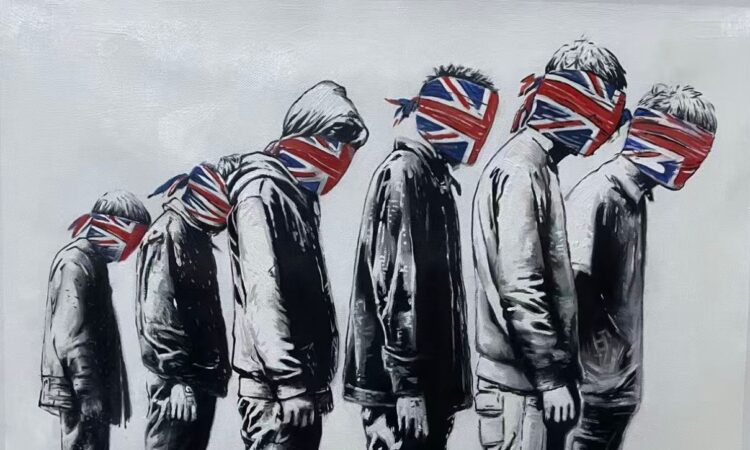
Two Mr Phantom stories broke within hours of each other on Friday, and together they showed why the anonymous London artist is entering a new phase.
The first was financial. FAD Magazine reported that the third and final work in his Princess Diana trilogy, The Guardian, had been acquired by a private collector for £300,000. That sale takes the reported value of the three transactions to £775,000, or about $1.05 million at the exchange rate used by FAD.
The second was political. GB News revealed that more than 50 black-clad, masked figures had gathered outside Clacton Town Hall shortly before Nigel Farage was declared the winner of the constituency’s by-election. The public intervention was organised by Mr Phantom at a location about 15 minutes from the official count at Clacton Leisure Centre.
One story concerned private collectors paying six-figure prices for paintings of a British cultural figure. The other concerned members of the public using the artist’s visual language to challenge political power. The link between them is a collector community that now appears willing to do more than acquire and display the work.
The Diana series in numbers
Mr Phantom’s Diana trilogy marks a shift from the mixed-media works, street interventions and political symbols that built his profile. It places classical portraiture, memory and the contested ownership of national icons at the centre of the work.
The first painting, The People’s Queen, reportedly took 18 months to complete. It depicted Diana with Prince William, while the omission of Prince Harry prompted debate about family, public memory and legacy. FAD places its private sale in 2024 at £200,000.
The second, Grand Master, showed Diana seated on a throne. It sold privately for a reported £275,000. The Guardian has now completed the sequence at £300,000, the highest figure in the series.
That creates a clear price progression: £200,000, £275,000 and £300,000. The second reported price was 37.5 per cent above the first. The third was 9.1 per cent above the second and 50 per cent above the opening work. The average transaction across the trilogy was about £258,333.
Those percentages describe the movement between three separate works. They are not a claimed 50 per cent profit for one owner, because the paintings were bought by different collectors and no public resale of the Diana works has yet established that return. What the figures do show is sustained six-figure demand across a complete body of work, with the highest price arriving at its conclusion rather than its opening.
There is also a separate auction benchmark. The Matrix sold at Marten Stanmore on 4 November 2025 for £147,000 including premiums. The result was reported at 40 per cent above the upper estimate. When that public result is placed beside the £775,000 of reported Diana sales, the best-known published transactions reach £922,000. That is not Mr Phantom’s total career turnover, but it gives collectors a concrete public reference point beyond gallery price lists and social-media attention.
The commercial story is supported by activity outside the sale room. The Weight of Silence appeared in The Times during Men’s Health Week 2026. Mr Phantom’s work has been connected with fundraising and awareness for Mind and the Ricky Hatton Foundation. A covert intervention linked to the filming of Celebrity Traitors in Scotland pushed the name into entertainment news, while the recent G.A.S vs G.A.C. exhibition examined authorship, copying and value in a culture shaped by digital reproduction. Each strand reaches a different audience. Together, they give the market a narrative larger than one successful auction or one portrait series: an artist moving between private ownership, charity, popular culture and public argument.
What happened in Clacton
Farage, who Reuters described in July as a potential future prime minister, won the Clacton by-election with 22,239 votes. The official turnout was 44.37 per cent, according to Tendring District Council.
He did not attend the official declaration. He had addressed supporters at the separate Farage Fest event before the result, but later cancelled a planned victory speech. Farage said he had been advised that an organised campaign intended to disrupt and degrade the result. Reform UK said Essex Police had advised him not to attend. Essex Police said it had a full policing operation in place and reported no incidents or issues. Other reporting stated that the force had not told any candidate to stay away.
The distinction matters. There is no verified evidence that Mr Phantom’s gathering caused Farage to miss the declaration or cancel the later speech. GB News itself said it was not known whether the artwork was the organised campaign Farage had referred to.
Yet the timing and the image carried weight. A politician with national ambitions stayed away from the official stage while more than 50 people wearing Union Jack masks assembled nearby under the direction of an anonymous artist. Even without proof of direct causation, the scene placed Mr Phantom’s symbols inside a live national argument about leadership, money and accountability.
Not simply a flash mob
The group included existing Mr Phantom collectors, working professionals and members of the public who wanted their concerns registered peacefully.
Their focus, organisers say, was not support for a political party. It was the influence of large sums of overseas-linked wealth around British politics, the stewardship of British cultural identity and the right of ordinary people to question those who may one day seek the country’s highest office.
That concern sits against the continuing scrutiny of a £5 million gift made to Farage by Christopher Harborne, a Thailand-based cryptocurrency billionaire. The gift and its disclosure are part of a parliamentary standards investigation that was listed as active again after the by-election. Farage has acknowledged receiving the money, says he did nothing wrong and has stated that the funds were intended to meet security costs.
No finding has established that the gift purchased political influence. The protesters’ point was that questions about money, access and decision-making deserve to be heard and examined, not dismissed because the people asking them wore masks or stood beside an artwork.
GB News described the event as a flash mob. The new detail is that the crowd came from within and around an established art community. Organisers say collectors across the wider Mr Phantom market have spent millions of pounds on his work over time. The full figure cannot be independently calculated from public records because most transactions are private. The £922,000 in prominent published sales shows the economic scale of the market around the group. Organisers say it includes people with a serious financial and cultural commitment to the artist’s career.
From ownership to participation
That may be the most important part of the story for collectors.
Art markets are often measured through price, scarcity, provenance and auction records. Mr Phantom’s current momentum includes all four. The Diana trilogy is finite. Its reported prices rise across the sequence. The Matrix supplies a visible auction result. His anonymity and recurring imagery provide instant recognition.
The Clacton intervention adds a less common asset: participation. A collector base becomes more culturally powerful when it behaves like a community rather than a mailing list. These buyers are not only storing objects. Some are prepared to appear in public, stand behind the ideas connected with the work and help carry those ideas into national discussion.
This does not remove the risks attached to any emerging artist’s market. One auction result cannot establish permanent liquidity, private-sale prices are less transparent than open bidding, and cultural attention can move quickly. Art Plugged made the same measured point when it assessed The Matrix: one sale cannot define a long-term market, but it can provide a public measure of collector demand.
For existing collectors, the latest sequence gives them stronger evidence than hype alone. They can point to a completed million-dollar portrait series, a £147,000 auction result, national press coverage and a public intervention that entered the political news cycle without violence or reported disorder.
For Mr Phantom, the next test is repetition. Further transparent auction results, careful control of supply and work that deepens beyond familiar masks and crowns will decide whether the present surge becomes a lasting market.
For now, the artist has achieved something rare. He has linked commercial value to a living public network. Princess Diana supplied the national memory. Clacton supplied the political stage. The collectors carried the message into the street.
Mr Phantom’s face remains hidden. His financial and cultural footprint is now visible.


