
“If you’re arguing that actually it’s going to be a sell-off, that’s so interlinked with borrowing, funding sources, that will have a knock-on effect on US yields. That’s a different, more extreme situation and we’re not positioned like that, to be honest.
“I can certainly see just pausing for breath. In any instance in history, there’s certainly areas which get over-excited and you might have a correction.”
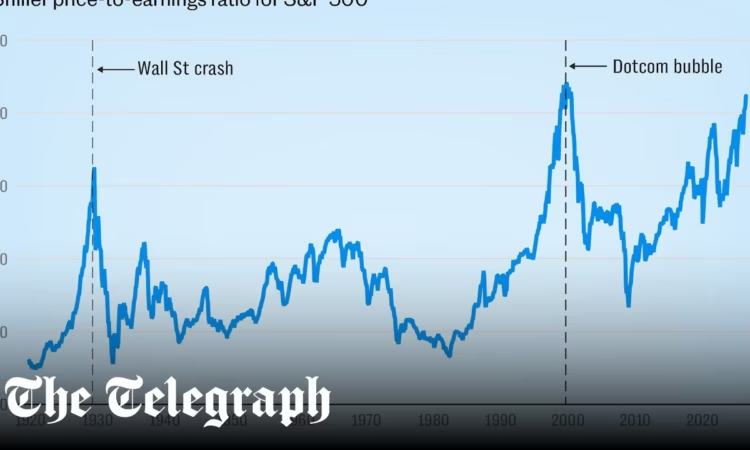
It takes a fund manager’s head to remain calm in the face of indicators like the Shiller PE ratio.
But it is not the only thing echoing the dotcom exuberance of 26 years ago.
Like in 2000, there is hype surrounding a new and as-yet not fully understood technology: Back then, it was the internet and now it is AI.
Also mirroring the dotcom era, there is significant excitement around the stock market listings of tech companies.
Pets.com, a website launched in November 1998, infamously raised nearly $83m (£61m) in a float in February 2000 after an advert was shown during that year’s Super Bowl.
Its valuation eventually reached nearly $300m, but it was shut down in November 2000 after failing to become profitable.
Investors might show caution after observing the hype around Elon Musk’s SpaceX.
The rocket company’s valuation surged past $2tn days after its listing on the Nasdaq in June.
It then plunged 53pc in a little over a month to fall below its offer price.
Its float happened a month after the Shiller PE ratio crossed the 40 mark for the first time since the dotcom crash.
Lauma Kalns-Timans, an analyst at Berenberg, was unequivocal. “US equities remain in bubble territory,” she said.
Even bond markets – now established as the harbingers of doom for high-spending governments – are also flashing warning signs for stock market investors.
Mike Riddell, a bond portfolio manager at Fidelity, says: “If you look at any kind of yield measure for equities, it’s now well below the yields you get on bonds.”
Mr Riddell says he has become “nervous” about the credit market, where investors trade the debt of corporations.
Tech giants such as Meta, Google, Amazon and Microsoft have driven a substantial surge in US corporate debt levels in recent years to fund their AI infrastructure plans.
But Riddell is not reaching for the panic button. “What you’re going to need to have a really big correction in risky assets is actually a shock or evidence of a downturn in the global economy,” he says.
“We’re not seeing evidence of a pronounced global growth slowdown, so I’m not saying that’s a view I have imminently. But I think just in terms of valuations, we are concerned.”
That concern appears to be well placed. US stocks have spent less than one year out of the last 145 years trading at valuations above current levels.
“When valuations are unattractive over the long term, you’ve tended to have inferior outcomes, say compared to when the valuations and the fundamentals line up,” says Robert Tipp, chief investment strategist at PGIM Credit.
However, there is an argument that things could be different now compared to when the Shiller PE ratio was last closing in on a record high.
“It’s not a timing tool,” adds Tipp. “You always have to look at the specifics of the situation. And the specifics of the situation are that investors for a handful of years running have underestimated the potential of major corporations to throw up sustained, very positive earnings growth. And if anything, we’re seeing that accelerate.”


