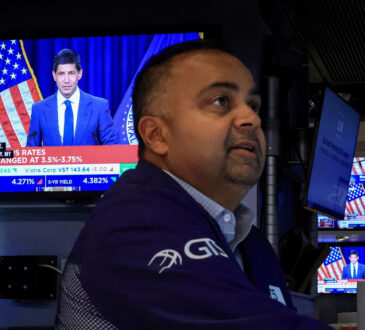
The main equity indexes reacted well at first to Federal Reserve Chair Kevin Warsh’s Jackson Hole Economic Symposium keynote speech on Friday. Treasury yields and odds of a rate hike in September rose, too. Stock market momentum waned as another low-volume late-summer trading session wore on, and all three indexes turned lower heading into the weekend.
At the closing bell, the Nasdaq Composite was down 0.5% at 26,402, but the tech-heavy index was up 0.8% for the week. The broad-based S&P 500 shed 0.3% on Friday but added 0.5% for the week to 7,711. The Dow Jones Industrial Average was off 0.02% on Friday, but Papa Dow rose 0.5% over the five days to 53,560.
Are markets pricing in a higher target range for the federal funds rate following the next Fed meeting, less than a month from now? Are investors, traders and speculators digesting Thursday’s mini-boom for technology and getting ready for a return to normal trading activity after Labor Day?
Sign up for Kiplinger’s Free Newsletters
Profit and prosper with the best of expert advice on investing, taxes, retirement, personal finance and more – straight to your e-mail.
Profit and prosper with the best of expert advice – straight to your e-mail.
Who’s to say with any real authority why any one buyer or seller made that decision, let alone all of them in aggregate.
At the same time: “We must be confident that underlying inflation is moving to our objective, clearly and at sufficient speed,” Warsh said shortly after Friday’s opening bell. “Otherwise, we have work to do.”
And, today, that means higher interest rates.
Looking for more timely stock market news to help gauge the health of your portfolio? Sign up for Closing Bell, our free newsletter that’s delivered straight to your inbox at the close of each trading day.
The 2-year Treasury yield was up 13 basis points to 4.352% from 4.232% on Thursday. The 10-year Treasury yield (+5.2 bps, 4.724%) and the 30-year Treasury yield (+1.8 bps, 5.209%) were higher, too.
CME FedWatch now shows a 57.5% probability of a 25-basis-point rate hike at the conclusion of the September 15-16 Federal Open Market Committee meeting, up from 35.4% on Thursday.
“Warsh’s speech at Jackson Hole went further than we had anticipated in signaling that he is willing to hike rates if underlying inflation is not moving toward 2% ‘clearly and at sufficient speed,'” Barclays Chief U.S. Economist Marc Giannoni writes. “We are changing our Fed call, now expecting a 25-basis-point hike in September and another one in December.”
MRVL sinks 10%
Marvell Technology (MRVL, -10.3%) was the closing act for Nvidia (NVDA, -4.6%) on this week’s earnings calendar, and it didn’t go particularly well for the semiconductor stock from a pure price-action perspective.
Marvell beat Wall Street expectations for its fiscal second quarter revenue (+36.5% year over year) and earnings per share (+40.3% YoY). But the beat just wasn’t big enough in the wake of MRVL’s more than 100% share-price surge since Nvidia’s $2 billion investment in the company in late March.
Still, Morgan Stanley analyst Joe Moore, citing a good quarter and outlook “largely in line with prior management expectations,” reiterated his Equal Weight (Hold) rating, yet raised his 12-month target price for the AI stock from $224 to $246.
The analyst notes that Marvell now sees 2027 data center growth of 60%, up from 50%, which should drive 10% upside for earnings.
“While we wish that positive long term commentary left more room for short term beats and raises,” Moore writes, “we generally agree with the long term optimism.” He cites Marvell’s work to diversify its growth drivers, beyond custom chips.
Moore concludes that “with AI strong across the board it’s a target-rich environment,” but he’d “be tactically long for the investor day if the stock sells off.”
NVDA, meanwhile, was the worst Dow Jones stock on Friday, a day after posting its biggest intraday gain in more than a year.
You can catch up with this week’s developments around the AI revolutionary on our Nvidia earnings blog.
There will be no $50B deal for PYPL
It was a bad day for Marvell, but PayPal Holdings (PYPL, -12.7%) was the worst S&P 500 stock on Friday after Bloomberg reported that private equity firm Advent International and privately held fintech Stripe have abandoned their joint attempt to buy the payments processing pioneer co-founded by Elon Musk.
The Wall Street Journal, citing people familiar with negotiations, said on August 14 that PayPal saw a $60.50 per share offer as “insufficient, but that the parties were talking about a higher price.”
Takeover talk has been churning since February, and PayPal’s expectations-beating second-quarter earnings helped the financial stock extend a 60%-plus rally off a mid-February 52-week low.
As Keefe, Bruyette & Woods analyst Sanjay Sakhrani notes, the buyout bid “had been a source of support for PYPL.” According to Mizuho Securities analyst Dan Dolev, it’s all about PayPal’s fundamentals now.
Of course, as Bloomberg concludes, Advent and Stripe could come back with another bid “if the situation changes.”