Is a Stock Market Crash Imminent Under President Donald Trump? More Than 85 Years of Historical Precedent Offers an Answer.
What’s faster than a speeding bullet, more powerful than a locomotive, and able to leap tall buildings in a single bound? No, it’s not Superman. It’s the stock market anytime President Donald Trump is in the White House.
During Trump’s first, non-consecutive term, the timeless Dow Jones Industrial Average (^DJI -0.02%), benchmark S&P 500 (^GSPC -0.25%), and technology-propelled Nasdaq Composite (^IXIC -0.52%) rallied 57%, 70%, and 142%, respectively. Since the president’s second-term inauguration, these indexes have gained an additional 23%, 28%, and 32%, respectively (as of the closing bell on Aug. 24).
While the stock market typically advances under most presidents, the annualized returns of the Dow, S&P 500, and Nasdaq Composite are higher under Trump than under most presidents since the late 1890s.

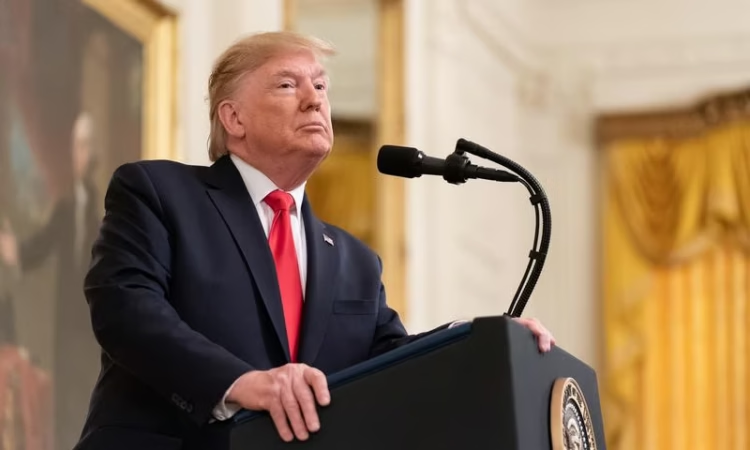
The stock market has soared under President Trump. Image source: Official White House Photo by Shealah Craighead, courtesy of the National Archives.
But these gains under President Trump have also occurred amid historic bouts of volatility. During the unforeseen COVID-19 crash, the broad-based S&P 500 shed 34% of its value in 33 calendar days. Likewise, the “tariff tantrum” in early April 2025 witnessed the S&P 500 lose more than 10% of its value over just two trading sessions.
It begs the question: Is a stock market crash imminent under President Donald Trump?
While short-term directional moves in Wall Street’s major stock indexes can’t be guaranteed, 85 years of historical precedent offers an answer — and investors might not be thrilled with it.
Trump’s second term has been packed with geopolitical/major events
Since Donald Trump’s inauguration on Jan. 20, 2025, he’s been somewhat of a magnet for major geopolitical and historical events.
There was the aforementioned tariff tantrum, involving the April 2025 unveiling of sweeping global tariffs and higher reciprocal tariffs on dozens of countries deemed to have unfavorable trade imbalances with America. The U.S. also bombed nuclear facilities in Iran in June 2025, removed Venezuela’s President, Nicolas Maduro, in early January 2026, and began military operations against Iran at the end of February 2026.
Here’s a list of major geopolitical events since WWII.
Up a median of 5% six months later. All of them felt really bad at the time. pic.twitter.com/Jb3QXL0L05
— Ryan Detrick, CMT (@RyanDetrick) February 28, 2026
Shortly after the Trump-led Iran war began, Carson Group’s Chief Market Strategist, Ryan Detrick, published a data set to X (formerly Twitter) examining the performance of the benchmark S&P 500 at various intervals following more than three dozen stock market shock events since the start of 1940.
Using data from S&P Dow Jones Indices, CFRA, and Carson Group’s own research, Detrick and his team determined that, on average, the S&P 500 gained 3% one year after a market shock event officially began. Furthermore, the S&P 500 was higher following 65% of qualifying shock events.
Although a 3% gain is well below the long-term annualized return of the broad-based S&P 500, it’s nevertheless a positive outcome amid heightened periods of uncertainty.
Based solely on the headline figure from Detrick’s data set, a stock market crash doesn’t appear likely under President Trump. However, there’s a bit more nuance to Carson Group’s data set than meets the eye.

Image source: Getty Images.
One scenario makes stock market crashes likelier, and Trump is overseeing it right now
Though nearly two-thirds of geopolitical and major market shock events spanning more than 85 years were followed by S&P 500 gains after 12 months, several of the losing events shared a common theme: energy supply disruption.
In October 1956, Britain, France, and Israel invaded Egypt to regain control of the Suez Canal, which Egypt had nationalized in July 1956. The closure of the Suez Canal disrupted oil shipments from the Middle East to Western Europe. The S&P 500 was lower by nearly 12% one year later.
The Oil Embargo of 1973 was an even bigger shock to Wall Street. Arab members of OPEC stopped selling oil to the U.S. and other allies of Israel, leading to a petroleum shortage and substantially higher fuel costs. The benchmark S&P 500 lost 35% of its value over the next year.
The ongoing Iran war features the largest energy supply disruption in modern history. Shortly after Trump approved military attacks against Iran, the latter closed the Strait of Hormuz to virtually all maritime traffic. This effectively halted the daily movement of a fifth of the world’s petroleum liquids (about 20 million barrels/day).
Energy supply shocks are the one geopolitical/major historical event that history shows Wall Street struggles to put in the back seat. While this doesn’t mean a stock market crash is in any way imminent or guaranteed under President Trump, the likelihood of an elevator-down move amid the largest energy disruption in modern history is certainly heightened.
64.
As in 64 consecutive months with US core inflation above the Fed’s 2% target.
The Fed has lost all credibility when it comes to fighting inflation.
Kevin Warsh talks a big game, but talk is cheap. The Fed should have hiked rates yesterday and ended QE. pic.twitter.com/HvimqfW6WW
— Charlie Bilello (@charliebilello) July 30, 2026
Making matters worse, evidence is mounting that Iran-war-driven Trumpflation has spilled beyond the energy sector. The price stickiness of Core Personal Consumption Expenditures, which excludes volatile food and energy costs and provides economists with a clearer view of long-term price trends, has been stuck at roughly 3.3%-3.4% for months. This suggests that businesses are incurring higher production and transportation costs as a result of the Strait of Hormuz’s closure, which are being passed on to consumers.
If Trump-driven inflation (i.e., Trumpflation) entrenches itself in the broader economy, persistently elevated inflation would make outsize stock market returns unlikely.
While there’s no imminent threat of a stock market crash under Donald Trump, the historical puzzle pieces do suggest a heightened likelihood of an elevator-down move and/or a substantial pullback in the Dow Jones Industrial Average, S&P 500, and Nasdaq Composite.