What Happens When You Invest in the Stock Market at the Worst Possible Time? History Has Reassuring News for Investors.
Over the last few years, the market has been unshakeable. Despite a few bouts of short-term volatility, the S&P 500 (^GSPC -0.25%), Nasdaq Composite (^IXIC -0.52%), and Dow Jones Industrial Average (^DJI -0.02%) have all notched new all-time highs in recent months.
There’s a sneaky downside to a record-breaking stock market, though. When the next bear market hits — and it is coming eventually — investors risk buying at peak prices immediately before the market tanks.
It can be daunting to invest near record highs for this reason, and some investors may be tempted to avoid the market altogether and wait for a pullback. But just how bad would it be if you invested at the “worst” possible moment? History suggests it’s not as bad as you might think — with a caveat.
Image source: Getty Images.
The worst recessions all have one trait in common
Even the most brutal recessions, crashes, and bear markets are only temporary. While they’re often crushing in the short term, with real financial and economic consequences, long-term investors have historically reaped the rewards.
Say, for example, you’d invested in an S&P 500 ETF in October 2007 — the month the Great Recession officially began. This bear market was the most severe economic downturn post-WWII, and it would take years for the market to fully recover.
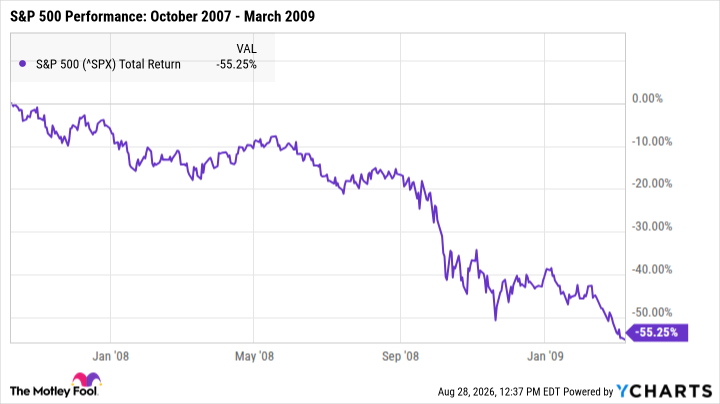
The most important thing to remember when investing, however, is that losing value is not the same as losing money. Your S&P 500 ETF would have lost 55% of its value throughout the Great Recession, but by staying invested until stocks recovered, you wouldn’t have locked in any losses.
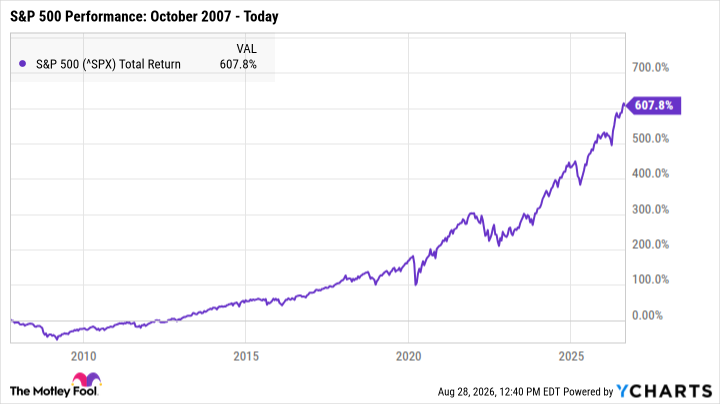
Between October 2007 and today, the S&P 500 has earned total returns of more than 600%. In other words, if you’d invested $10,000 in an S&P 500 ETF back then and made zero additional contributions, you’d have more than $70,000 by today.
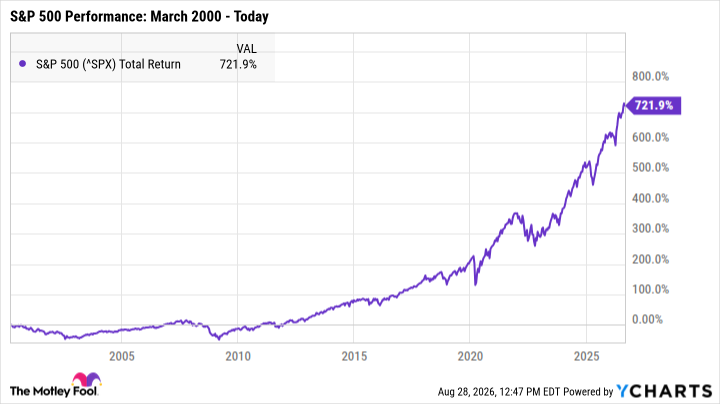
This is a trend that’s repeated throughout history, too. The dot-com bubble officially popped in March 2000, and that bear market was arguably worse for many investors. Not only was it one of the longest bear markets in S&P 500 history, but shortly after the market began reaching new highs, the Great Recession hit.
However, if you’d invested in an S&P 500 ETF in March 2000 — immediately ahead of two back-to-back recessions — you’d have earned total returns of around 722% by today.
History’s greatest lesson for investors
If there’s just one takeaway for investors, it’s that with a long-term outlook, it doesn’t necessarily matter when you invest.
Could an investor have theoretically earned more if they’d waited until the market bottomed out during a bear market to buy? Most definitely. But hindsight is 20/20, and in the moment, it’s impossible to know where the market is headed.
Rather than waiting for the perfect opportunity to buy, it’s often more lucrative to invest consistently and stay in the market for the long haul. Even if you invest at the “wrong” time, history proves that the market will more than make up for it over time.