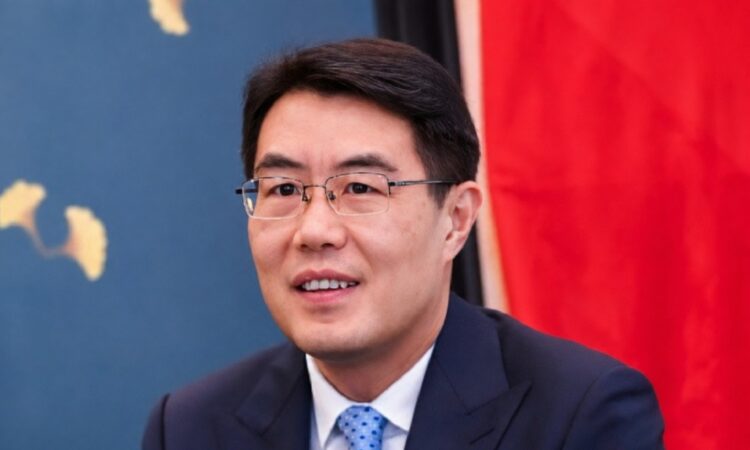

The interest of Chinese companies in expanding their presence in Colombia now faces a condition that goes beyond business opportunities. Zhu Jingyang, China’s ambassador to Bogota, said that new investments by companies from his country will depend to a large extent on the political and diplomatic decisions made by the government of President Abelardo De la Espriella.
During the 38th National Exporters Congress, held in Colombia, the diplomat confirmed that the Embassy has received numerous Chinese companies interested in exploring business opportunities, establishing operations, and expanding their activities in the country. Among the projects being considered are assembly plants for household appliances and other products.
China says new investments in Colombia depend on De la Espriella
Zhu Jingyang explained that the companies interested in investing are not only assessing the economic and commercial conditions of the Colombian market. They are also watching the direction of the new government’s foreign policy and, particularly, how Bogotá manages its relations with China and the United States.
The ambassador thus described a scenario in which decisions by the De la Espriella administration could directly influence the progress of new Chinese-funded projects. The warning comes at a time when Colombia is seeking to attract foreign investment and diversify its markets while maintaining a strategic relationship with Washington and deepening its economic ties with Beijing.
“We have received a very significant number of Chinese companies that are coming to Colombia in search of business opportunities, either for investments or to establish new plants. I am referring, for example, to the assembly of household appliances or other products,” Zhu said during the business meeting.
The diplomat’s message does not, however, signal a withdrawal of Chinese interest in Colombia. On the contrary, he confirmed that companies are studying the possibility of establishing production capacity on Colombian territory, a prospect that could generate jobs, technology transfers, and new opportunities for domestic suppliers.
Las oportunidades de Colombia para exportar a China
La dinámica comercial global exige una lectura estratégica de los mercados internacionales.
Mientras potencias como China y Estados Unidos compiten por el liderazgo económico y tecnológico, Colombia enfrenta el reto de… pic.twitter.com/Av6J0mebIi
— Analdex Colombia (@AnaldexColombia) August 29, 2026
Infrastructure and trade at the center of the relationship
China holds a significant position in Colombia’s foreign trade, and the Beijing government is also interested in participating in infrastructure projects. Zhu stressed the importance of continuing initiatives that are already underway and welcomed the signals of continuity expressed by De la Espriella after his visit to Bogota Metro Line 1, a megaproject being developed by a Chinese consortium.
The president has defended the need to maintain infrastructure projects he considers strategic for the country, regardless of ideological differences. That position was welcomed by the Chinese ambassador, who expressed his government’s willingness to continue working with Colombia.
What is certain is that these statements helped ease the situation following the change in government, as Beijing feared an economic shift in Bogota after Gustavo Petro left the presidency. It is worth recalling that it was Petro who opened the South American country to Chinese investment, holding two meetings with the Chinese leader and negotiating to make Colombia a member of the Belt and Road Initiative.
With this geopolitical issue now temporarily set aside, infrastructure appears to be one of the main areas for expanding bilateral cooperation. However, Zhu also referred to the Belt and Road Initiative, which he presented as a platform for strengthening interconnectivity and promoting projects aimed at improving the infrastructure of participating countries.
Suscribo este espíritu del Sr. Presidente: “el progreso de Colombia no puede detenerse por caprichos ideológicos… Colombia necesita construir sobre lo construido y avanzar sin mezquindades.”
Hagamos que “gato cace ratones”, independientemente de su color! https://t.co/DUBmuJEVZI
— Zhu Jingyang (@zhu_jingyang) September 3, 2026
Balancing China and the United States
The geopolitical factor, however, could ultimately prove decisive for the investments currently under consideration. Zhu insisted that Colombia must maintain a balance in its relations with China and the United States to prevent a decision involving one of the two powers from ultimately affecting opportunities for cooperation with the other.
The warning is particularly relevant for Chinese companies considering long-term investments. An assembly plant or industrial expansion requires capital commitments that extend beyond the short term, making regulatory stability and predictability in economic and foreign policy key factors for companies.
The ambassador also advocated for greater diversification of Colombian exports and the search for new markets to reduce dependence on traditional destinations. “It is not enough for Colombia to maintain its traditional market; we must support efforts to diversify markets and increase exports to new markets as important as China,” he said.
In this context, China represents an opportunity to increase Colombian sales and expand the country’s presence in one of the world’s largest markets. Against this backdrop, the goal of the Colombian National Foreign Trade Association (Analdex) of reaching US$100 billion in exports by 2030 was mentioned as one of the objectives that could drive this diversification.
The economic relationship between Bogota and Beijing is thus entering a new stage, while seeking to preserve a relationship that the two countries have maintained for more than two decades. Chinese business interest remains, but its evolution will be closely tied to the decisions of the De la Espriella government.
“It all depends on Colombia’s policy toward China, on how we can maintain this pragmatic spirit of continuing to work together, and on how Colombia manages to balance its relationship with the United States and China,” the Chinese ambassador to Colombia said emphatically.