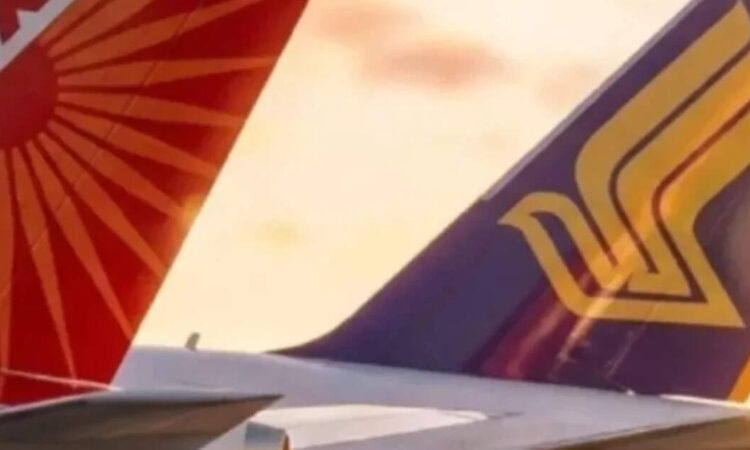
Responding to a question in Parliament, Transport Minister Jeffrey Siow said Singapore Airlines is a listed company that finances its investments from its own balance sheet and has not sought additional capital from its shareholders.
Also Read: Singapore government won’t interfere in decisions on Air India
Singapore Airlines is majority-owned by state investor Temasek.
The defence comes as the airline’s 25.1% stake in Air India faces growing scrutiny after the Indian carrier’s losses widened during a multibillion-dollar turnaround that could take up to a decade. Air India has sought about $1.5 billion in fresh equity from its owners, Tata Sons and Singapore Airlines, Reuters reported last month.

“Many overseas investment returns will not necessarily emerge immediately. Whether its specific investment in Air India proves valuable is for (Singapore Airlines) and its shareholders to answer,” Siow said, adding that the current assessment was that the investment had not adversely affected the airline’s ability to serve Singaporeans.
“Singapore Airlines has not sought further capital from its shareholders, and if it were to do so, that would be a commercial matter between the company and its shareholders,” he said.Singapore Airlines said on Tuesday that its investments in India have been and will continue to be funded through its internal resources, subject to board approval and a disciplined capital allocation framework.
The carrier said Air India’s transformation was a complex, multi-year programme that was not expected to be linear. It described its investment in the Indian airline as a long-term strategic commitment aligned with its multi-hub strategy.
Also Read: Temasek backs Singapore Airlines to fly long haul with Air India
Singapore Airlines acquired its 25.1% stake in Air India following the 2024 merger of Air India and Vistara.
The investment has come under political scrutiny in Singapore after reports that Air India was seeking additional funding. Workers’ Party lawmaker Kenneth Tiong last month urged that Temasek funds not be used to support the Indian carrier and submitted questions for Parliament.
Tiong had questioned whether Air India’s losses had been assessed against Singapore Airlines’ ability to provide essential transport services and whether the carrier’s potential funding requirements had implications for its obligations as a designated airline.
Singapore Senior Minister K Shanmugam said on Saturday that Temasek, as a shareholder in Singapore Airlines, expects the company to make responsible investment decisions, but that such decisions were ultimately for the airline to make.
Shanmugam also asked police to examine racist comments that surfaced online during the debate over Singapore Airlines’ investment in Air India.
“That news has given rise to a whole series of anti-Indian, racist ranting online,” Shanmugam said over the weekend, adding that Temasek’s chief executive and senior management had been attacked over their ethnicity.
The controversy comes as Air India undertakes a broad turnaround following its return to the Tata Group. The airline has faced significant losses and operational challenges, while its owners seek to overhaul its fleet, systems and network. Its transformation is expected to be a multi-year process.
For Singapore Airlines, the Air India investment is part of a broader strategy to build an international network beyond the relatively small Singapore market. Siow said the airline’s overseas investments were necessary because the number of passengers travelling to and from Singapore was inherently limited.
The minister said whether the Air India investment ultimately delivers the expected returns would be a matter for Singapore Airlines and its shareholders to assess, rather than the government.