Discussion of City’s Investment Policy Devolves Into Accusations of Antisemitism
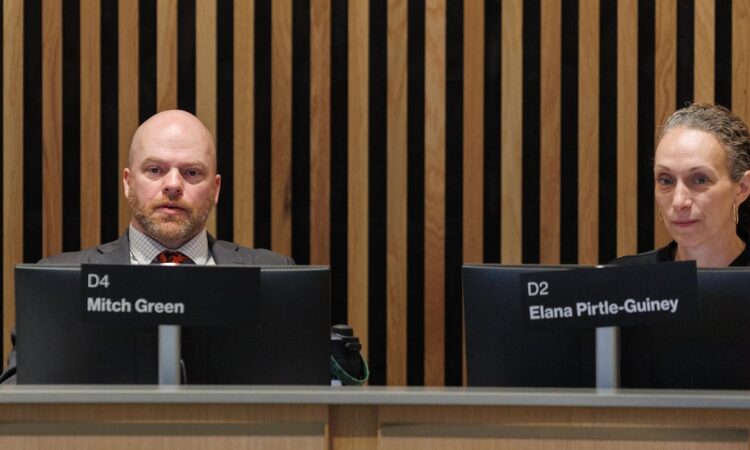
The Portland City Council’s discussion last week about revising the city’s investment policy turned acrimonious.
A handful of moderate councilors accused several of their leftist colleagues of antisemitism, and the leftist councilors responded in equal force, saying the moderate councilors were engaging in their own form of antisemitism by conflating Jewish identity with support for Israel.
The discussion—which took place at the Finance and Governance Committee of the Whole—is just the latest example of the council’s propensity to stray from debating the merits of policy and instead enter into the choppy waters of race, religion and identity.
With an election just three months away that will see six of the council seats up for grabs, tensions between the council’s progressive caucus and its moderate caucus have at times turned remarkably bitter.
At issue on Sept. 3: The city is required by state law to annually review its investment policy. Previous councils over the years have tightened the city’s portfolio by barring investments in certain industries like oil and gas production and storage, or small arms and correctional facilities. But the current council has considered tightening it further.
City Treasurer Brigid O’Callaghan presented the council with options for how to further restrict the city’s possible investments, including those in industries like military aircrafts, defense, armored vehicles and tanks, munitions, missiles and naval ships. The presentation came as a result of a resolution by the City Council in December 2025 that pledged to review the policy and to seek “options to include methods for screening potential investments based on human rights including those listed in the Universal Declaration of Human Rights, with the intention of ensuring the City does not invest in companies that enable or facilitate war, armed conflict, or human rights abuses including but not limited to genocide, slavery, torture, indefinite or arbitrary detention, war crimes, and crimes against humanity.”
While the options presented by staff last week did not specify any countries or specific conflicts, a few moderate councilors that took issue with the discussion said it was a thinly veiled targeting of American businesses and industries that may be supplying products to Israel in the ongoing conflict in Gaza.
The effect, said moderate councilors, was antisemitism against Jewish Americans who are unfairly being targeted because of the war crimes committed by the Israeli government.
“There has been a fixation since before we took office on things that this council could do to send an anti-Jewish statement,” said Councilor Zimmerman. “I wish that we didn’t live in a time where politicians could be so outwardly antisemitic and get away with it, but we are. It’s wild to me.”
(Zimmerman was likely referring to a pledge that the four Democratic Socialists of America council members signed last fall to investigate Portland companies suspected of having ties with Israel’s military campaign against Gaza.)
Progressive caucus members Angelita Morillo and Mitch Green responded to Zimmerman, pointing out that the staff presentation was neutral and made no reference to Israel or the Gaza conflict at any point.
“To water down what antisemitism is makes it more difficult for our communities to identify it and to fight back against it later,” Morillo retorted. “I am profoundly disappointed that a colleague would level such a heavy, horrific and painful accusation when we are trying to do something to the benefit of a lot of people.”
Green said Zimmerman’s allegations were “wildly off base and frankly a breach of decorum” and that it was its own form of antisemitism to “conflate any criticism with the state of Israel of being anti-Jewish.”
Moderate Councilor Loretta Smith came to Zimmerman’s defense, saying: “While we may be appearing to be broad when discussing this investment policy, really we’re trying to go after Israel, it’s clear.”
And Councilor Elana Pirtle-Guiney, one of two Jewish members of the council, said that the council’s discussion has at times “become deeply antisemitic in places.”
“When our conversation begins to put pressure on a single community to adhere to a litmus test, when that community is Jewish, that is antisemitic,” Pirtle-Guiney said. And she asked her colleagues—it was obvious she was asking the socialists—to “do everything within your power to address the groups outside of this room who are putting the pressure for a litmus test on this conversation to stop doing so because it creates a safety issue.”
The discussion ended with little real resolution.
The options presented by staff for broadening the city’s list of banned investments have not yet made their way into a formal ordinance yet, and it’s unclear when, or if, they will.
Willamette Week’s reporting has real-life impact that changes laws, forces action by civic leaders, and drives compromised politicians from public office.
Help us dig deeper.